

Introduction: Inclusive Panel Interviews
While panel interviews offer companies the ability to hire a candidate based on the perspectives of several people, they can also be problematic. The presence of multiple interviewers can introduce group bias, as individuals can influence each other and agree on one choice instead of making independent decisions.
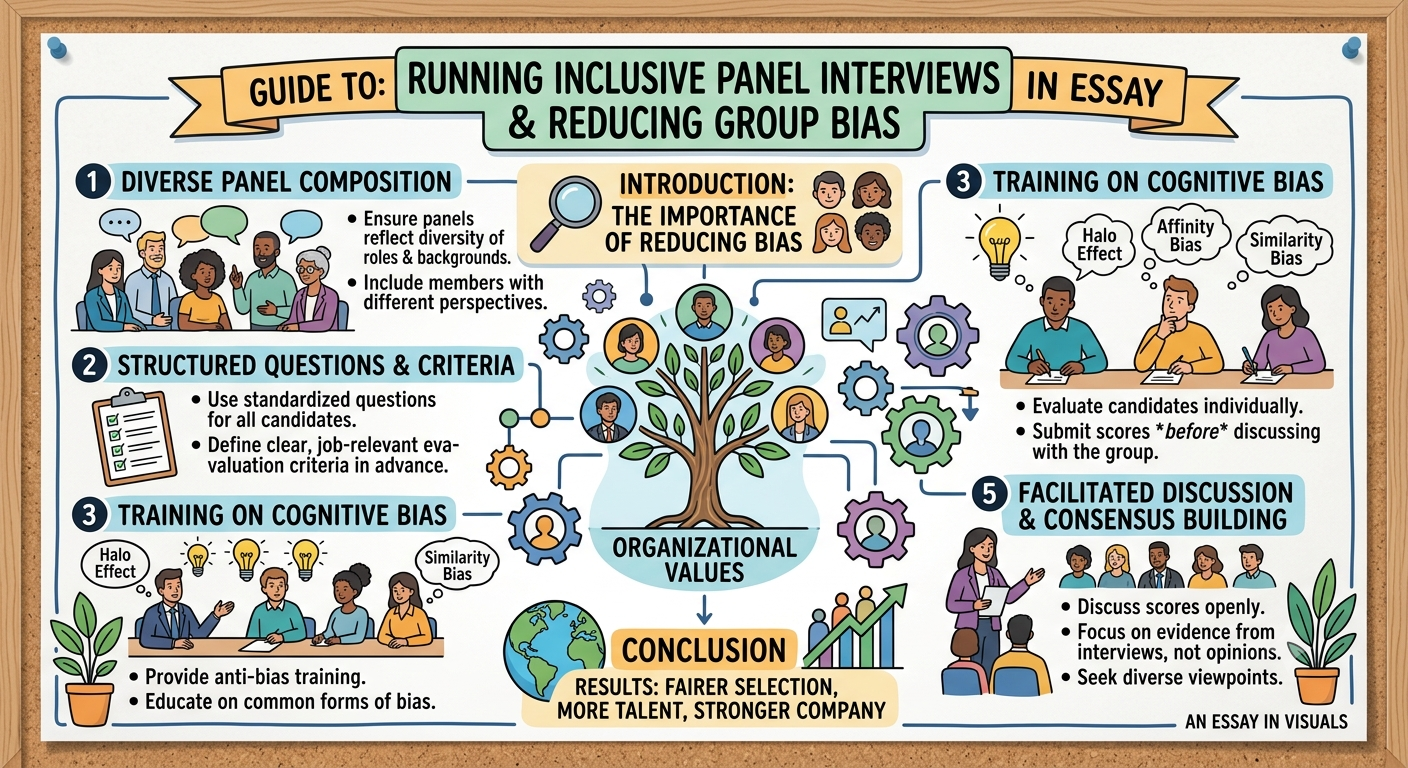
A structured process can ensure that interviews are inclusive. How to run inclusive panel interviews that reduce group bias provides tips on defining roles, using structured questions, and basing decisions on uniform standards.
How to Run Inclusive Panel Interviews that Reduce Group Bias Essay?
1. Understand How Group Bias Can Occur
Sometimes, one interviewer will voice a negative opinion about a candidate, and others will agree simply because they are inclined to listen to the leader. One party could be overly favorable toward a candidate due to attending the same school or working for the same company as them.
Personal preferences could influence the hiring process, causing interviewers to focus on a candidate’s communication skills or accent rather than whether the candidate meets the job requirements.
Realize that everyone has biases, but aim to create a system that limits their impact.
2. Create a Structured Interview
Structured interviews offer consistency by ensuring candidates have the same experience during the hiring process. Beforehand, the panel must discuss the qualifications and abilities for the job.
For example, a marketing position requires communication skills, problem-solving capabilities, knowledge of digital media, teamwork, creativity, and the ability to understand customers.
Ask candidates the same core questions that relate to these areas, and allow additional ones for elaboration.
Doing so allows interviewers to compare individuals fairly, as each is graded on the same criteria.
3. Give Interviewers Different Roles
Assign roles to the panel so that every interviewer has a purpose. For instance, one person can lead the discussion while another focuses on assessing the candidate’s technical skills.
Moreover, individuals should avoid interrupting others, and should allow a candidate to finish speaking before posing another question.
This reduces the likelihood of one interviewer dominating the conversation, or the candidate being intimidated into stopping mid-sentence.
The process should also be professional and offer opportunities for all parties to contribute.
4. Have Interviewers Score Candidates Individually
Before discussing a candidate, each interviewer should provide a score based on individual criteria.
For instance, everyone can rate the applicant on a scale from one to five for specific skills, and offer reasons for their answers.
Only after everyone has scored the candidate should the group come together to talk about them.
This tactic prevents the pressure of having to conform to others’ opinions immediately, and leaves room for everyone’s thoughts to be heard.
5. Focus on Evidence
Interviewers should avoid vague remarks such as “I liked her,” “He isn’t confident,” or “She is a good fit for our company” and instead focus on evidence that supports the statement. If an interviewer claims, “He is a strong problem-solver,” the rest of the panel should ask for details. Did he figure out how to address a customer’s complaint? Did he test two solutions and evaluate whether they were successful?
Evidence makes it easier to make objective decisions.
6. Make It Easy to Have Differing Opinions
An inclusive panel should welcome dissenting viewpoints.
Instead of letting the most senior or outspoken member go first, the moderator should ask for the perspective of everyone present in the room.
Do this by asking questions such as, “What evidence supports your score?” “Did anyone see this differently?” or “Are we considering the requirements for the job?”
Doing this encourages interviewers to have a constructive conversation, and to make choices based on the facts instead of what others think.
Conclusion: Inclusive Panel Interviews
Inclusive panel interviews require more than diverse interviewers; they demand a structured process that limits the risk that individuals will sway each other. Structured questions, defined roles, independent scoring, focusing on evidence, and ensuring that every interviewer has received proper training can increase the chances that firms will make rational hiring choices.
Remember that a panel is not about favoring one person’s opinion over another, but about ensuring that every decision is based on the skills, qualities, and experience of the candidate. By implementing these tactics, companies can offer candidates an inclusive experience while making it easier to determine who fits the requirements of the position.
Ready to make your hiring process more inclusive and reduce group bias? Use the Best Job Tool platform to discover practical hiring resources, improve your interview process, and build stronger, more equitable teams. Start exploring today and take the next step toward better hiring decisions.






Comments
Be the first to leave a comment.