

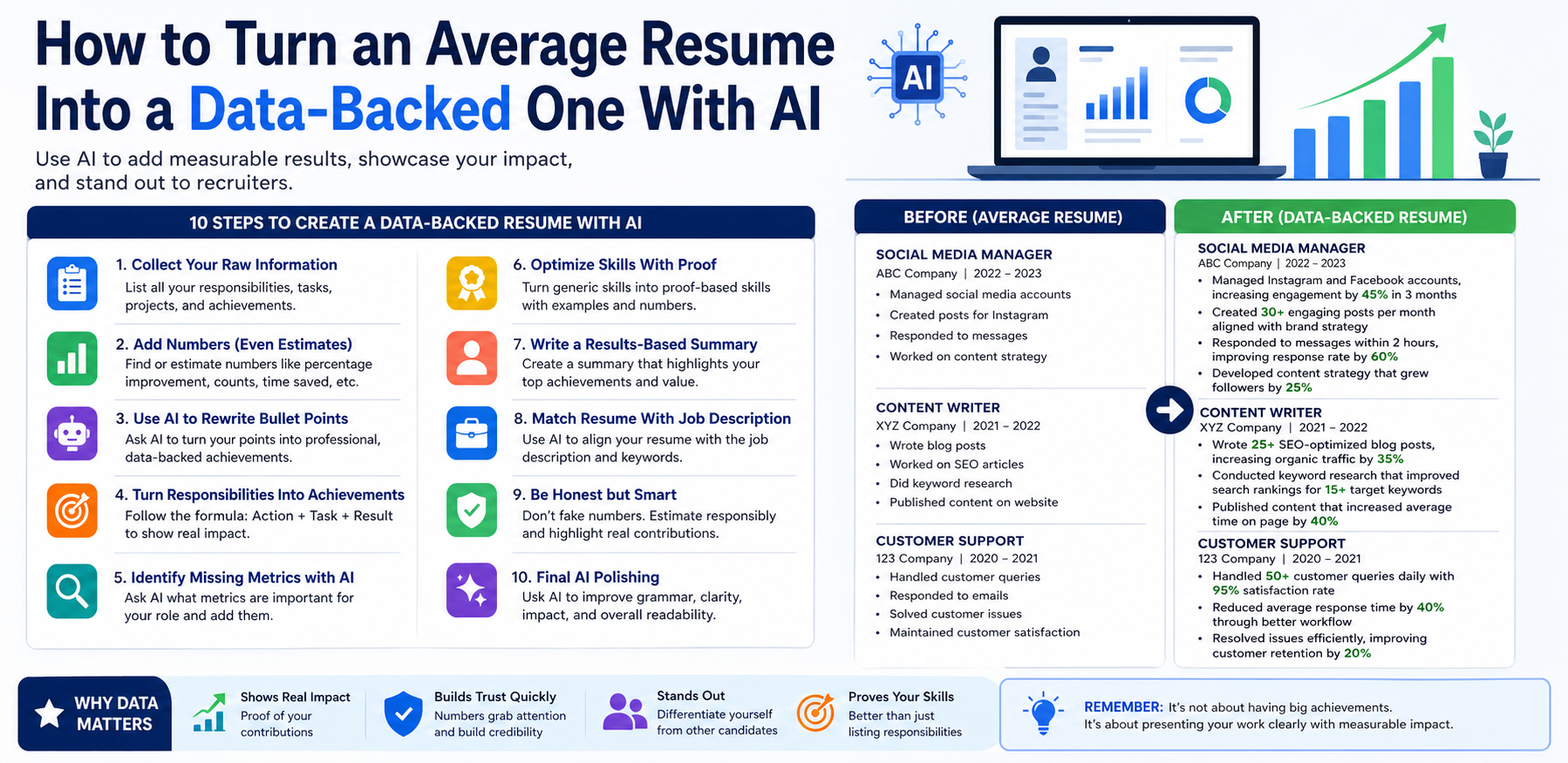
Introduction: Data-Backed Resume
Most resumes look the same.
A list of jobs. A few skills. Some responsibilities written in plain sentences like “handled customers”, “managed tasks”, or “worked on projects.”
The problem is simple:
These resumes don’t prove anything.
Today, companies don’t just want to know what you did. They want to know how well you did it. That’s where a data-backed resume becomes powerful—and AI can help you create one even if your current resume feels average.
In this article, you will learn step-by-step how to transform a normal resume into a strong, data-driven resume using AI tools in a simple and practical way.
What is a Data-Backed Resume?
A data-backed resume is a resume that includes numbers, measurable results, and proof of impact instead of only responsibilities.
Example:
WRONG: Average Resume Line:
- Managed social media accounts
CORRECT: Data-Backed Resume Line:
- Increased Instagram engagement by 45% in 3 months through content strategy and posting schedule optimization
See the difference?
The second one shows:
- What you did
- How you did it
- And what result you achieved
This is what recruiters love.
How to Turn an Average Resume Into a Data-Backed Resume With AI?
Step 1: Collect Raw Information About Your Work
Before using AI, write everything you did in simple form.
Don’t worry about grammar or structure.
Just list:
- Your responsibilities
- Tasks you handled
- Projects you worked on
- Any results (even small ones)
Example:
- Posted content on Instagram
- Replied to customer messages
- Created blog posts
- Helped increase engagement
- Worked on SEO articles
This is your raw material.
Step 2: Add Numbers for Data-Backed Resume
Most people think they don’t have data—but they actually do.
You just need to estimate or track results.
Examples of hidden data:
- Number of posts per week
- Increase in followers
- Time saved in a process
- Number of clients handled
- Improvement in engagement
- Sales increase percentage
Even approximate numbers are better than nothing.
Example transformation:
Before:
- Wrote blog posts for website
After:
- Wrote 15+ SEO blog posts in 2 months, increasing website traffic by approximately 30%
Step 3: Use AI to Rewrite Your Resume Bullet Points
Now you can use AI.
Give it your raw points and ask:
“Rewrite these resume points into professional, data-backed bullet points with measurable impact.”
Example input:
- Managed social media
- Created posts for Instagram
- Responded to messages
AI output:
- Managed Instagram account, improving engagement by 35% through consistent posting strategy
- Created 20+ engaging posts per month aligned with brand voice and audience interests
- Responded to customer queries within 2 hours, improving response rate and user satisfaction
AI helps you turn basic tasks into impactful achievements.
Step 4: Turn Responsibilities Into Achievements
Most resumes fail because they focus on what you did, not what you achieved.
Simple Formula:
Action + Task + Result
Example:
WRONG: Responsibility:
- Worked on customer support
RIGHT: Achievement:
- Handled 50+ customer queries daily and improved response time by 40% through better workflow organization
AI can help you reframe everything in this structure.
Step 5: Use AI to Identify Missing Metrics
Sometimes your resume is weak because it lacks data completely.
You can ask AI:
“What kind of metrics can I add for this job role?”
For example:
If you are a content writer, AI may suggest:
- Number of articles written
- SEO ranking improvements
- Traffic growth
- Engagement rate
- Publishing consistency
If you are a student:
- Projects completed
- Internship tasks
- Academic improvements
- Certifications earned
This helps you think in a data-driven way.
Step 6: Optimize Your Skills Section With Proof
Most skills sections look like this:
- Communication
- Writing
- Teamwork
- Problem solving
But this is too generic.
Improve it using AI:
Ask:
“Turn my skills into proof-based skills with examples.”
Example:
Skills: Writing
Data-backed skill: SEO content writing with experience in producing 30+ optimized articles and improving organic traffic
Skills: Communication
Data-backed skill: Strong client communication skills with experience handling 100+ customer interactions per week
Step 7: Add a Results-Based Summary Section
Your resume summary is the first thing recruiters read.
Instead of writing:
“Hardworking and motivated content writer seeking opportunities”
Write:
“Content writer with experience in creating 50+ SEO articles, improving blog engagement by 40%, and helping brands grow online visibility through data-driven content strategies.”
AI can easily convert your old summary into this format.
Step 8: Use AI to Match Job Descriptions
One powerful trick:
Paste a job description into AI and ask:
“Rewrite my resume to match this job description using my experience and add measurable results.”
AI will:
- Highlight relevant skills
- Remove unnecessary information
- Align your resume with recruiter expectations
This increases your chances of getting shortlisted.
Step 9: Keep It Honest but Smart
Important rule:
Never fake numbers.
But you can:
- Estimate responsibly
- Highlight small achievements
- Focus on improvements and contributions
- Show consistency and effort
Recruiters value honesty + clarity more than exaggerated claims.
Step 10: Final AI Polishing
Once your resume is ready, use AI for final improvement:
Ask:
“Improve clarity, grammar, and impact while keeping it professional and data-driven.”
AI will:
- Fix language issues
- Remove repetition
- Strengthen action words
- Make it more readable
Conclusion: Data-Backed Resume
Turning an average resume into a data-backed resume is not about having big achievements.
It is about:
- Presenting your work clearly
- Adding measurable impact
- Using AI smartly to refine your experience
- Thinking like a results-driven professional
AI does not replace your experience—it only helps you present it better.
If you learn this skill, even a simple resume can compete with experienced professionals.
Because in today’s job market, it’s not just about what you did—it’s about how well you can prove it.






Comments
Be the first to leave a comment.