

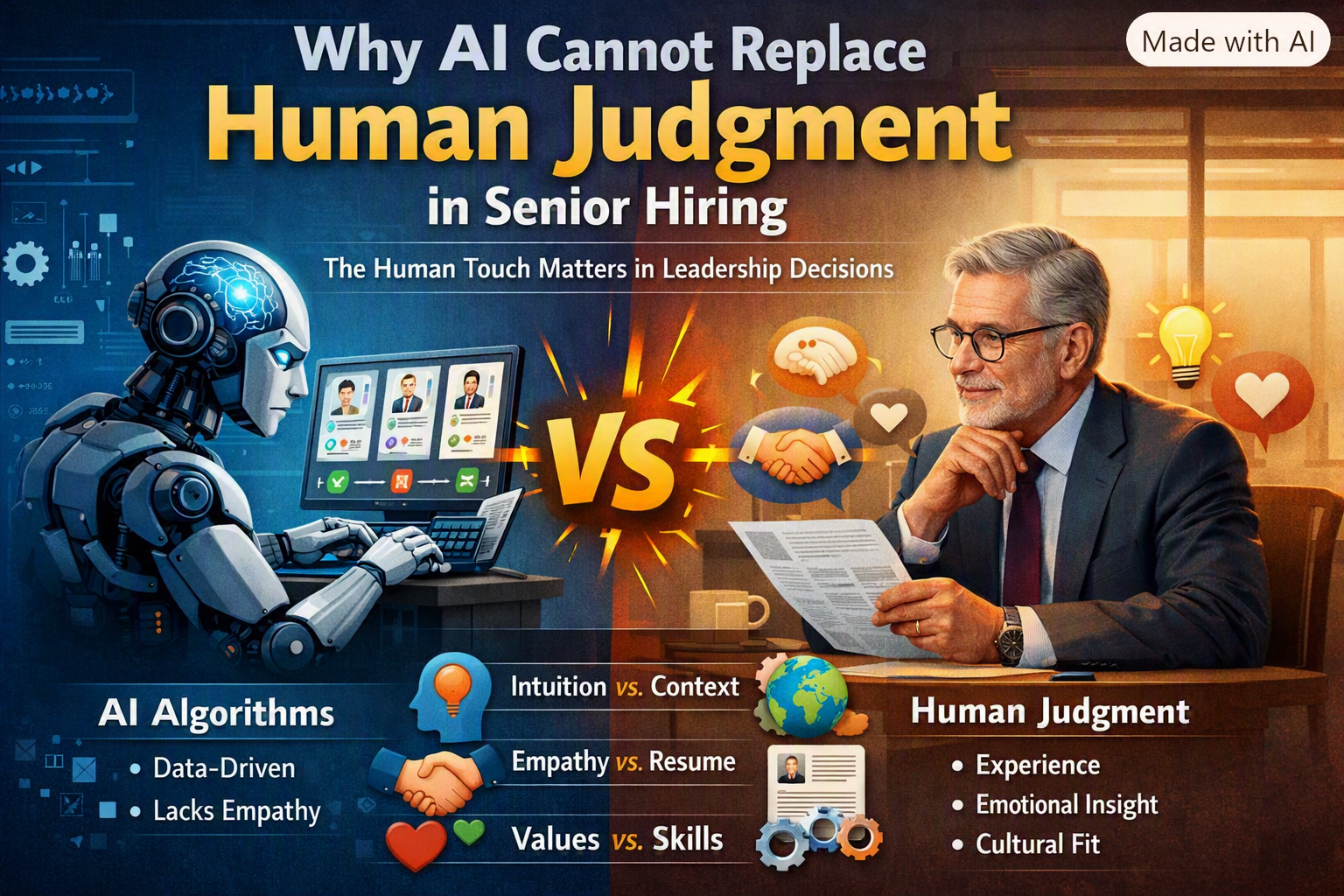
Introduction: Human Judgment
Artificial intelligence is changing the game for many companies. From resume-screening software to candidate-assessment technologies, it allows companies to hire more people while spending less time on the process. At the same time however, there are certain areas where technology cannot substitute for human judgment, senior hiring being one of them.
Senior hiring is not as simple as plugging in requirements and obtaining a list of candidates that meet them. It is essential to analyze and assess leadership skills, values, business acumen, cultural impact and other qualities that would enable the executive make a positive contribution to the company.
Why AI cannot replace human judgment in senior hiring is an intriguing question, which many companies may ask themselves, as they begin to rely on automated approaches to recruitment. However, one should not be quick to dismiss the role of human judgment, when it comes to filling senior positions, as it plays an essential role in the selection process.
Why AI Cannot Replace Human Judgment in Senior Hiring?
1. The Complexity of Senior-Level Hiring
While hiring for entry-level roles or highly specific positions may have objective measures in experience, skills, and qualifications, senior roles require more nuanced evaluations. While a CEO, CFO, CTO, director, or senior executive will have excellent résumés, predictive and demonstrable qualities may be harder to define and measure objectively.
Two candidates may have comparable or nearly identical achievements, education, and professional backgrounds, but one may be significantly more suitable for a specific company in a specific role. Furthermore, two candidates may have considerably different levels of suitability for the same vacancy. In many cases, it may be evident to an experienced human recruiter but not to an AI.
Both candidates will have strengths and weaknesses, and their suitability for a specific position depends on the context of the vacancy and the company that wants to fill it. Human recruiters can ask clarifying questions, observe responses, and gauge a candidate’s personality, motivations, and values. An AI recruiter may recognize patterns in provided information but may fail to obtain relevant information or consider it in proper context.
2. Leadership Requires More Than Information
One of the primary reasons humans must fill senior roles, such as C-level, director, and other executive positions, is that leadership requires subjective evaluation. An executive has to be able to lead, manage, organize, and make tough decisions in complex situations.
Candidates demonstrate qualities such as empathy, resilience, communication, adaptability, and integrity rather than simply stating them, which makes these qualities challenging to identify during hiring. A candidate may have extensive expertise in a particular domain but be lacking in generic people-skills. A human recruiter can identify most soft skills during an interview in combination with insights from a candidate’s professional background.
A candidate’s suitability for a position may become evident during a conversation when a candidate demonstrates certain qualities or the lack thereof. While an AI recruiter may identify patterns, it would be hard to replace the intuition and experience of a human recruiter.
3. Understanding The Candidate’s Motivation
While the AI can analyze the applicant’s experience, skills, and competencies, it cannot evaluate their motivation. It is especially vital to assess the motivation of the candidates in the lead positions since they will charge a significant amount of responsibility. Therefore, checking if the candidate has the right intentions is crucial since they will base their work on the company’s goals and mission.
An ethical leader will make decisions to benefit their team, stakeholders, and the organization in the long run. However, the AI tool might miss a chance to investigate the hidden motives of the shortlisted applicants. Human interviewers can ask clarifying questions to determine whether money, challenges, recognition, or inspiration motivates a candidate.
4. Determining The Candidate’s Ethics
The executive members make critical decisions that can affect the employees, stakeholders, clients, and the organization’s reputation. Hence, it is vital to hire the leader with the best competencies and highest self-guiding principles. While the AI can identify the candidates with rich experience, human interviewers can develop the conversation to clarify if the applicant has the sufficient level of intellectual honesty and social responsibility.
5. Assessing Adaptability and Emotional Intelligence
The challenges presented by the business environment are diverse, and include elements such as market forces, competitive environments, technological progress, and internal issues. It is the responsibility of leaders to navigate these complexities and keep the team motivated in the process.
These elements cannot fit into a binary choice, so they require a more personal assessment. In addition, they must also demonstrate a set of personal qualities that will allow them to resolve interpersonal conflicts and effectively communicate the necessary information to subordinates. These elements cannot fit into a binary choice, so they require a more personal assessment.
While algorithms may screen candidates on paper, a human recruiter will be able to determine whether the applicant demonstrates the necessary soft skills to avoid clashes within the team and perform under pressure. A personal interview may be tedious, but it can yield invaluable information about a candidate’s suitability for the position.
6. Accountability for the Final Decision
Perhaps the single most compelling reason why the human element must be retained in senior recruitment decisions is the issue of accountability. It is one matter to make a mistake and select a poorly suited candidate, but it is another to deny responsibility and take credit for the outcome. An algorithm may fail, but it cannot be accused of lying, misrepresenting information, or knowingly misjudging applicants.
In theory, automated recruitment software could supplement the work of human recruiters by generating objective information about the candidates’ personal qualities. The human element must be retained at the managerial level, where the executive will have to justify their judgment in front of stakeholders and take responsibility for their subordinates’ performance.
Conclusion: Human Judgment
Automated systems represent the future of data processing, and they are likely to penetrate deeper into the realm of human resources with every year. At the same time, the role of personal qualities in senior leadership cannot be underestimated, and neither can the responsibility of executive recruiters for their choices.
Recruitment algorithms are useful, but they are not beyond reproach. Human leaders must retain control over the process in order to ensure that all relevant information is taken into account. The human element must be prioritized in the final selection of executive candidates.
You can read more such blogs with the Best Job Tool.






Comments
Be the first to leave a comment.