

Introduction
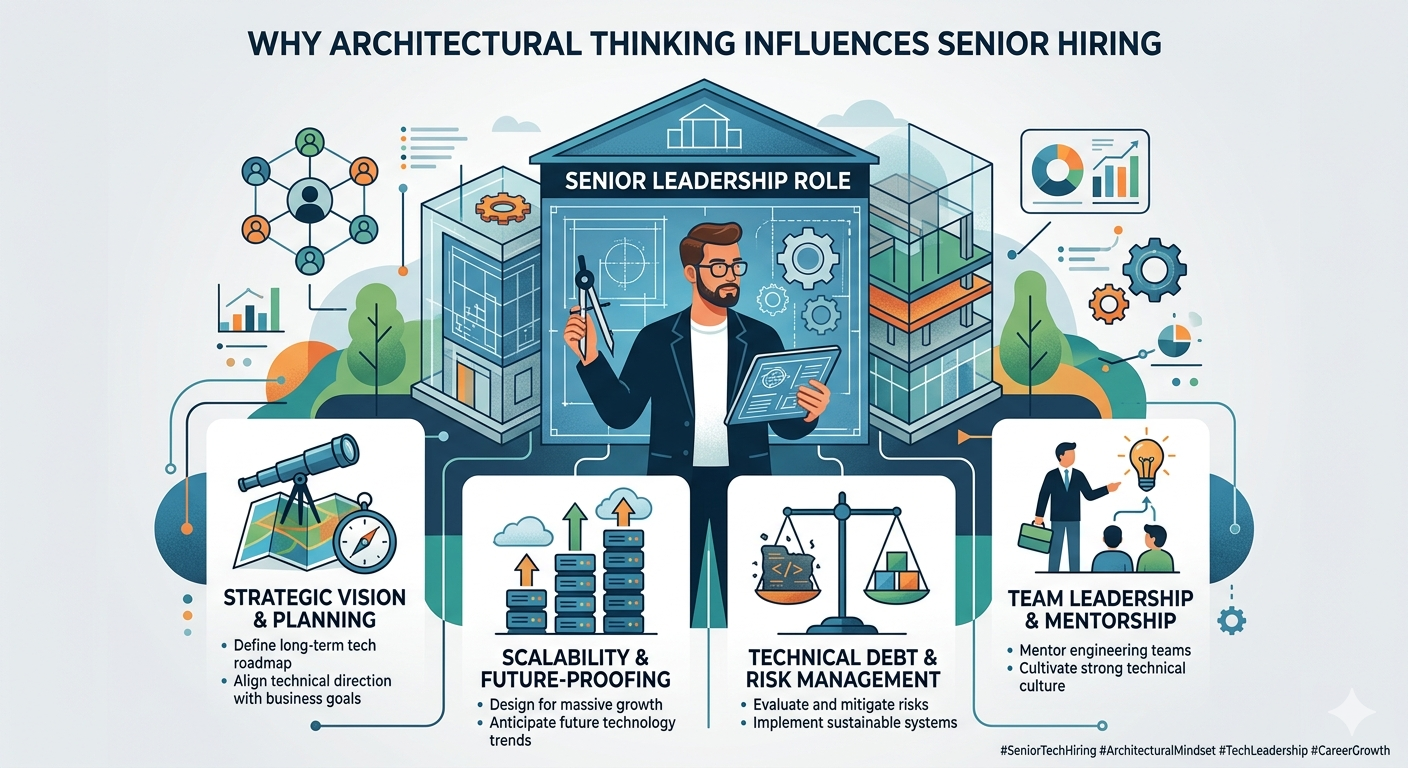
As professionals move from mid-level to senior roles, expectations shift significantly. Companies no longer look only for execution skills such as coding or task completion. Instead, they evaluate how candidates design systems, make long-term decisions, and align technical solutions with business goals. This shift explains exactly why architectural thinking influences senior hiring across engineering, IT, and technical leadership roles.
Architectural thinking involves understanding how systems are structured, how components interact, and how decisions affect scalability, performance, and maintainability. Senior professionals must think beyond immediate tasks and focus on long-term system health.
Senior roles require system-level perspective
Junior and mid-level engineers often focus on specific features or modules. However, senior roles require a broader perspective across the entire system.
Hiring managers evaluate whether candidates understand how different services, databases, and integrations work together. Candidates who think in terms of complete systems demonstrate readiness for higher responsibilities.
System-level thinking distinguishes senior professionals from individual contributors.
Scalability considerations drive hiring decisions
Modern applications must handle growing user bases, increasing data volumes, and evolving business requirements. Therefore, scalability becomes a key evaluation factor.
Interviewers assess whether candidates consider load distribution, performance optimization, and resource management while designing systems. Strong candidates explain how systems can scale without failure.
Scalable design reflects forward-thinking capability.
Trade-off analysis shows decision-making maturity
Architectural decisions often involve trade-offs between performance, cost, complexity, and maintainability. There is rarely a perfect solution.
Senior candidates must evaluate these trade-offs and justify their decisions clearly. Interviewers observe how candidates balance competing priorities and explain their reasoning.
Mature decision-making strengthens hiring confidence.
Long-term maintainability matters
Systems must remain maintainable as teams grow and requirements change. Poor architectural decisions can lead to technical debt and operational challenges.
Hiring managers look for candidates who design systems with clean structure, modular components, and clear dependencies. These practices ensure easier updates and long-term stability.
Maintainability is a core responsibility of senior professionals.
Cross-team impact increases with seniority
Senior engineers influence multiple teams and projects. Their decisions affect development, operations, security, and product teams.
Interviewers evaluate whether candidates consider cross-team impact when designing systems. Candidates who understand how architecture affects different stakeholders demonstrate leadership readiness.
Broader impact increases the importance of architectural thinking.
Risk awareness and failure handling
Architectural thinking includes planning for failures. Systems must handle errors, downtime, and unexpected conditions without major disruptions.
Senior candidates are expected to discuss fallback mechanisms, redundancy, and monitoring strategies. This proactive approach reduces operational risk.
Failure planning reflects advanced technical maturity.
Alignment with business goals
Technical decisions must support business objectives such as growth, cost efficiency, and user experience. Senior professionals must align architecture with these goals.
Interviewers evaluate whether candidates connect technical design with business impact. Candidates who explain how architecture supports product strategy demonstrate higher value.
Business alignment strengthens leadership capability.
Communication of complex ideas
Architectural discussions often involve explaining complex systems to both technical and non-technical stakeholders. Therefore, communication becomes critical.
Senior candidates must present their designs clearly, justify decisions, and respond to feedback effectively. Interviewers observe how well candidates explain their approach.
Clear communication improves collaboration and trust.
Influence on team and technical direction
Senior professionals often guide teams on best practices, design standards, and technical strategies. Their architectural decisions shape the direction of projects.
Hiring managers prefer candidates who can lead discussions, mentor team members, and influence technical direction positively.
Leadership potential emerges through architectural thinking.
Conclusion
Technical execution remains important, but senior roles demand broader thinking and strategic decision-making. That is precisely why architectural thinking influences senior hiring across modern engineering and IT environments.
Employers seek professionals who design scalable systems, evaluate trade-offs, manage risks, and align technology with business goals. By developing strong architectural thinking, candidates position themselves for leadership roles, greater responsibility, and long-term career growth in technical fields.
Find Your Dream Job Today – Explore Endless Career Opportunities and Secure Your Next Role with Best Job Tool.






Comments
Be the first to leave a comment.