

Introduction: High Salary
Starting a career is often the time when many people set the bar in regards to their salary. A good job that requires and provides good payment after a long study course can make anyone feel successful. Money plays a significant role in people’s lives and provides them with financial stability, independence, and motivation; however, chasing a high salary at the begging of one’s professional life can be a debilitating endeavor.
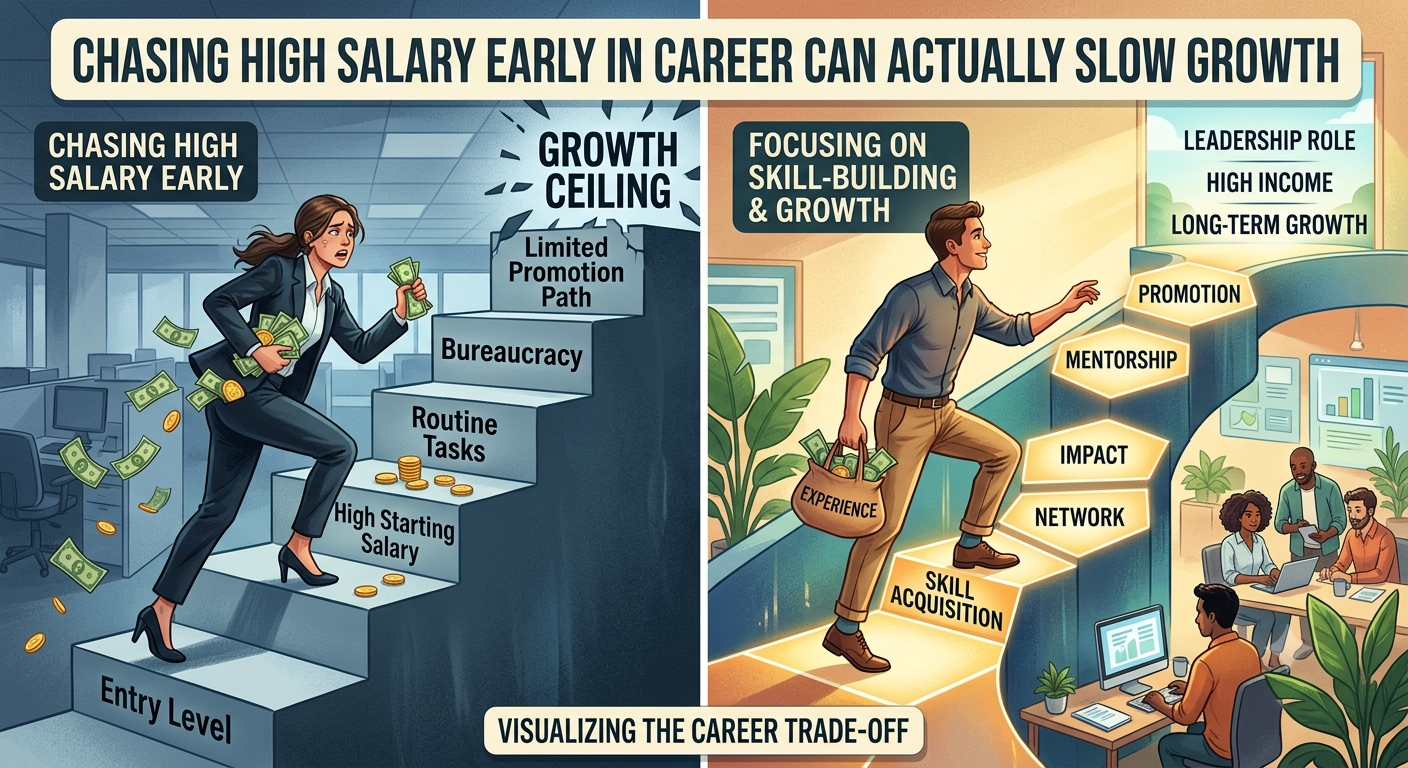
Why Chasing High Salary Early in Career Can Actually Slow Growth is an important consideration for young professionals who seek to establish a successful career in the future. It is important to note that a good salary should not be the sole determinant of one’s job selection. Experience, mentorship, responsibilities, learning opportunities, and the potential for career advancement are very important to ensure a good salary later.
Why Chasing a High Salary Early in Your Career Can Slow Growth?
1. Salary Does Not Always Reflect Learning Opportunities
Similar job positions at different companies offer people distinct opportunities that can either benefit or hinder their career in the future. Some companies can offer better learning opportunities even if they cannot provide the highest salary. For instance, a company that offers a high salary might provide the worker with repetitive tasks and responsibilities that do little to advance their career. On the other hand, some organizations are willing to provide lower wages with the opportunity to work on more complex projects and responsibilities.
At the beginning of one’s career, it is important to focus on the development of new skills and the understanding of the industry. Experience and exposure are essential to ensure one can move forward with confidence. If one focuses solely on salary, an amazing opportunity might be missed.
2. Skills Create Long-Term Earning Potential
The current salary indicates what a person can earn currently. A person’s skills, however, dictate what one can achieve potentially.
Professionals have the ability to continuously develop and hone their skills so that they can be more competitive. For instance, a good marketing professional can develop multiple skill sets and become a good marketing director and eventually a chief marketing officer. Similar opportunities can be realized by professionals in other fields. Instead of focusing only on how much money one can make, it is important to think about what one wants to learn. An opportunity that allows a person to continue learning can potentially make them more competitive and thus, more lucrative.
3. Early Career Is the Best Time to Experiment
Careers can be complicated at times as responsibilities can become very demanding as time goes. As such, it is essential to experiment with the available options early in life. The financial burden and responsibilities associated with families can also discourage people from changing careers. The best time to experiment with life is when everything is still new in one’s career. At this point, change is easier and more flexible. A young professional can consider different industries and specialties in their field to find the most suitable one. The focus should be on finding an opportunity that allows them to learn better.
An individual might find that an attractive salary can often come associated with a job they do not really enjoy. As such, the experimental period can help people to avoid getting stuck doing something that they really do not like merely because they enjoyed the money.
4. High Salary Can Create a False Sense of Progress
Having a good and well-paying job can often create a false sense of accomplishment and advancement. Someone might feel as if they are making better progress than others due to their increased income. The truth is that money can dictate one’s financial progress but not necessarily their professional one.
At the professional level, people are considered to be making better progress if they are taking on more responsibilities and acquiring new skills. If someone makes a good income but only by performing the same tasks and responsibilities throughout their career, then chances are that their professional growth is minimal. This can be detrimental to such a person’s future as they might struggle to change their career trajectory. When they apply to change jobs or industries, the interviewer will view their resume and realize that their current and past salaries do not reflect their potential or skills.
Real career growth is multifaceted and should be considered when making career decisions. In addition to the salary amount, professionals should consider the responsibilities they will have, their skill acquisition and application, decision-making abilities, professional relationships, and achievements to know if they will make a meaningful change to their career.
5. Mentorship Can Be More Valuable Than a Bigger Paycheck
A good mentor has a significant role to play in one’s career. Good mentors can assist people with career moves and advice. They can offer significant insight into how an industry works and how people can get ahead. Some companies are willing to offer slightly lower salaries but can provide better mentorship opportunities. A good mentor can help a young professional to achieve great heights in a short time. It is important for young professionals to realize that the people they will interact with, especially their mentors, are significant determinants of their future success. As such, they should always seek to work with good mentors.
6. Job Titles and Responsibilities Matter
Job titles can be misleading as some positions might entail numerous responsibilities while others have very few. A professional should always consider the roles and obligations of a position to know if it suits their needs. A person should consider if the job will allow them to take on more responsibilities. For instance, a junior employee who is tasked with more responsibilities can grow faster than a senior employee who only performs routine tasks. When considering an offer, young professionals should focus on these questions:
Will I be able to take on more responsibilities and perform diverse duties?
Will I be exposed to more difficult projects or tasks?
Is there any opportunities for promotions or salary increases if I demonstrate competency?
Will the duties performed allow me to continue learning and mastering new skills?
Will these skills be valuable to me in the future?
7. Financial Needs Still Matter
It is important to always consider one’s financial needs when making important decisions. Every person has different responsibilities and financial burdens to bear. Sometimes one has to compromise their need to pursue the most lucrative job offers for the sake of meeting basic needs.
8. The focus should be on finding the right balance.
Professionals should have a good idea of their financial needs and always look out for the best opportunities that can fulfill those requirements. If two opportunities present themselves with roughly comparable learning opportunities, the one with the higher salary should be chosen. The main point is that a young professional should not always base the decision on which job to choose solely on which one pays better. It is important to choose the option that offers more learning and development opportunities as this will have a long-term positive impact.
9. Think About the Next Five Years
One of the best ways to think about the opportunities that present themselves at the beginning of one’s career is to consider where they can be in the next five years. A job that looks attractive might have little or no potential to move one forward within the next five years. A person should instead invest in an opportunity that can provide them with skills and experience to move forward in their career.
Consider the experiences, skills, networking opportunities, and responsibilities that each job entails. Consider if the job can help a person to look good on paper in the future.
Conclusion: High Salary
Chasing a high salary early in your career can be tempting, but salary should not be the only factor guiding your career decisions. Skills, experience, mentorship, responsibilities, networking, and opportunities for advancement can have a greater impact on your long-term professional success. A lower-paying role that provides meaningful learning and growth may ultimately lead to better opportunities and higher earnings in the future.
The goal should not be to choose between money and growth, but to find the right balance between the two. By focusing on continuous learning, gaining valuable experience, and considering where each opportunity can take you in the next five years, you can build a career that offers both financial stability and professional growth.
Ready to build a career that offers more than just a paycheck? Explore the right job opportunities with Best Job Tool, compare roles, discover growth opportunities, and find positions that match your skills and long-term career goals. Start your job search today and invest in your career growth.






Comments
Be the first to leave a comment.