

Introduction
Technical roles often focus on skills such as coding, system design, data analysis, or infrastructure management. However, real workplace success depends on more than technical knowledge. Professionals must make decisions constantly, often under time pressure and with incomplete information. These decisions directly affect system performance, business outcomes, and team efficiency. This reality explains why decision-making ability matters in technical roles across IT, analytics, and engineering environments.
Employers value professionals who can choose the right approach, balance risks, and act responsibly in complex situations. Strong decision-making transforms technical knowledge into practical impact.
Technical problems require judgment, not just knowledge
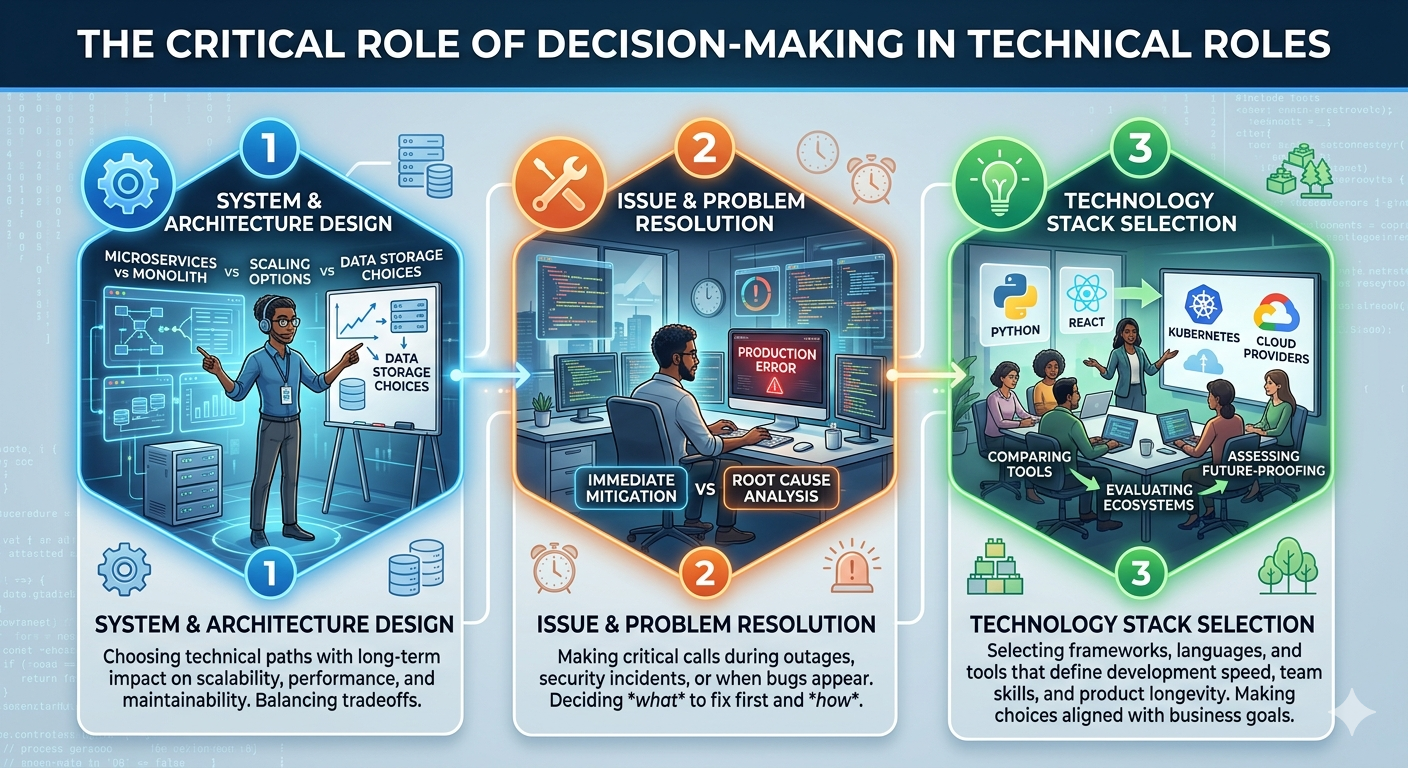
Technical challenges rarely have a single correct answer. Multiple solutions may exist, each with different trade-offs in performance, cost, and complexity.
Professionals must evaluate these options and select the most appropriate solution. This requires judgment rather than memorized knowledge. Candidates who demonstrate structured decision-making stand out in technical roles.
Thoughtful choices improve long-term system performance.
Prioritization affects system stability
In real-world environments, multiple issues decision-making ability matters often occur simultaneously. Some problems may be urgent, while others can wait.
Professionals must prioritize tasks based on impact and urgency. For example, a production outage requires immediate attention, while a minor bug can be scheduled later.
Strong prioritization ensures that critical issues are handled first, which protects system stability and user experience.
Decision-making reduces operational risk
Every technical action carries some level of risk. Deploying new code, updating infrastructure, or modifying databases can introduce unexpected issues.
Professionals who evaluate risks before acting reduce the chances of system failures. They consider potential consequences and plan fallback strategies when needed.
Risk-aware decisions improve reliability and trust.
Speed and accuracy must be balanced
Technical roles often require quick decisions, especially during incidents or system failures. However, acting too quickly without proper analysis can lead to mistakes.
Strong professionals balance speed with accuracy. They gather essential information, analyze the situation, and then take action confidently.
This balance ensures effective problem resolution without unnecessary errors.
Collaboration depends on decision clarity
Technical professionals frequently work with cross-functional teams. Clear decision-making helps align team efforts and avoid confusion.
When professionals explain their decisions clearly, other team members understand the reasoning and follow the plan more effectively.
Transparent decision-making improves collaboration and workflow efficiency.
Problem-solving improves through structured decisions
Decision-making is closely linked to problem-solving. Professionals who follow a structured approach can break down complex problems into manageable steps.
They analyze root causes, evaluate options, and implement solutions logically. This structured thinking leads to better outcomes and fewer repeated issues.
Strong decision-making enhances problem-solving capability.
Employers evaluate decision-making in interviews
During technical interviews, recruiters often present real-world scenarios to evaluate decision-making ability. Candidates may be asked how they would handle system outages, performance issues, or conflicting requirements.
Interviewers observe how candidates think, prioritize actions, and justify their choices. Candidates who explain their reasoning clearly demonstrate professional maturity.
Decision-making skills influence hiring outcomes significantly.
Leadership potential depends on decision-making
As professionals grow in their decision-making ability matters careers, decision-making becomes even more important. Leadership roles require guiding teams, making strategic choices, and managing risks.
Employers look for individuals who can make informed decisions confidently. Strong decision-makers often move into roles such as team lead, project manager, or technical architect.
Leadership growth is closely tied to decision-making ability.
Adaptability in changing environments
Technology environments evolve rapidly. New tools, frameworks, and challenges appear regularly.
Professionals must adapt their decisions based on changing conditions. Flexible decision-making allows them to respond effectively to new situations.
Adaptability strengthens long-term career success.
Conclusion
Technical expertise forms the foundation of professional performance, but decision-making determines how effectively that expertise is applied. That is precisely why decision-making ability matters in technical roles across modern technology environments.
Professionals who prioritize correctly, evaluate risks, communicate clearly, and act with confidence deliver stronger results and gain greater trust within organizations. By developing decision-making ability matters strong decision-making skills, individuals improve their performance, increase their career growth opportunities, and position themselves for leadership roles in technical fields.
**Find Your Dream Job Today – Explore Endless Career Opportunities and Secure Your Next Role with Best Job Tool






Comments
Be the first to leave a comment.