

Introduction
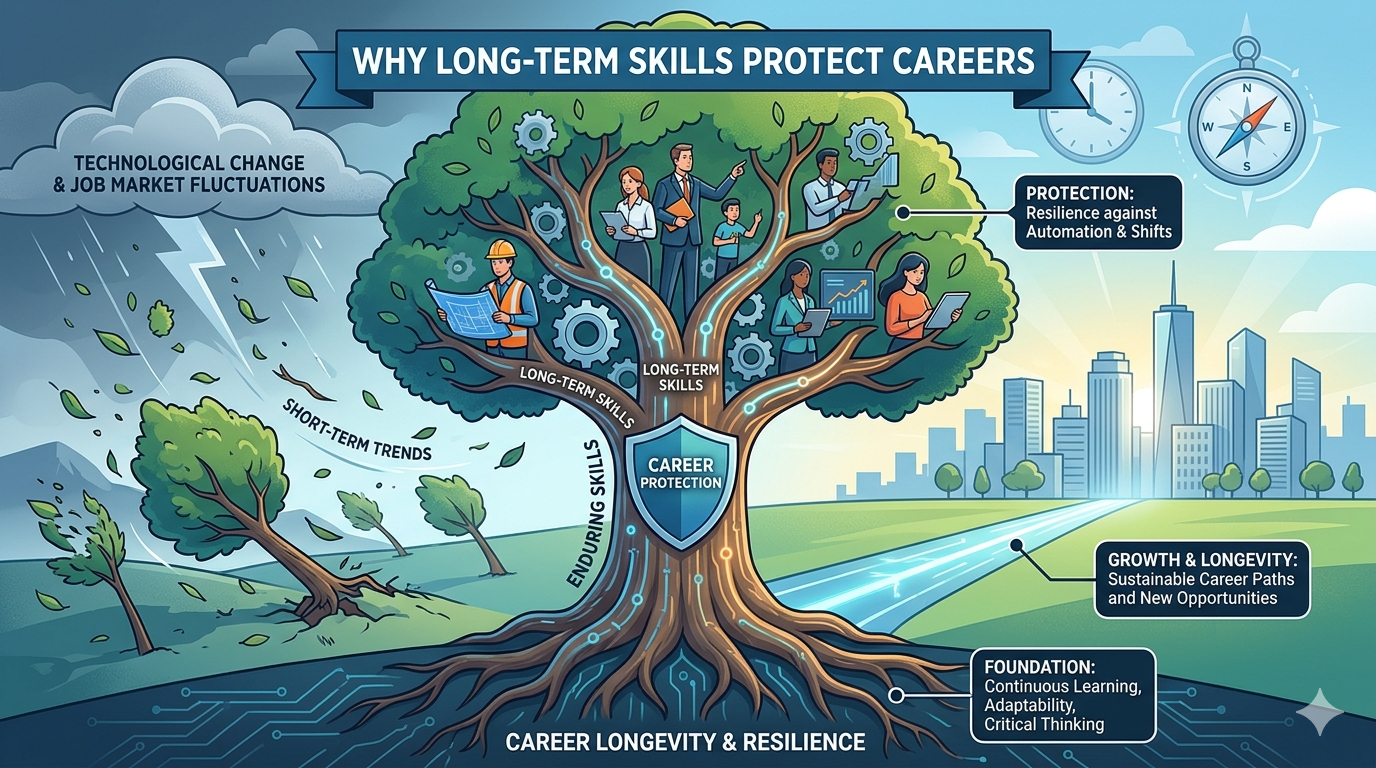
Careers today are no longer linear. Industries evolve quickly, and job roles change constantly. Therefore, professionals must focus on skills that remain valuable over time. This is exactly why long-term skills protect careers.
Short-term skills may help you secure a job. However, long-term skills ensure you stay relevant. They provide stability in uncertain environments.
Professionals who invest in long-term skills adapt faster. As a result, they handle change more effectively and grow consistently.
What long-term skills really mean
Long-term skills are abilities that remain valuable across roles and industries. They are not limited to specific tools or technologies.
These skills include critical thinking, communication, problem-solving, and adaptability. They support performance in different situations.
Moreover, long-term skills evolve with experience. They become stronger over time.
Therefore, they form the foundation of sustainable career growth.
Why long-term skills protect careers in changing industries
Industries are constantly evolving. Technologies become outdated, and new systems replace old ones.
Professionals who rely only on technical tools may struggle to adapt. However, those with strong foundational skills adjust quickly.
Long-term skills allow individuals to learn new tools efficiently. Therefore, they remain relevant despite changes.
This explains why long-term skills protect careers in dynamic environments.
The role of adaptability in career stability
Adaptability is one of the most important long-term skills. It helps professionals respond to change effectively.
When job requirements shift, adaptable individuals adjust their approach. They learn new skills and embrace new challenges.
Moreover, adaptability reduces stress during transitions. It creates confidence in uncertain situations.
Thus, adaptability strengthens career stability.
How long-term skills improve decision-making
Decision-making is essential in every role. Long-term skills enhance this ability.
Critical thinking helps professionals analyze situations clearly. Communication ensures decisions are conveyed effectively.
Additionally, problem-solving enables individuals to handle complex challenges.
Therefore, long-term skills lead to better decisions and outcomes.
The connection between long-term skills and leadership
Leadership requires more than technical expertise. It depends on communication, judgment, and emotional intelligence.
Long-term skills support these qualities. They help leaders guide teams and make informed decisions.
Moreover, leaders must adapt to changing environments. Long-term skills make this possible.
Thus, these skills are essential for leadership development.
Why short-term skills are not enough
Short-term skills focus on specific tools or tasks. While they are useful, they may become outdated quickly.
Professionals who rely only on these skills may face challenges when industries change.
Additionally, short-term skills limit flexibility. They restrict career growth to specific roles.
Therefore, balancing short-term and long-term skills is important.
How to build long-term skills effectively
Building long-term skills requires consistent effort. It involves continuous learning and practice.
Focus on improving communication and critical thinking. These skills apply across all roles.
Additionally, seek diverse experiences. Exposure to different situations strengthens adaptability.
Moreover, learn from feedback. This helps refine your abilities.
Over time, these efforts build strong foundational skills.
The impact of long-term skills on career growth
Career growth depends on versatility. Long-term skills make professionals more adaptable and valuable.
They open opportunities across industries. This increases career flexibility.
Additionally, professionals with strong foundational skills are trusted with greater responsibilities.
Therefore, long-term skills support sustainable career growth.
How long-term skills protect careers during uncertainty
Economic changes and market shifts can affect job security. However, long-term skills provide resilience.
Professionals with strong skills can transition between roles. They can learn new tools quickly.
Moreover, these skills reduce dependency on specific jobs. This increases career security.
Thus, long-term skills act as a safety net during uncertainty.
Why long-term skills protect careers in the future
The future of work will continue to evolve. New technologies and roles will emerge.
Professionals who focus on long-term skills will remain relevant. They can adapt to new environments easily.
Additionally, these skills support lifelong learning. This ensures continuous growth.
Therefore, why long-term skills protect careers becomes even more important for future success.
Conclusion
Understanding why long-term skills protect careers is essential in today’s unpredictable job market. These skills provide stability, adaptability, and growth.
While short-term skills may help in the present, long-term skills secure the future. They enable professionals to navigate change and seize opportunities.
By investing in long-term skills, you build a strong foundation for success. Combine this approach with the best job tool to find opportunities that align with your strengths and career goals.
Find Your Dream Job Today – Explore Endless Career Opportunities and Secure Your Next Role with Best Job Tool.






Comments
Be the first to leave a comment.