

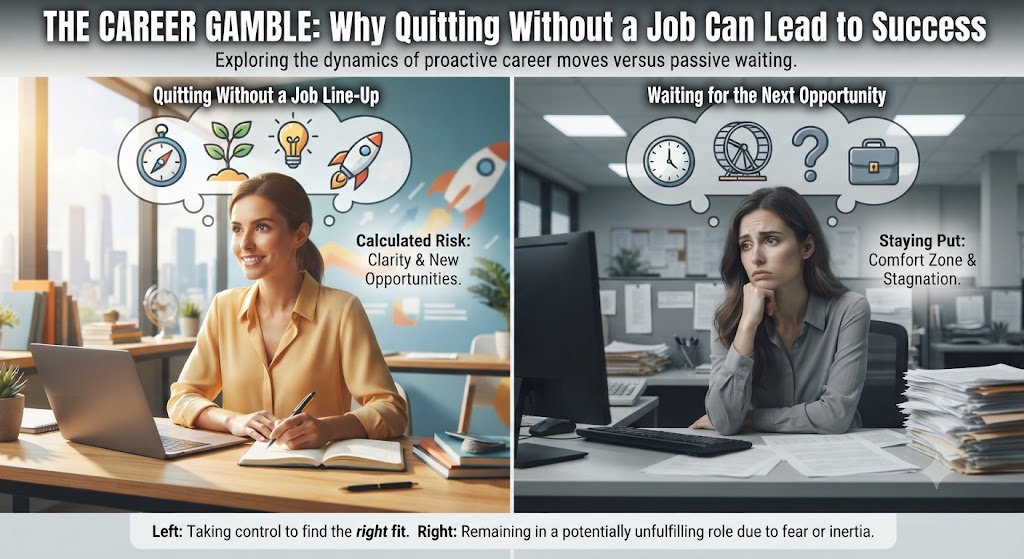
Leaving a job without another offer is often viewed as a risky career decision. In many cases, waiting for the next opportunity before resigning can provide greater financial security and reduce uncertainty. However, some professionals who leave first still manage to build stronger careers than those who wait.Quitting
The difference is rarely the resignation itself. Instead, it often comes from what happens afterward. Professionals who quit without a job may create more time for focused job searching, skill development, networking, portfolio building, and career planning. They can also become more selective about their next opportunity rather than accepting the first available offer.
However, this approach only works when it is supported by preparation. A career break without savings, a realistic job-search strategy, or a clear direction can create unnecessary financial pressure.
For professionals considering this path, the goal should not be to quit impulsively. Instead, it should be to understand when leaving without another job can create flexibility and when waiting is the more practical choice.
1. They Create Time for a Focused Job Search
One major advantage of leaving a demanding job is having more time to search strategically. Full-time employees often apply for jobs during evenings, weekends, or short breaks. As a result, their job search can become inconsistent.
After leaving, professionals may have several hours each day to focus on career development.
A structured job-search routine can include:
- Researching suitable companies and roles
- Customizing resumes for relevant positions
- Building professional connections
- Preparing for interviews
- Improving technical or industry-specific skills
- Following up with recruiters
- Creating or improving a professional portfolio
However, more time does not automatically produce better results. Without structure, an unemployed professional can spend hours scrolling through job boards without making meaningful progress.
A better approach is to divide the day into specific blocks. For example, mornings can focus on applications and networking, afternoons on skills and portfolio work, and evenings on interview preparation or industry research.
This creates the discipline normally provided by a workplace schedule.
2. They Can Make a More Intentional Career Move
Professionals who already have another job offer may feel pressure to accept it quickly. This is especially true when they are tired of their previous workplace or concerned about maintaining income.Quitting
Someone who has intentionally created a financial runway may have more time to evaluate opportunities.
Instead of asking only, “Who will hire me?”, they can ask:
- Does this role support my long-term career goals?
- Is the company financially and professionally stable?
- Does the position offer meaningful skill development?
- Is the working arrangement suitable?
- Will the role improve future career opportunities?
- Does the compensation justify the workload and responsibilities?
This distinction matters because a career move should not only solve an immediate employment problem. It should also improve the professional direction of the next several years.
Professionals should still remain realistic. Having no job can reduce bargaining power if the search continues for too long. Therefore, career selectivity should be balanced with financial planning and a defined job-search timeline.
3. They Use the Career Gap Productively
A gap between jobs does not automatically damage a career. What matters is how the professional uses and explains that period.
For example, someone who spends three months completing a certification, building a portfolio, consulting, freelancing, volunteering professionally, or developing a new skill can demonstrate continued career activity.
A productive career gap might include:
- Completing an industry certification
- Learning an in-demand software platform
- Building two or three portfolio projects
- Taking freelance assignments
- Attending professional events
- Conducting informational interviews
- Publishing industry-related insights
- Improving communication or presentation skills
The key is documentation. Keep a record of completed courses, projects, client work, measurable outcomes, and professional activities.
During interviews, this makes it easier to explain the period between jobs as a deliberate phase of professional development rather than an unexplained absence.
4. They Build Better Remote and Location Strategies
Remote work has changed how professionals approach career transitions. A job search no longer has to be limited to employers within commuting distance.
Professionals can potentially explore remote, hybrid, and onsite opportunities across different cities and countries, depending on their qualifications, work authorization, and employer requirements.
This flexibility can significantly expand the number of relevant opportunities.
At the same time, remote job searching requires additional planning. Before accepting a location-independent position, professionals should evaluate:
- Time-zone requirements
- Internet reliability
- Communication expectations
- Equipment requirements
- Employment regulations
- Tax implications
- Travel limitations
- Meeting schedules
Travel testing can also be useful for professionals considering remote work. Rather than assuming that working from another location will be easy, they can test their productivity during a short trip.
For example, a professional could spend one week working from another city while tracking internet reliability, meeting interruptions, work hours, expenses, and overall productivity.
This provides practical information before making a larger relocation or extended-travel decision.
5. They Treat Productivity Like a Professional Responsibility
One hidden challenge of quitting without another job is the loss of external structure. Without meetings, deadlines, managers, and colleagues, it becomes easy to postpone important tasks.
Professionals who handle this transition successfully often replace workplace structure with personal systems.
A simple daily framework can include:
Morning:
Job applications, recruiter communication, and networking.
Midday:
Learning, portfolio development, or interview preparation.
Afternoon:
Company research, applications, and professional projects.
Evening:
Reviewing progress and preparing the next day’s priorities.
Weekly targets can make the system more measurable.
For example:
- 10–15 high-quality applications
- 5 networking conversations
- 2 interview preparation sessions
- 5 hours of skill development
- 1 portfolio improvement
- 1 industry-related article or professional post
Quality should remain more important than volume. Sending hundreds of generic applications can be less useful than sending carefully targeted applications to appropriate roles.
Using a best job tool, which functions as a global job platform, can help professionals organize their search around relevant opportunities instead of relying on one source.
6. They Protect Their Finances Before Taking the Risk
The biggest difference between a planned career break and an impulsive resignation is financial preparation.
Before quitting without another job, professionals should calculate their minimum monthly expenses and determine how long their savings can support them.
The calculation should include:
- Housing
- Food
- Utilities
- Transportation
- Insurance
- Debt payments
- Family responsibilities
- Healthcare costs
- Job-search expenses
- Emergency expenses
A simple runway calculation is:
Available savings ÷ essential monthly expenses = approximate financial runway
For example, if someone has $18,000 available and essential monthly expenses are $3,000, the theoretical runway is six months. However, the entire amount should not necessarily be treated as available for job searching because unexpected expenses can reduce that period.
Professionals should also consider income alternatives such as freelancing, consulting, temporary work, or part-time projects where appropriate.
Travel should be budgeted separately. A career break can become financially stressful when frequent travel consumes money that was originally intended to support the job search.
Financial planning therefore determines how much career flexibility a person actually has.
7. They Know When Waiting Is the Better Choice
Quitting without another job is not automatically a superior career strategy. For many professionals, waiting for an offer is the safer and more practical option.
Waiting may make more sense when:
- Savings are limited
- Debt obligations are high
- Family members depend on your income
- Your industry has a long hiring cycle
- Your skills are currently difficult to market
- You have limited professional connections
- Your employment situation is stable
- You expect significant upcoming expenses
In these situations, staying employed while searching can protect financial stability and preserve negotiating power.
Professionals can still create many of the benefits associated with quitting while remaining employed. They can schedule applications before or after work, build skills during weekends, network consistently, and use vacation days for interviews.
The important question is therefore not simply whether someone should quit before finding another job. The more useful question is whether their financial position, career objectives, marketability, and personal circumstances support that decision.
Conclusion
Some people who quit without a job do better because they use the transition intentionally. They create time for focused searching, improve their skills, explore broader opportunities, test new working arrangements, and make more deliberate career decisions.
However, these advantages depend heavily on preparation. Without financial reserves, structure, and a realistic plan, leaving a job can create unnecessary pressure and reduce career flexibility.Quitting
Professionals considering a resignation should therefore evaluate their financial runway, target roles, skills, networking strategy, productivity system, and potential remote-work options before making the decision.Quitting
The modern job market provides more ways to search, work, learn, and connect than previous generations had. A global job platform such as a https://insights.bestjobtool.com/best job tool can support that process by helping professionals discover opportunities across different markets and employment arrangements.
Ultimately, career progress comes less from whether someone quits first or waits for an offer and more from how deliberately they manage the transition. A planned career move can create opportunities, while an unplanned resignation can create avoidable pressure. The difference is preparation.






Comments
Be the first to leave a comment.