

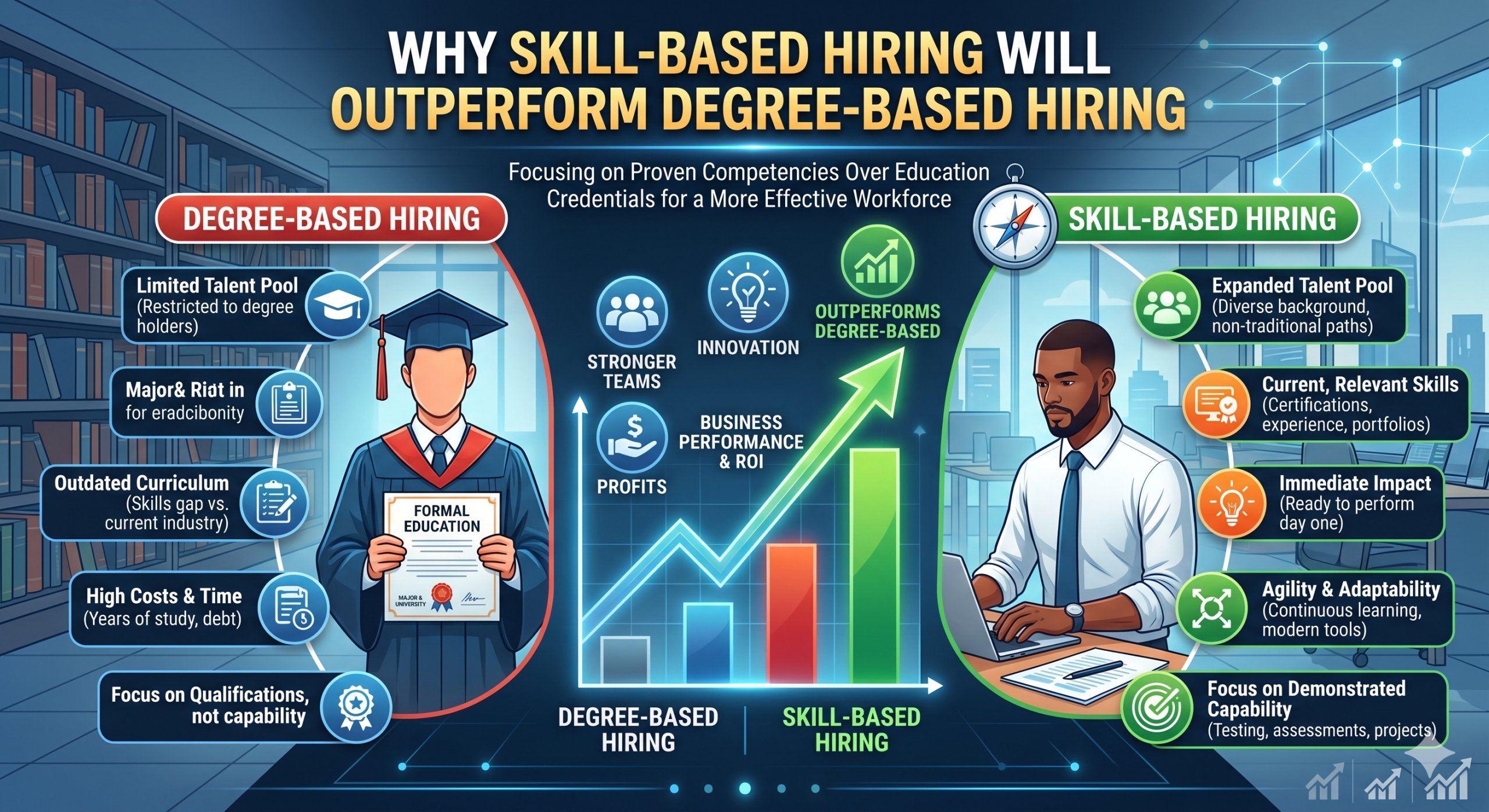
Hiring is changing. For decades, degrees acted as a default screening tool for employers trying to assess capability, discipline, and readiness for work. A bachelor’s or master’s degree often served as shorthand for competence, even when the job itself did not directly require academic specialization. Outperform But that model is becoming less effective in a labor-outperforming market defined by accelerating digital transformation, rapidly changing job requirements, remote work, and rising pressure to hire for measurable performance rather than pedigree.
Today, employers are increasingly recognizing a simple reality: degrees do not always reflect job readiness, and many high-performing candidates build valuable skills outside traditional education pathways. They learn through hands-on work, online courses, certifications, freelance projects, bootcamps, internships, apprenticeships, and self-directed practice. At the same time, businesses are facing talent shortages in key roles, especially in technology, operations, digital marketing, customer success, analytics, and project-based work. Relying too heavily on degree filters can exclude capable candidates and slow down hiring in markets where practical skills matter more than academic credentials.
This is why skill-based hiring is gaining momentum across industries. Instead of focusing primarily on where a candidate studied, employers evaluate what the candidate can actually do. That shift is not only more inclusive; it is often more effective. Skill-based hiring helps companies widen talent pools, improve role fit, reduce unnecessary screening barriers, and align recruitment more closely with business outcomes.
This article explains why skill-based hiring will outperform degree-based hiring, what is driving the shift, and how organizations can implement this model in a structured, practical way.
1. Degrees Are No Longer a Reliable Proxy for Job Readiness
A degree can still be valuable. It may reflect subject exposure, persistence, and academic discipline. In some professions—such as medicine, law, engineering, and highly specialized technical fields—it remains essential. But for a growing number of business, digital, support, and operational roles, a degree alone says very little about whether someone can perform effectively in a real workplace.
The core issue is that many jobs now evolve faster than formal education systems. A university curriculum may take years to adapt, while business tools, platforms, workflows, and employer expectations change every few months. A graduate may leave university with a degree in a relevant field but still lack practical Outperform experience in the tools, systems, and problem-solving methods the job requires.
For example, consider roles in:
- customer success
- operations coordination
- digital marketing
- recruiting
- project management
- data reporting
- content operations
- remote executive support
In these functions, success often depends on tool proficiency, communication quality, adaptability, time management, analytical thinking, and execution under real business constraints. A degree may help, but it does not prove competence in these areas.
Why degrees fall short as hiring filters
- They do not consistently reflect practical ability
- They do not show tool familiarity or workflow execution
- They can overvalue theory while underweighting real problem-solving
- They exclude candidates who learned through alternative paths
- They may create false confidence in a candidate’s readiness
Skill-based hiring addresses this gap by shifting the focus Outperform from academic qualification to demonstrated capability. Instead of assuming competence from a credential, employers ask for evidence of performance.
2. Skill-Based Hiring Expands Access to Stronger Talent Pools
One of the biggest advantages of skill-based hiring is that it dramatically widens the available talent pool. Degree requirements can unintentionally eliminate candidates who are fully capable of doing the work but took a nontraditional route into the profession. This includes professionals who learned through bootcamps, online certifications, freelance work, side projects, apprenticeships, internal promotions, military experience, or self-teaching.
In competitive hiring markets, narrowing the pool unnecessarily is expensive. It increases time-to-fill, raises sourcing costs, and can force companies to compete for the same limited group of degree-holding candidates while ignoring strong talent elsewhere.
Skill-based hiring opens access to:
- self-taught professionals with proven portfolios
- career switchers who built relevant capabilities through practice
- experienced workers without formal degrees in a specific field
- professionals from emerging markets or nontraditional institutions
- internal employees ready to grow into new roles based on demonstrated ability
This matters especially for startups, remote-first teams, and Outperform companies hiring for digital roles. Many of the best candidates in these environments are not defined by conventional educational paths. They are defined by what they have built, improved, solved, or delivered.
Business benefits of a wider talent pool
- faster hiring in difficult roles
- more diverse candidate pipelines
- lower dependence on narrow sourcing channels
- stronger access to high-motivation candidates who have already proven learning agility
In a labor market where speed and adaptability matter, a hiring model that unnecessarily restricts supply becomes a strategic disadvantage.
3. Skills Predict Performance More Directly Than Credentials
Hiring should ultimately answer one question: can this person do the job well? Degrees may provide background context, but skills provide more direct evidence of likely performance. If the role requires project coordination, customer communication, Excel reporting, process documentation, or CRM usage, then testing those capabilities tells an employer far more than simply checking whether the candidate completed a degree.
Skill-based hiring works because it aligns evaluation with the actual demands of the role. It focuses on what success looks like in practice and then assesses whether the candidate can deliver it.
Examples of skills that predict role performance
- writing clear client emails for customer support roles
- building spreadsheet trackers for operations roles
- creating structured hiring workflows for recruiting roles
- managing campaign reporting for marketing roles
- documenting SOPs and cross-team Outperform updates for administrative roles
- prioritizing tasks and timelines for project coordination roles
When hiring teams evaluate these abilities directly—through work samples, simulations, case exercises, structured interviews, or portfolio review—they make better decisions. They reduce the risk of selecting candidates who look strong on paper but struggle with execution once hired.
What skill-based assessment can reveal
- practical communication ability
- comfort with role-relevant tools
- problem-solving under realistic constraints
- judgment and prioritization
- ability to learn and adapt quickly
- depth of ownership in previous work
In other words, skill-based hiring is often a more accurate way to predict how someone will actually perform after joining.
4. It Supports Faster Hiring in Fast-Changing Industries
Many industries no longer have the luxury of hiring slowly. Startups, digital businesses, service companies, and modern operations teams often need people who can contribute quickly. They do not always need perfect credentials; they need people who can learn systems, solve problems, and deliver results within weeks rather than months.
Degree-based hiring can slow this process because it Outperform creates rigid screening criteria that do not always reflect urgency or actual job needs. If a company insists on a specific degree for a role where tool proficiency and execution matter more, it may spend weeks filtering out otherwise strong candidates.
Skill-based hiring creates a more flexible, faster model:
- the hiring team defines the critical skills required for success
- recruiters source candidates based on those capabilities
- assessments are designed to test practical fit
- hiring decisions focus on execution readiness rather than educational prestige
This is especially useful in functions where tools and workflows evolve rapidly:
- AI-enabled operations
- performance marketing
- customer support systems
- revenue operations
- content production
- remote team coordination
- digital recruiting
Why speed matters
Every delayed hire creates operational cost:
- missed revenue opportunities
- overloaded existing teams
- slower product delivery
- reduced customer response quality
- management distraction
Skill-based hiring can reduce Outperform these delays by focusing the process on what matters most: capability, not convention.
5. It Improves Inclusion Without Lowering Standards
A common misconception is that skill-based hiring lowers the quality bar. In reality, it often raises it. The difference is that the standard becomes more relevant. Instead of asking whether a candidate has a particular academic credential, the employer asks whether the candidate can perform the work to the required level.
This creates a more inclusive hiring process without compromising rigor. Candidates from less privileged educational backgrounds, smaller institutions, career-break situations, or nontraditional career paths gain a fairer opportunity to compete. But they still need to prove capability through practical evidence.
Inclusion benefits of skill-based hiring
- reduces bias toward pedigree and institution brand
- gives career switchers a realistic pathway into new fields
- supports social mobility by recognizing alternative learning routes
- broadens access for candidates in regions where elite education is less accessible
- values demonstrable effort, learning, and applied competence
The key point is that inclusion and quality do not conflict here. In fact, overreliance on degree filters can weaken quality by excluding high-potential candidates who may outperform traditional applicants once hired.
Better standard, not lower standard
A strong skill-based process still requires:
- clear role definition
- structured evaluation
- relevant work tests
- calibrated interviews
- consistent scoring criteria
The difference is that the candidate is judged on evidence of ability rather than assumptions based on educational background.
6. Modern Work Rewards Continuous Learning More Than Static Credentials
One of the biggest reasons skill-based hiring will continue to outperform degree-based hiring is that modern careers are built on continuous learning. Most professionals no longer rely on a single educational milestone to stay relevant for decades. They must keep updating their capabilities as technology, business models, customer expectations, and tools evolve.
A degree is static. Skills are dynamic.
That distinction matters. Employers increasingly need people who can:
- learn new software quickly
- adapt to process changes
- work with AI tools
- take on cross-functional responsibilities
- build competence outside formal training environments
Candidates who demonstrate Outperform this kind of learning agility are often more valuable than those with strong academic backgrounds but limited evidence of current skill development.
Signals of continuous learning employers should value
- certifications tied to role-relevant tools
- portfolio projects and side work
- evidence of tool adoption in previous jobs
- self-initiated upskilling during career transitions
- internal role progression based on capability growth
For example, an operations candidate who taught themselves advanced spreadsheet workflows, built reporting trackers, and learned a project management tool may be better prepared for a digital operations role than a candidate with a generic business degree but limited practical exposure.
Skill-based hiring recognizes this reality. It rewards current, applicable capability rather than relying too heavily on past academic achievement.
7. It Aligns Hiring With Business Outcomes, Not Legacy Assumptions
Ultimately, hiring should serve Outperform business performance. Companies do not hire degrees; they hire people to solve problems, build systems, support customers, manage workflows, increase revenue, and improve execution. The strongest hiring models therefore align candidate evaluation with the actual outcomes the business needs.
Degree-based hiring is often inherited from old processes rather than intentionally designed around current role requirements. It can become a default checkbox rather than a strategic decision. Skill-based hiring forces organizations to get more precise:
- What does success in this role actually look like?
- Which capabilities are essential in the first 90 days?
- Which tools, behaviors, and outputs matter most?
- What evidence would prove someone can deliver those outcomes?
These are better hiring questions. They produce clearer job descriptions, stronger interviews, more useful assessments, and better onboarding plans.
Examples of outcome-based hiring thinking
Instead of “Bachelor’s degree required,” ask:
- Can this person manage stakeholder communication under deadline pressure?
- Can they analyze data accurately and present it clearly?
- Can they maintain operational consistency in a remote environment?
- Can they write documentation that improves team efficiency?
- Can they learn our systems quickly and solve real business problems?
This approach is especially important for employers using a best job tool or global hiring platform to reach broader talent pools. When hiring across markets, companies need clearer capability signals than degree prestige alone can provide. A best job tool becomes more effective when employers use it to source based on skills, outcomes, and role-specific requirements rather than outdated credential filters.
How Employers Can Shift to Skill-Based Hiring Practically
Moving toward skill-based hiring does not require rewriting the entire talent function overnight. It can begin with a structured review of how roles are defined, screened, and assessed.
Step 1: Audit current job descriptions
Remove degree requirements from roles where they are not genuinely necessary. Replace them with skill and outcome-based criteria.
Step 2: Define success for each role
Clarify what the employee needs to achieve in the first 3–6 months and identify the capabilities that directly support those outcomes.
Step 3: Build practical assessments
Use work samples, simulations, short case tasks, or portfolio reviews to test the most important skills.
Step 4: Train hiring managers
Teach managers how to evaluate evidence of capability, not just resume familiarity or educational pedigree.
Step 5: Rework screening logic
Source and shortlist candidates based on relevant experience, tools, outcomes, and Outperform demonstrated learning—not only academic credentials.
Step 6: Track hiring quality
Measure performance, ramp time, retention, and manager satisfaction to compare the effectiveness of skill-based hires over time.
This transition can start with one department or role family and expand as the organization gains confidence in the model.
Conclusion
Skill-based hiring will outperform degree-based hiring because it is more closely aligned with how work actually gets done. Degrees still have value in many contexts, and they will remain important in professions where formal training is essential. But for a growing share of modern roles, especially in digital, operational, startup, support, and cross-functional environments, a degree is no longer the best indicator of readiness or potential.
Employers need people Outperform who can solve problems, use tools effectively, communicate clearly, learn continuously, and contribute quickly. Those qualities are better identified through skills, work evidence, and practical assessment than through academic credentials alone. Skill-based hiring widens access to talent, improves speed, strengthens inclusion, and creates a more direct connection between recruitment decisions and business outcomes.
For organizations looking to build stronger teams in a fast-changing market, the shift is not just philosophical. It is operational. The companies that define roles clearly, assess capability directly, and hire for proven skills will be better positioned to compete than those still relying on degree filters as a default shortcut. In the years ahead, the strongest hiring strategies will not ask only where candidates studied. They will ask what those candidates can actually do—and how quickly they can create value once hired.






Comments
Be the first to leave a comment.