

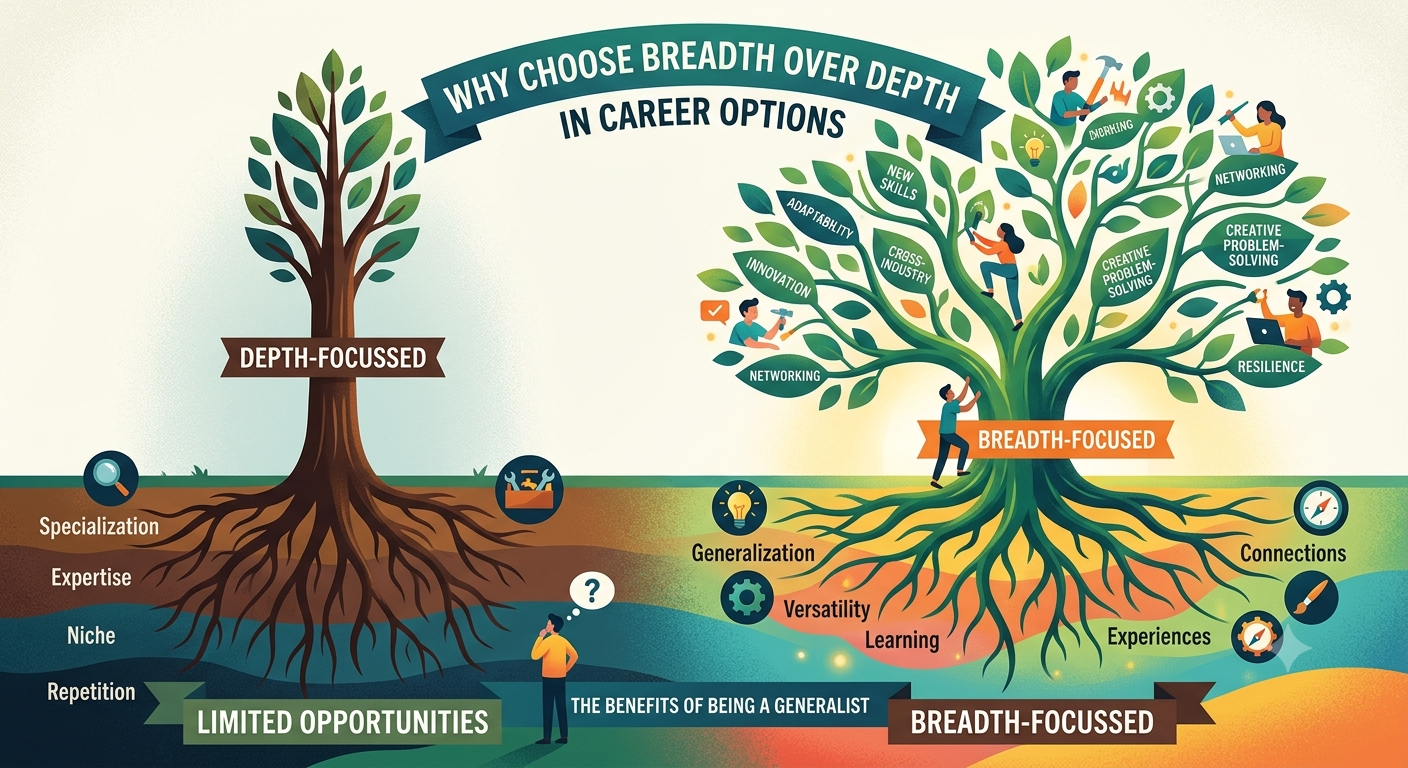
Introduction: Career Depth
Professionals used to be told to become a jack-of-all-trades and master of none. Having diverse knowledge, multitasking abilities, experience in several areas, and diverse skill set used to be a recipe for career success. It is not so in the modern world. Career depth helps professionals build specialized knowledge that becomes more valuable over time.
With automation, robotics, and artificial intelligence making many areas of work easier for computers than humans, being a generalist might not be the best career choice. Instead, to maximize career potential, it seems that the option of depth-oriented approach should be preferred.
A professional moat is a protective barrier around one’s professional skills, knowledge, and competencies. It makes one’s professional skills valuable and difficult to reproduce by competitors.
The idea of professional moats was pioneered by Warren Buffett. It refers to any sort of competitive advantages that people possess and which allow them to earn more money. In this paper, I will argue why choosing depth over generality is a superior career choice.
Why Choosing Depth Over Generality Builds a Stronger Career Moat?
1. Deep Expertise Makes You More Valuable than Broad Competencies
What is depth without time and effort? Not easy expertise to gain, that’s what!
Depth takes time to develop, and most often, the longer one spends learning about one narrow professional area, the more valuable this expertise will be in terms of personal productivity. There is no doubt that it is easy to learn writing skills or social media marketing. But how many people know the exact writing and psychological techniques to use in their field? That is how deep expertise makes a difference. Depth makes professionals knowledgeable, and they provide value in much higher degrees than generalists do
2. Expertise Makes You Stand Out in the Crowd of Competitors
It has never been that easy to get a degree, get certified, and do a couple of projects before starting to look for a new job. Every resume looks similar, every candidate knows the same things, but employers want professionals that have unique knowledge and unique professional strengths.
That is why depth makes you stand out against the crowd of job applicants. You do not necessarily need to be an expert in everything, but you should be exceptional at something.
An employer does not want another generic social media marketer; they want a specialist with 10 years of niche expertise. So, if you want to stand out, turn yourself into an expert, not a generalized professional
3. Depth Builds Lasting Professional Relationships Networks
Colleagues and co-workers know about your professional strengths and tend to rely on experts rather than generalists for advice and decision-making.
That is one of the major perks of career depth expertise. The more professional value one provides, the higher is their value in terms of personal and workplace relationships.
This might land you a highly skilled and dedicated colleague or another employee that will always come to you for advice. Even employers might notice that you know your stuff and take you into account for important meetings and assignments. Such professional recognition often brings career opportunities and professional achievements later on.
4. Experience in Specific Professional Area Is Harder to Replace than General Skills
It is possible that technological advancements make many expert-level skills easy to acquire.
Artificial intelligence, robots, databases, computer programs, and other technologies can help anyone achieve skill levels beyond what was possible 10 or 20 years ago. However, depth-based professional expertise is difficult to obtain. Depth is usually a mix of professional experience and expert-level knowledge of a particular professional area.
Even though a computer can complete statistical calculations in seconds and perform data analysis effortlessly, it is still difficult to find a professional who knows how to interpret and explain data to make relevant decisions.
A person with broad professional competencies and high knowledge is unlikely to be able to perform as well as someone who gained years of experience. It is also important to remember that most often, these are not mutually exclusive. A professional with vast experience in the specific skill usually does have transferable skills that could be used elsewhere. Depth expertise will still have an advantage over generalist-type knowledge.
5. The Option of Career Depth Expertise Opens More Opportunities
Not only does being a professional generalist not promote career and skill development, but it may also significantly reduce the number of options available. To put it another way: there are always more opportunities for specialists compared to generalists.
It does open many more doors for people who chose to pursue an expert-based professional path. For instance, one does not have to specialize in cybersecurity for a career in just one company. Expert-level knowledge often makes the professional valuable across industries, and this is an advantage in terms of choosing a future workplace.
6. Depth Expertise Does Not Mean that Other Skills Do Not Exist
Choosing to prioritize career depth does not mean that one will be ignorant towards other professional areas. The best career choice is usually to form a T-letter shaped expertise. It prioritizes depth while also promoting transferable skills. So, a writer does not only have to be an expert in writing per se but also in search engine optimization.
7. Professional Depth Enables Good Judgement and Strategic Thinking
Professionals gain knowledge, skills, and expertise with time. However, the more one is involved in a certain career path, the better their judgement skills become. As an expert, a professional has to analyze, review, discuss, suggest changes, and analyze some more before committing to decisions.
They understand what works and what does not work and are aware of common mistakes made in their area of expertise. Thus, they are the people that others trust to make important judgement calls and strategic decisions
8. Building a Career Moat Takes Time and Effort
It should have been evident by now that a professional moat-building requires significant time and effort. Learning a new subject is exciting but being an expert in a professional area is much more gratifying. It can be disheartening at times, since the majority of people choose breadth over depth.
It might seem that no matter how much time and effort you put into the development of your own career moat, nothing really changes. But it always does. The more you study, research, and practice, the higher you are in terms of professional expertise.
This, in turn, affects the judgement skills and strategic thinking ability, which directly impacts one’s ability to advance in their chosen career path. It will eventually lead to better salary, promotion, and professional reputation. After a while, it becomes difficult to match the level of expertise another person has. Their career moat is stronger, and they became better at their job than most others for a long time.
Conclusion: Career Depth
Modern-day career opportunities reward professional flexibility. However, such flexibility does not always mean that breadth-based expertise is a better choice.
In the modern working world, depth-oriented approach is usually more rewarding than to attempt to gain some knowledge in many areas. This is why choosing depth over generality is important to building one’s professional moat.
Depth lets one gain expertise in a specific professional area. Expert-level knowledge and vast experience leads to better salary, job offers, and career advancement opportunities. Furthermore, professional relationships and networks are also typically stronger among people who chose the career depth path.
A lot of other transferable skills are also required to succeed in almost any career, so it is beneficial to develop them alongside professional expertise.
Ready to turn your expertise into a career advantage? Explore the right Best Job Tools, use job search tools to find specialized roles, and update your resume to highlight your strongest skills. Focus on building deep expertise in an area that employers value, and let your specialization become your long-term career advantage.






Comments
Be the first to leave a comment.