

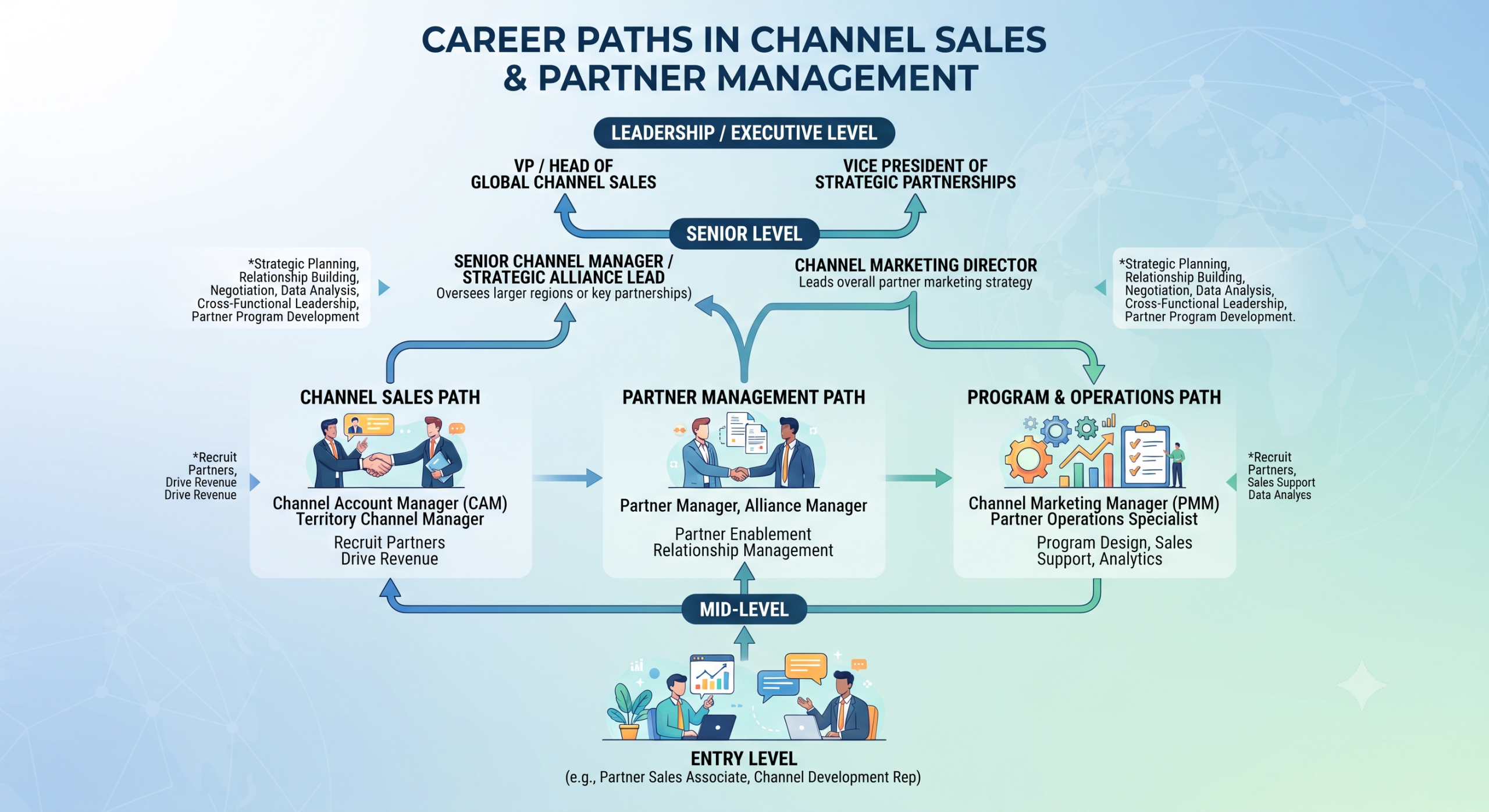
Companies often rely on partners, distributors, resellers, agencies, and technology providers to expand their market reach. As a result, channel sales and partner management have become important career areas across technology, SaaS, manufacturing, telecommunications, financial services, and professional services.
Unlike traditional sales roles, channel-focused professionals do not always sell directly to the final customer. Instead, they build relationships with organizations that help distribute, promote, implement, or sell products and services. Therefore, these careers combine sales, relationship management, negotiation, business development, and strategic planning.
The field can be particularly attractive to professionals who enjoy working with multiple stakeholders rather than managing only individual customer accounts. Moreover, many partner management activities can be performed remotely, allowing professionals to work with organizations across different regions.
This guide explains the major career paths in channel sales and partner management, the skills required, and practical ways to build long-term career growth.
Understand Channel Sales and Partner Management
First, understand how channel sales differs from direct sales. In a direct sales model, a company sells its product or service directly to customers. In a channel model, the company works with external partners to reach customers.
These partners may include:
- Resellers
- Distributors
- Retail partners
- Technology partners
- Agencies
- Consultants
- System integrators
- Referral partners
- Affiliate partners
For example, a software company may work with an implementation partner that introduces the software to business customers and helps deploy it.
Similarly, a hardware manufacturer may use distributors and resellers to reach customers in different markets.
Therefore, channel sales professionals need to understand both the company’s offering and the partner’s business model.
Partner management goes one step further. Instead of focusing only on generating sales, partner managers build long-term relationships and help partners become more successful.
Their responsibilities may include:
- Recruiting new partners
- Training partners
- Creating joint business plans
- Managing partner performance
- Supporting co-marketing
- Resolving partner issues
- Tracking revenue
- Coordinating incentives
As a result, communication and relationship-building skills are central to these careers.
Start With Entry-Level Channel Sales Roles
Next, identify suitable entry-level roles. You do not necessarily need years of sales experience to begin working in channel operations.
Potential starting positions include:
- Channel Sales Coordinator
- Partner Operations Specialist
- Channel Account Representative
- Business Development Representative
- Partner Support Specialist
- Sales Operations Coordinator
- Partner Marketing Coordinator
These roles can provide exposure to partner communication, CRM systems, sales reporting, onboarding, and channel programs.
For example, a Partner Operations Specialist may maintain partner records, coordinate training sessions, prepare reports, and support channel campaigns.
Meanwhile, a Channel Sales Representative may communicate directly with resellers or distributors to generate business opportunities.
Therefore, choose an entry-level position that gives you exposure to both commercial activities and partner relationships.
As you gain experience, you can move toward more strategic positions.
Build Skills in Partner Relationship Management
Successful partner managers need strong relationship-management skills. However, building relationships is more than regularly communicating with partners.
You need to understand what motivates each partner and how your company can help them achieve their business objectives.
For example, a reseller may care about margins and sales volume. Meanwhile, a technology partner may focus more on integration opportunities and customer adoption.
Therefore, learn to ask questions such as:
- What are the partner’s business goals?
- Which customer segments does the partner serve?
- What products does the partner already sell?
- What challenges are limiting growth?
- What training would help the partner?
- Which joint opportunities exist?
- How can both companies generate more revenue?
This approach creates a more strategic relationship.
Additionally, learn how to handle disagreements professionally. Channel relationships can involve pricing conflicts, territory issues, lead ownership, and performance expectations.
Instead of reacting immediately, document the issue, understand both perspectives, and work toward a solution that follows the agreed partner program.
Develop Sales, Negotiation, and Business Skills
Channel sales also requires strong commercial skills. Partners need a clear reason to invest time and resources in selling another company’s products.
Therefore, learn the fundamentals of:
- Prospecting
- Negotiation
- Sales planning
- Pipeline management
- Account development
- Business development
- Revenue forecasting
- Presentation
- Contract discussions
For example, when recruiting a new reseller, you may need to explain the commercial opportunity, training resources, product advantages, and expected partner benefits.
Similarly, during annual planning, you may negotiate targets, marketing activities, and growth objectives with an existing partner.
As a result, channel professionals need to communicate business value rather than simply describe product features.
You should also become comfortable working with numbers. Important metrics may include partner-generated revenue, pipeline value, deal registrations, partner activation, average deal size, and partner contribution to overall sales.
Understanding these metrics helps you move from relationship management toward strategic partner management.
Explore Partner Marketing and Ecosystem Roles
Channel careers are not limited to sales. Another career path is partner marketing.
Partner marketing professionals help companies and partners create joint marketing activities. These programs can include webinars, events, email campaigns, content, product launches, and co-branded campaigns.
Typical responsibilities may include:
- Planning joint campaigns
- Creating partner marketing materials
- Managing campaign budgets
- Coordinating webinars
- Supporting events
- Measuring campaign results
- Communicating marketing opportunities
For example, a SaaS company could provide a partner with campaign materials that promote a specific product solution to the partner’s existing customer base.
Similarly, a technology company might organize a joint webinar with a consulting partner.
Therefore, professionals with marketing backgrounds can transition into partner marketing without starting their careers from scratch.
Over time, experience in partner marketing can lead to broader ecosystem roles involving strategic alliances and business development.
Build a Remote-Friendly Global Partner Career
Channel and partner management can be highly compatible with remote work because many activities involve virtual meetings, CRM systems, reporting platforms, email communication, and digital training.
However, successful remote partner management requires strong organization.
Create systems for tracking:
- Partner meetings
- Follow-ups
- Sales opportunities
- Training activities
- Joint campaigns
- Revenue targets
- Partner performance
For example, maintain a structured weekly schedule for partner calls, pipeline reviews, internal meetings, and follow-ups. This can prevent important relationships from becoming inactive.
Travel testing can also be relevant to channel careers. If your company operates in travel, logistics, hospitality, retail, or international services, visiting partner locations can provide useful insight into local customer behavior and operational challenges.
However, business travel should have a clear objective. Use visits to understand the partner’s market, meet stakeholders, evaluate customer experiences, or identify new opportunities.
When searching for roles, a best job tool, which is a global job platform, can help you discover channel sales and partner management opportunities across different locations and work arrangements.
Additionally, search for related titles such as Channel Account Manager, Partner Account Manager, Alliances Manager, Partner Development Manager, Channel Marketing Manager, and Strategic Partnerships Manager.
Plan Career Growth and Financial Goals
Finally, create a long-term career plan. Channel sales and partner management can lead to several senior positions.
A potential progression could look like:
Entry level:
Channel Coordinator or Partner Operations Specialist
Early career:
Channel Sales Representative or Partner Account Executive
Mid-level:
Channel Account Manager or Partner Development Manager
Senior level:
Senior Partner Manager or Strategic Alliances Manager
Leadership:
Head of Partnerships, Channel Director, or Partner Sales Director
However, progression depends on the company, industry, and your specialization. Therefore, focus on building capabilities rather than following one fixed title sequence.
At the same time, maintain a clear financial strategy. Review your income, savings, professional development costs, and potential travel expenses.
Consider:
- Training and certification costs
- Professional networking expenses
- Travel requirements
- Remote-work expenses
- Emergency savings
- Salary progression
- Commission opportunities
- Long-term investment goals
For example, a role with frequent international travel may provide valuable experience but also require careful expense planning.
Similarly, a channel sales position with performance-based compensation should be evaluated based on both base salary and achievable incentive structures.
A best job tool, as a global job platform, can also help you explore different opportunities and compare roles based on responsibilities, locations, and career requirements.
Conclusion
Channel sales and partner management offer diverse career paths for professionals who enjoy sales, business development, communication, and relationship building. Unlike direct sales, these roles require professionals to create value through external organizations and long-term commercial relationships.
First, learn how channel models work and understand the different types of partners. Next, develop skills in relationship management, sales, negotiation, CRM systems, reporting, and business planning.
Furthermore, consider specialized paths such as partner marketing, strategic alliances, and partner operations. These areas can provide opportunities for professionals with different backgrounds, including marketing, sales, operations, and customer success.
Remote work can also make international partner careers more accessible. However, strong organization and consistent communication are essential when managing relationships across different locations and time zones.
Most importantly, measure your impact. Partner-generated revenue, pipeline growth, partner activation, campaign performance, and customer opportunities can demonstrate the value you bring to an organization.
With practical experience, strong commercial skills, and disciplined career and financial planning, professionals can build sustainable careers across channel sales, partner management, strategic alliances, and broader business development.






Comments
Be the first to leave a comment.