

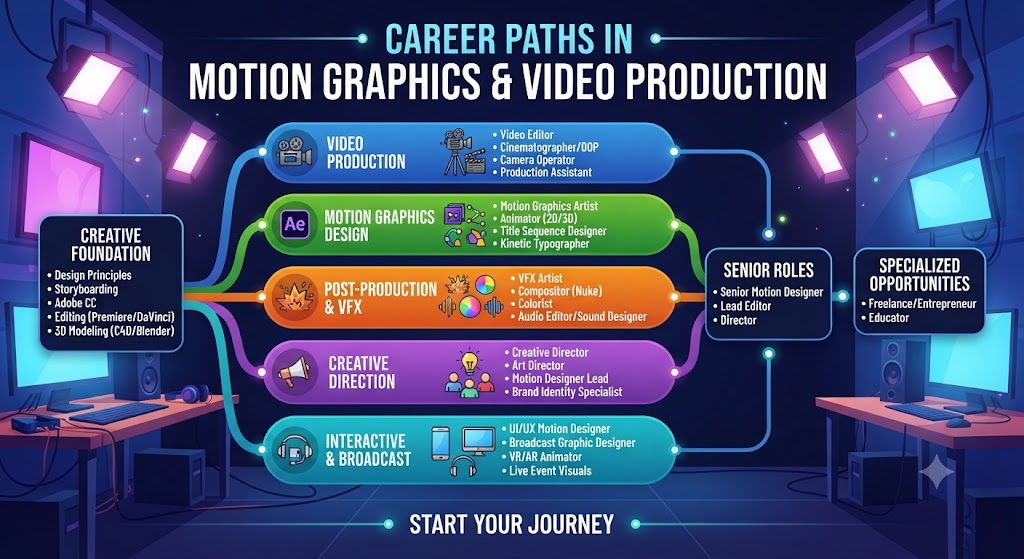
Career paths in motion graphics and video production are expanding as businesses, media companies, technology brands, advertising agencies, and content platforms increasingly rely on video to communicate with audiences. From animated social media content to product videos, advertisements, educational content, and film production, visual storytelling has become an important business skill.
Professionals entering this field can choose from several career directions. Some focus on animation and visual effects, while others specialize in editing, production, storytelling, or creative direction. In addition, remote work has created new opportunities for video professionals to collaborate with companies and clients across different locations.
Building a successful career requires more than learning editing software. Professionals need a strong portfolio, technical knowledge, storytelling ability, project management skills, and an understanding of current content requirements. With the right strategy, motion graphics and video production can provide opportunities for employment, contract work, remote careers, and long-term creative growth.
1. Understand Career Paths in Motion Graphics and Video Production
Motion graphics and video production cover a wide range of creative and technical responsibilities. Understanding these roles can help you choose a specialization based on your interests and strengths.
Common career options include:
- Motion Graphics Designer
- Video Editor
- 2D Animator
- 3D Animator
- Video Producer
- Visual Effects Artist
- Art Director
- Creative Director
- Post-Production Specialist
- Social Media Video Editor
- Content Producer
- Broadcast Designer
Motion graphics designers typically create animated text, graphics, transitions, visual effects, and branded content. Video editors focus on assembling footage, improving pacing, adding sound, and creating the final visual narrative.
Video producers often manage projects from planning through delivery. Their responsibilities may include coordinating creative teams, schedules, locations, budgets, and production requirements.
Because these roles overlap, learning the fundamentals of several areas can help you understand which specialization suits your career goals.
2. Build the Technical Skills Employers Expect
Technical skills are essential for professionals pursuing career paths in motion graphics and video production. However, you do not need to master every software platform before applying for your first role.
Start by learning the tools relevant to your chosen specialization.
Important areas include:
- Video editing
- Motion design
- 2D animation
- 3D fundamentals
- Color correction
- Audio editing
- Visual effects
- Typography
- Storyboarding
- File management
Professionals should also understand video formats, resolutions, frame rates, aspect ratios, compression, and export requirements.
For example, a social media video may need to be produced in a vertical format, while a corporate presentation may require a widescreen version. Understanding these technical requirements helps prevent production problems.
At the same time, storytelling should remain central. Good editing is not simply about adding transitions and effects. It is about presenting information clearly and keeping the viewer engaged.
Therefore, combine software skills with visual communication and storytelling.
3. Create a Portfolio That Attracts Employers
A strong portfolio is one of the most important assets for anyone pursuing career paths in motion graphics and video production.
Employers usually want to see what you can produce rather than only read about your software knowledge.
Your portfolio can include:
- Animated brand logos
- Social media videos
- Product animations
- Explainer videos
- Promotional advertisements
- Short-form video edits
- Title sequences
- 2D animations
- 3D experiments
- Corporate videos
- Visual effects projects
If you do not have professional experience, create realistic self-initiated projects.
For example, choose a fictional technology company and create a 20-second product animation. Develop the storyboard, visual style, animation, sound design, and final video.
You can also redesign an existing type of advertisement as a personal exercise without presenting it as official client work.
Keep your portfolio focused. Five to ten excellent projects can communicate your abilities more effectively than dozens of unfinished experiments.
For every project, explain your role and the skills involved. This helps recruiters understand whether you handled editing, animation, sound, visual design, or the entire production process.
4. Find Remote Opportunities in Video Production
Remote work has changed how many creative teams operate. Editors, motion designers, animators, and post-production professionals can often complete projects digitally without being physically present on location.
Remote opportunities can be found in:
- Advertising agencies
- Technology companies
- Marketing departments
- Media companies
- E-learning platforms
- Streaming businesses
- Gaming companies
- Social media teams
- Corporate communications departments
However, remote video production requires excellent organization.
Create a reliable workflow for receiving footage, managing project files, communicating revisions, and delivering final exports.
A practical remote workflow should include:
- Confirm the creative brief.
- Establish deadlines and milestones.
- Organize footage and project files.
- Share early drafts for feedback.
- Track revisions carefully.
- Export according to delivery requirements.
- Maintain backups of important projects.
Time-zone differences should also be considered when working with international teams. Establish communication windows that allow important decisions to be made without delaying production.
A global job platform such as best job tool can help professionals discover remote and international opportunities in creative and video-related roles.
5. Improve Productivity and Manage Creative Projects
Creative work can become time-consuming when projects lack structure. Motion graphics and video production often involve multiple revisions, large files, and detailed production requirements.
Productivity improves when you divide projects into clear stages.
A practical process is:
Planning: Understand the objective, audience, format, and deadline.
Pre-production: Create scripts, storyboards, mood boards, and asset lists.
Production: Record, design, animate, or assemble the required content.
Post-production: Edit footage, add motion graphics, improve audio, and complete color adjustments.
Review: Collect feedback and identify required revisions.
Delivery: Export the final files and verify quality before submission.
Avoid making major creative decisions only at the final stage. Early previews can reveal problems with pacing, design, or messaging before significant production time is spent.
You should also create reusable templates for common tasks. Organized project structures, presets, title animations, and frequently used assets can reduce repetitive work.
6. Test Travel and Location Flexibility
Video professionals who work remotely may eventually want to combine their careers with travel. However, travel can affect productivity, internet access, meeting schedules, and project delivery.
Before adopting long-term travel, test your working setup for several days or one week.
During the test, evaluate:
- Internet speed and stability
- Backup connectivity
- Workspace quality
- Electricity reliability
- Noise levels
- Time-zone differences
- File upload performance
- Meeting availability
- Daily productivity
Large video files can make connectivity especially important. A location that works well for ordinary office tasks may not be suitable for uploading or downloading production files.
You should also calculate travel costs before making decisions. Accommodation, transportation, coworking spaces, equipment insurance, and connectivity can increase monthly expenses.
The purpose of travel testing is to determine whether location flexibility genuinely supports your career rather than creating additional stress.
7. Plan Your Career Growth and Finances
Long-term career growth in motion graphics and video production requires continuous learning. Technology, platforms, visual trends, and production workflows change quickly.
Once you establish basic skills, consider developing expertise in a specific area.
Possible specializations include:
- Brand motion design
- 3D animation
- Product visualization
- Advertising
- Film and entertainment
- Educational video
- Social media content
- Visual effects
- Corporate communications
Specialization can help you become easier for employers to identify when they need a particular type of creative professional.
Financial planning is equally important. Creative careers may involve periods of changing income, particularly when professionals combine employment and contract work.
Maintain a budget covering:
- Living expenses
- Software subscriptions
- Computer and equipment upgrades
- Training
- Portfolio development
- Travel expenses
- Emergency savings
- Long-term investments
If you receive freelance or contract income in addition to a salary, allocate part of that income toward taxes, savings, and professional expenses instead of treating the entire amount as disposable income.
Over time, career growth can lead from junior creative positions to senior designer, lead animator, producer, art director, or creative director roles.
Conclusion
Career paths in motion graphics and video production offer opportunities for creative professionals across advertising, technology, media, education, entertainment, and corporate communications. The field includes roles such as motion graphics designer, video editor, animator, producer, visual effects artist, and creative director.
The best way to enter the industry is to develop practical technical skills while building a focused portfolio. Instead of trying to master every tool, choose a specialization and learn the software, storytelling techniques, and production processes that support it.
Remote work can expand your access to international opportunities, but successful remote production requires organized workflows, reliable communication, and strong file management. If you plan to combine remote work with travel, test your setup first and evaluate connectivity, productivity, time zones, and costs.
Finally, maintain a financial plan and continue developing specialized skills as the industry evolves. A combination of creative expertise, technical knowledge, professional organization, and career planning can help you build a sustainable future in motion graphics and video production.






Comments
Be the first to leave a comment.