

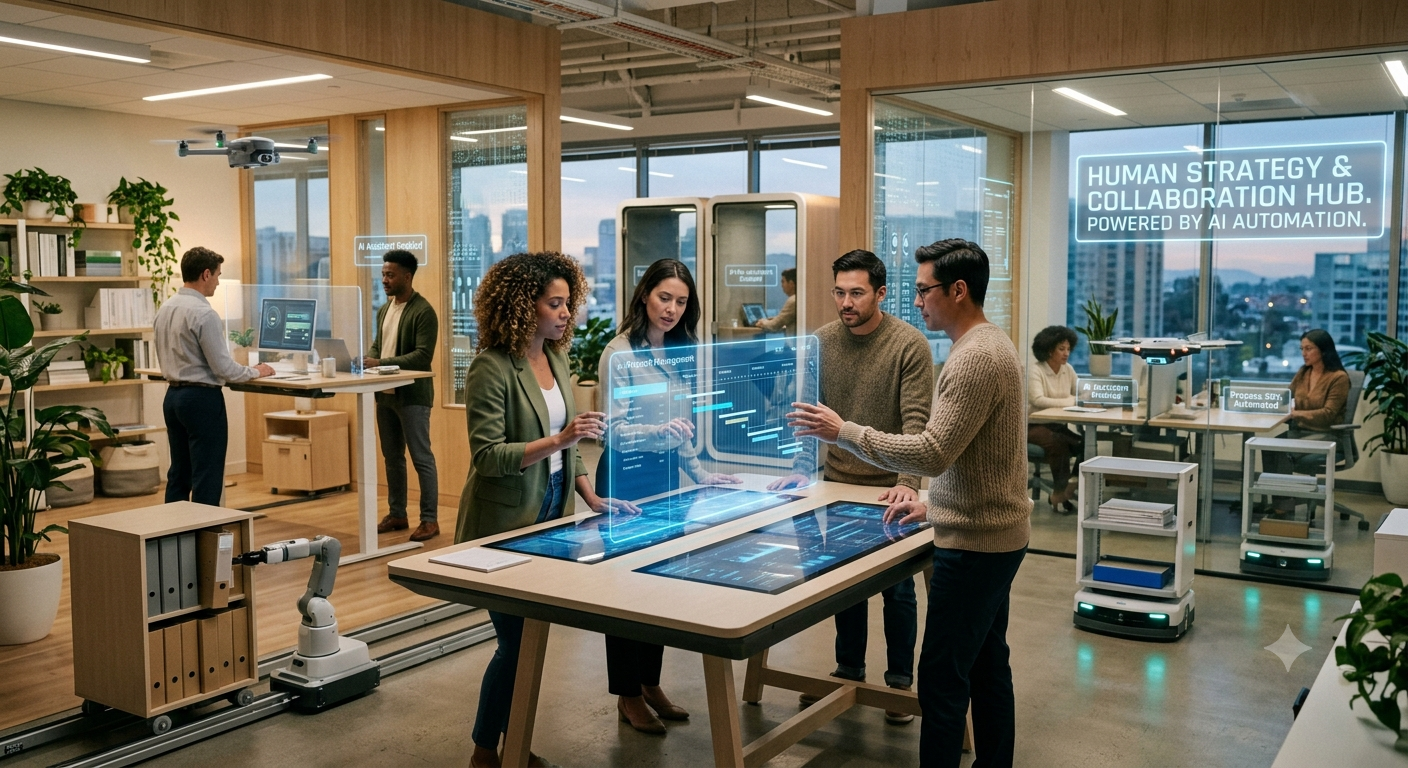
Introduction: AI handles 50 percent of tasks
Artificial Intelligence (AI) fundamentally transforms business operations, employee performance, and organizational management. AI automates routine tasks such as emails, data analysis, and customer interactions, helping businesses improve productivity. As AI handles 50 percent of tasks, employees and employers must adapt to new technologies and changing workplace responsibilities.
Although AI may change many jobs, it will also create new responsibilities requiring human skills. Understanding how work will change as AI handles more tasks is essential for businesses to prepare for the future. Understanding how work will change when AI handles 50 percent of tasks can help professionals prepare for future career opportunities.
What Work Will Look Like When AI Handles 50 Percent of Tasks?
1. Employees will do more thoughtful work
AI technologies can solve repetitive and monotonous problems, which allows humans to focus on more meaningful work. For example, AI summarizes reports and writes essays, while employees review the content and make decisions. In doing so, humans engage in higher-level tasks than scribes or analysts, which ultimately raises the quality of work performed. When AI handles 50 percent of tasks, employees can spend more time on strategic planning, creative thinking, and complex problem-solving.
Although AI automates routine tasks, humans remain in control. Companies should set clear goals, avoid overloading employees, and ensure workers have the skills to manage AI effectively.
2. Jobs will change
Regardless of the location, AI is expected to disrupt the labor market drastically, especially for clerical positions. The ability of AI to complete monotonous assignments will change almost every occupation, beginning from a recruiter’s job to medicine. For example, recruiters can utilize AI tools during the screening, organizing, and interviewing processes to save time while hiring. Similarly, marketers can employ artificial intelligence to study their target audience and come up with ideas for engagement.
AI can automate different tasks across industries, but humans remain essential for critical decisions. Businesses must address skill gaps and train employees to adapt to changing workplace demands.
3. There will be growing demand for AI skills
As businesses adopt AI to improve workflows, employees who know how to use these tools will have an advantage. Generating excellent prompts and learning how to evaluate what comes out of an AI tool can become a sought-after skill. Most AI-assisted jobs won’t require coding or advanced mathematics, but learning to use AI tools effectively will be valuable as AI handles 50 percent of tasks.
In short, everyone can make use of emerging technology. An employee can begin by identifying which tasks consume the most time and if AI can assist. Employees should understand how AI tools work and recognize the risks of using them. As long as there is a willingness to learn, the opportunities keep multiplying.
4. Human skills will become more valuable and sought after
While AI makes machines smarter, humans should not stop learning how to do what people are best at. For example, customer service centers routinely utilize chat bots for FAQs, but there are moments when a live agent needs to take over. When a dissatisfied client complains or raises a difficult query, it is a human being who has the right skills – emotional intelligence, empahtey, leadership, critical thinking, and so on. At the same time, when AI presents several options for a business plan, professionals must make decisions about what is right for a company.
Notably, collaboration and strong communication skills can become vital assets as human-AI teaming becomes increasingly widespread. Additionally, with AI-assisted work, a lot of other soft skills will become valuable, including effective communication and management abilities to interact with clients and coworkers alike. As mundane and mechanical tasks become automated, workplaces will be forced to invest in human skills.
5. Productivity will increase
In the workplace, efficiency drives profit and growth, which is why enterprises employ automation solutions to improve it. As businesses utilize artificial intelligence to augment the actions of employees, there will be a significant increase in organizational productivity. With that said, it is essential to bear in mind that simply employing AI tools does not guarantee such an outcome. Similar to any investment, AI-assisted work comes at a price.
For example, a finance team may employ an AI accountant to classify financial documents, detect suspicious transactions, and generate reports, which makes the accounting department twice as productive as it could be without the use of disruptive technologies. When programmers utilize AI code-reviewer and assistant, project completion rates multiply. As a result, businesses can work faster, which makes them more competitive while also providing a platform for employees to deliver value and become more productive. Small businesses in particular benefit from AI-assisted work since it levels the playing field.
6. Some jobs will go away, while others emerge
The prospect of AI doing half the work means that enterprises will have the capacity and time to invest in more meaningful activities while outsourcing the mundane and mechanical tasks to automation. The bottom line is that it is necessary to rethink job requirements across industries. While some occupations, including data entry clerks, will definitely disappear, there are others that will resurface, primarily in relation to the use of AI itself. Even when AI handles 50 percent of tasks, the impact on employment will depend on the nature of the work, industry requirements, and the demand for human skills.
For example, while there will be a lot of data entry clerks laid off, enterprises will have jobs for people who can manage and control the accuracy of AI-powered tools. This trend shows that a lot will depend on how soon businesses adopt AI-assisted technologies, how much automation is implemented, and whether jobs will be created or eliminated in due course.
It is also important to remember that jobs are a function of tasks. A single post usually involves many activities and processes. Hence, 50% automation does not mean 50% downsizing. Overall, if the right skills are developed at the right time, there will be enough work opportunity. However, if certain industries take longer to restructure, certain occupations will become redundant.
7. Collaboration will become key
In the workplace of the future, it is possible that employees will team up with AI. This means that for particularly difficult and time-consuming tasks, an employee will delegate a few problems to a computer to solve. Once an AI-platform completes its routine, a working person goes over the instructions and executes the solution. Such an approach saves time and is more efficient than having an AI-trainer review reports, contracts, articles, and so on on a daily basis.
At the moment, this approach does not work due to legal and data privacy issues in a corporate setting. However, the prospect of AI-assisted work makes it clear that collaboration will be the new normal.
As such, there should be appropriate policies that regulate what employees can and cannot do with AI at the workplace. Moreover, it is also necessary to establish rules about what data may be used in what ways, including the safety and accuracy of employing artificial intelligence in work. The key advantage of such an approach is that tasks are divided between humans and machines, allowing enterprises to get the best of both worlds.
8. There will be a greater demand for employee training
The fact is that simply buying a few tools and expecting them to do all the work will not be enough in the workplace. Companies need to invest in employee training to understand how such technologies work, how they can assist in specific occupations, and what skills would need to be acquired in the future.
An enterprise must ensure that employees are not only able to use particular AI tools but also understand the underlying concepts. The question of who is responsible for what, and who can use artificial intelligence is one that employers can address by educating their staff. The workforce also needs to see the value in such technologies.
By investing in employee training, companies can make employees aware of not just the advantages but also the disadvantages of utilizing AI. Such an approach would ensure that workers are ready for the transition, which eliminates the fear of losing a job. Moreover, by using such an approach, enterprises obtain professional and knowledgeable employees in whatever industry they are in.
9. The risks are enormous, but the rewards are huge
Any increase in efficiency, especially such as achieving by implementing AI-assisted work at the workplace, is accompanied by an issue with ethics and integrity if not controlled. In particular, AI can present biased data, and false information about people, making it inappropriate for use in sensitive areas. Simply put, the danger presented by the use of these tools is enormous, and the question is whether there will be proper control and moderation of such technologies.
For these reasons, businesses need to ensure that appropriate measures are taken when introducing artificial intelligence into the workplace environment. When it comes to the ethics of using such technologies, human moderation remains of paramount importance, especially in sensitive areas, including recruitment screening and testing of candidates, working with customers, employee and workforce management, and so on.
In the end, moderation and regulation are key considerations while adopting AI for work purposes. If a firm wants to enjoy the benefits of an improved skill gap without harming its workforce, such aspects need to be considered carefully.
Conclusion: AI handles 50 percent of tasks
The future of work with artificial intelligence handling 50 percent of the tasks is likely to see a significant change in the way people perform their duties.The future of work with artificial intelligence handling 50 percent of the tasks is likely to see a significant change in the way people perform their duties. In my opinion, humans would continue to play a critical role in the workplace by engaging in more creative tasks, managerial roles, interpersonal skills, and other cognitively complex activities.
In my opinion, humans would continue to play a critical role in the workplace by engaging in more creative tasks, managerial roles, interpersonal skills, and other cognitively complex activities.
While there are likely to be fewer jobs in specific fields and the rise of new professions in others, I believe companies must strategize on how to reorient their workforce and embrace AI technologies to remain competitive. The focus should be on ensuring humans do not do away with their efforts where robotics can take over. However, the focus should be on leveraging technology to enhance their performance and ensure they have the necessary skill set to meet the changing landscape.
Ready to adapt to the future of work? Use the best job tools to improve your productivity, develop in-demand skills, and stay competitive in an AI-driven workplace.






Comments
Be the first to leave a comment.