

Introduction: Risk Management and Credit Analytics
The finance world provides numerous opportunities for qualified professionals. Apart from traditional areas like accounting, investment banking, and financial planning, one can choose between relatively new but promising spheres such as Risk Management and Credit Analytics. These disciplines allow one to work in various industries, understand financial matters, and be a part of the business decision-making process.
Career paths in risk management and credit analytics can be different for graduates with various qualifications and degrees, experience, and interests. Although the areas are closely related, one should understand their main differences and challenges.
Career Paths in Risk Management and Credit Analytics
1. Risk Management Overview
Essentially, Risk Management involves mitigating any adverse financial outcome and is highly relevant to the work of banks, insurance companies, investment firms, fintech, big business, and other organizations. In general, this discipline studies financial risks, develops risk management strategies, and helps businesses navigate the uncertainties of the business world. Risk Management is a broad term, which encompasses different types of risk: credit, market, operational, liquidity, and financial risk.
A risk management professional generally has to identify potential issues in a business, analyze them, and come up with solutions. For example, a bank may be concerned about the default risk, and a risk analyst has to calculate the probability of this outcome. To do so, he/she may study customer data, economic trends, repayment behavior, and other relevant factors.
To work in this area, one typically needs at least a bachelor’s degree in finance, economics, math, statistics, accounting, or business administration. Although academic knowledge is important, practical skills are even more valued in this field. Therefore, one should also be proficient in Excel, financial analysis, statistics, and data visualization. In addition, it may be helpful to learn more about financial statements, corporate finance, and risk management basics.
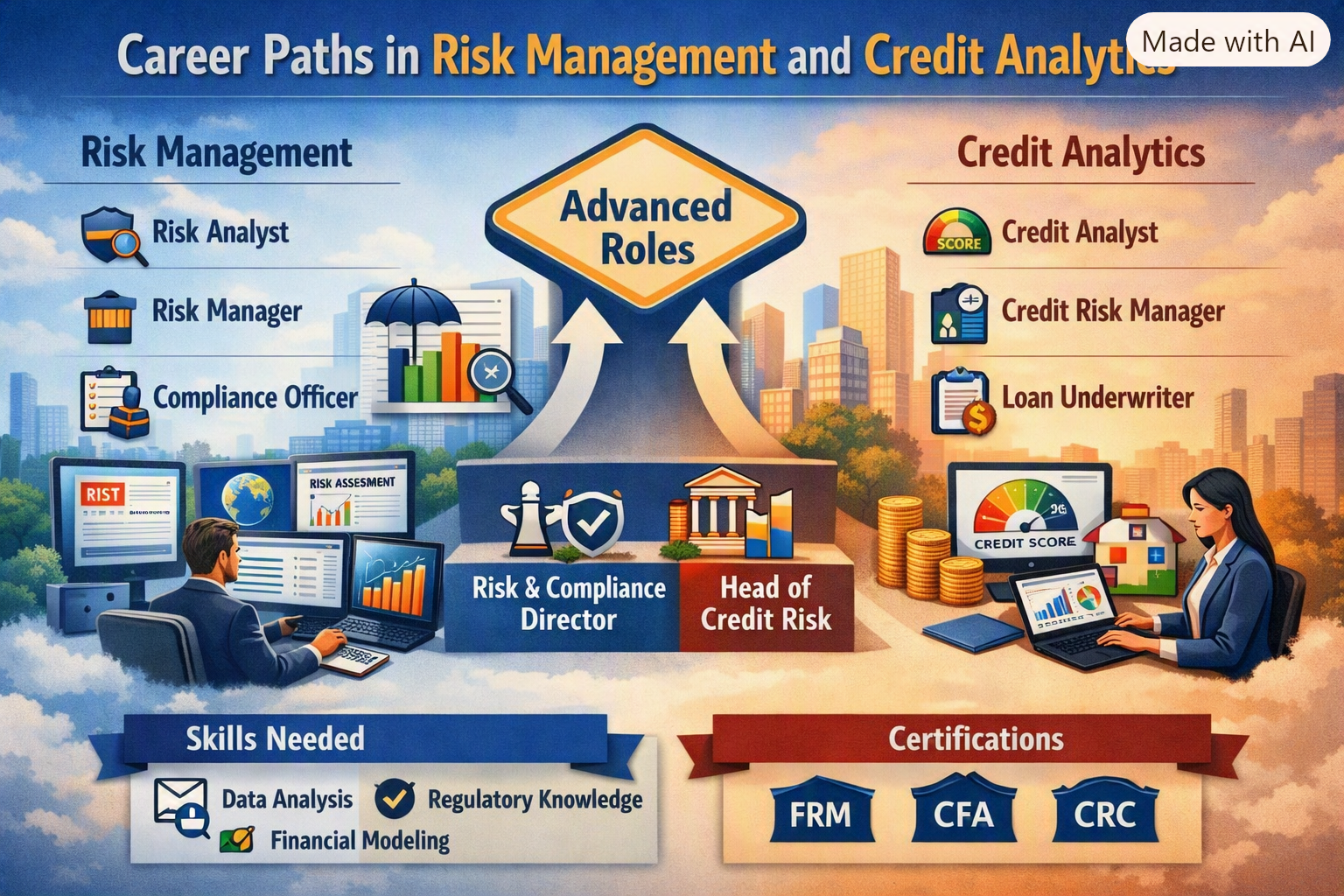
In general, a risk analyst’s job is often the entry-level position, and one can climb up the career ladder fairly quickly. With a decent amount of experience, one can become a senior risk analyst or move on to other roles, such as risk manager, enterprise risk manager, or risk consultant.
2. Credit Analytics Overview
Credit analysts, in turn, specialize in determining a borrower’s ability to repay a loan. This is a critical function for banks, financial institutions, fintech companies, and other organizations that offer credit to customers. Credit analysts work with personal and business loans, mortgages, credit cards, and other debt instruments. They review borrowers’ income, financial statements, bill payment history, credit scores, and other factors to determine their creditworthiness.
To do so, a credit analyst has to conduct a financial assessment and provide recommendations based on their findings. For example, a company may apply for a business loan, and a credit analyst has to go over the firm’s financials to see if it is a good candidate for a loan.
A credit analyst’s job is typically entry-level as well, and one can climb up the career ladder fairly quickly. Entry-level positions may also include a loan analyst, underwriting analyst, or credit risk analyst. With a decent amount of experience, one can move on to more advanced positions, such as senior credit analyst, portfolio management, credit risk manager, or specialized areas, such as data analytics. In particular, credit analysts who want to move into data science have to learn statistics, SQL, Python, and machine learning to work with large sets of data.
In general, Credit Analytics is a great choice for a finance-related career because it combines financial risk assessment with cutting-edge data science techniques. The demand for professionals who know both financial statements and Excel is growing daily, especially with the advent of disruptive fintech innovations. In particular, many financial institutions are now using big data to make better lending decisions, which makes data analytics vital for the modern financial industry.
3. Skills
In general, both areas require strong analytical skills, but a credit analyst has to be a financial expert, understand financial statements, and be fluent in risk assessment terminology. However, the job of a credit analyst is not just number crunching; he/she also has to be able to explain the findings in simple terms to people without financial expertise. Therefore, good communication skills are also vital in this field.
Key skills for Credit Analytics and Risk Management professionals broadly include:
- Financial analysis
- Excel
- Data interpretation
- Statistics
- Risk assessment
- Financial statements analysis
- Communication
- Problem-solving
- Detail-oriented
- Coding (for data analytics roles)
Similarly, risk management analysts have to be good at financial analysis, Excel, data interpretation, and statistics. In addition, they normally have to deal with probabilities and risk-related factors, so proficiency in risk assessment is also beneficial for this career path.
Finally, one should always strive to improve one’s soft skills, such as presentation skills, to be able to explain one’s findings to business partners, shareholders, colleagues, etc. Essentially, good communication is vital in most fields, including finance.
4. Certifications and Education
Apart from basic degrees, one may also consider getting additional certifications to advance their career. In particular, there are a number of finance-related specializations, such as credit risk, financial risk management, financial modeling, credit analyst, financial analyst, data analytics, and others. These credentials may take time but are worth considering since they open more opportunities and make one stand out in the job market.
Although many credit analysts and risk management professionals get their degrees at the master’s level, a bachelor’s degree is sufficient for entry-level positions. However, if one wants to climb up the career ladder, a master’s degree in finance, economics, or business administration may be beneficial.
5. Senior-Level Positions
In general, senior roles normally require years of experience, and a professional has to demonstrate their leadership skills, risk management expertise, and industry knowledge. For example, senior risk managers, portfolio managers, and credit officers typically hold specialized positions and have to understand complex financial instruments.
Many professionals also switch from financial institutions to consulting, fintech, or insurance companies. Alternatively, one may switch from big corporations to government agencies or financial regulators. In general, a career in credit analytics and risk management is fairly flexible, and one can move between industries, roles, and even career tracks.
Finally, it is always a good idea to leverage one’s network and try to get internship opportunities or work in the chosen field. In particular, working on financial projects and building a portfolio may be beneficial for landing a job, especially in data analytics and data science fields. For example, one may design a credit-risk model, analyze publicly-traded companies’ credit scores, and write down their findings.
Therefore, Risk Management and Credit Analytics offer exciting opportunities for motivated professionals. Although both areas have different aspects, they generally involve working with numbers, financial statements, risk, and uncertainty. In general, the best way to start a career in credit analytics or risk management is to learn financial basics, get good at Excel, and improve one’s data science skills. This way, one will be able to work in high-level finance and contribute to business decision-making processes in various industries.
Conclusion: Risk Management and Credit Analytics
Risk management and credit analytics offer strong career opportunities for professionals interested in finance, data analysis, and decision-making. While risk management focuses on identifying and controlling financial and operational risks, credit analytics involves assessing borrowers and evaluating creditworthiness. Both fields require analytical thinking, financial knowledge, and attention to detail.






Comments
Be the first to leave a comment.