

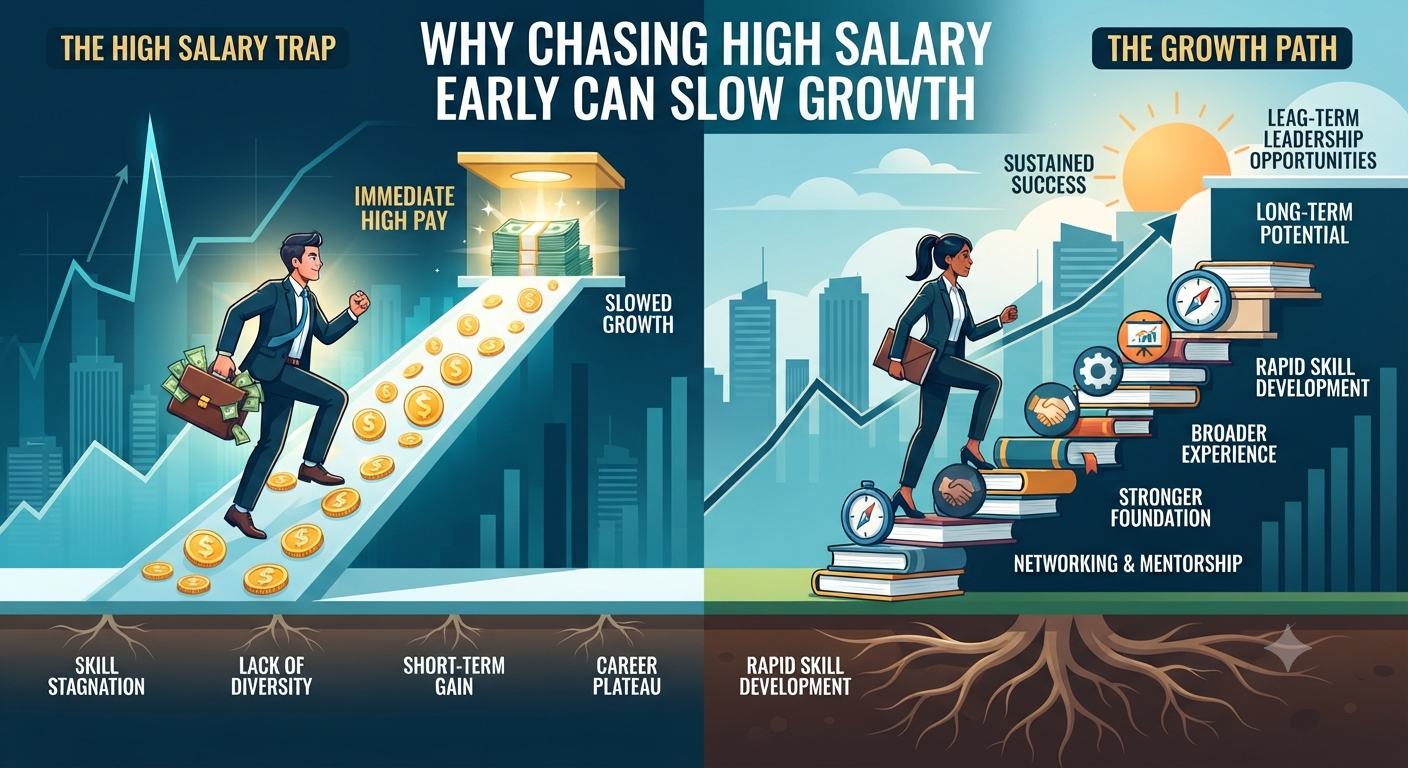
Starting a career often comes with pressure to earn more as quickly as possible. A higher salary can feel like proof of success, especially when professionals compare offers, job titles, and career progress on social media. However, maximizing salary too early can sometimes lead to decisions that limit long-term development.
Early career choices should build more than income. They should also develop skills, industry knowledge, professional relationships, decision-making ability, and opportunities for advancement. Therefore, a role with a slightly lower salary may sometimes provide greater long-term value than a higher-paying position with limited learning.
This does not mean salary is unimportant. Financial stability matters, and professionals should understand their market value. However, compensation should be evaluated alongside career growth, responsibilities, mentorship, flexibility, and future opportunities.
Understand the Difference Between Salary and Career Value
Salary is one measurable part of a job. Career value is much broader.
A position can pay well while offering limited exposure to meaningful projects. In contrast, another role may offer stronger training, greater responsibility, and access to experienced professionals while paying somewhat less initially.
For example, a junior professional might choose between two positions:
- Role A offers a higher starting salary but repetitive responsibilities.
- Role B offers slightly lower pay but exposure to clients, analytics, project management, and senior leadership.
- After several years, the second professional may have developed a broader skill set and stronger professional profile.
Therefore, early-career decisions should consider what the role can teach you, not only what it pays today.
A useful career-value checklist includes:
- Skill development
- Quality of mentorship
- Responsibility
- Industry exposure
- Leadership opportunities
- Professional network
- Internal mobility
- Flexibility
- Long-term earning potential
The best job tool is one that helps professionals evaluate opportunities based on the complete career picture rather than salary alone.
High Salary Can Create a Career Comfort Zone
A significant salary increase can make it harder to leave a role that no longer supports professional growth.
Once expenses increase, professionals may become dependent on a particular income level. As a result, they may avoid opportunities that offer stronger learning but temporarily lower compensation.
This can create a career comfort zone.
For instance, someone earning well in a narrow operational role may hesitate to move into a strategic position that requires starting at a similar or slightly lower level. Meanwhile, another professional who prioritized skill development may eventually qualify for roles with greater responsibility and earning potential.
This does not mean professionals should accept poor compensation indefinitely. Instead, the goal is to avoid allowing short-term income to become the only factor controlling career decisions.
A practical approach is to ask:
“If I stay in this role for two or three years, what will I be able to do that I cannot do today?”
If the answer is unclear, the salary increase may not compensate for the lack of development.
Prioritize Skills That Increase Future Earning Power
Early in a career, skills can have a compounding effect.
A professional who develops valuable technical, commercial, analytical, communication, or leadership capabilities can become qualified for increasingly complex roles. Consequently, future salary opportunities may improve because the individual’s professional value has increased.
Focus on skills such as:
- Data analysis and business intelligence
- Project and program management
- Client relationship management
- Financial understanding
- Negotiation
- Sales and business development
- Technical expertise
- Strategic communication
- Leadership
- Industry-specific knowledge
However, skill development should be connected to actual workplace outcomes.
Instead of simply collecting certificates, look for opportunities to apply knowledge to real projects. For example, learning data analytics becomes more valuable when you can use it to improve reporting, identify trends, or support business decisions.
Similarly, learning project management becomes stronger when you have actually coordinated timelines, stakeholders, budgets, or deliverables.
Evaluate What You Are Learning From Your Manager and Team
Your manager can significantly influence early career development.
A strong manager may provide feedback, assign challenging projects, explain business decisions, and help you understand how your work contributes to organizational goals. Therefore, the quality of the team should be part of your job evaluation.
Before accepting a role, consider:
- Who will manage me?
- How frequently will I receive feedback?
- Will I work with experienced professionals?
- Will I have access to cross-functional projects?
- Can I ask questions and learn from senior colleagues?
- Is there a clear path to greater responsibility?
Mentorship is particularly valuable when you are still building professional judgment.
Furthermore, working alongside experienced colleagues can expose you to situations that cannot be learned from courses alone. You may observe how professionals handle difficult clients, negotiate priorities, solve problems, manage budgets, and communicate with executives.
That experience can become valuable career capital.
Consider Exposure, Not Just Job Titles
A prestigious title does not always create strong career development.
Similarly, a modest title does not necessarily indicate limited potential.
What matters is the scope of work behind the title.
A professional with a junior title who manages important projects, works with customers, analyzes business performance, or collaborates across departments may develop stronger capabilities than someone with a more impressive title performing highly repetitive work.
Therefore, evaluate the responsibilities carefully.
Look for roles that provide exposure to:
- Customers and stakeholders
- Business decisions
- Revenue or cost management
- Technology
- Operations
- Strategy
- Cross-functional collaboration
- International teams
- Problem-solving
- Measurable business outcomes
This exposure becomes particularly useful when preparing for future promotions or career transitions.
Additionally, professionals working remotely should pay attention to visibility. Remote work can provide flexibility, but it is important to remain involved in meaningful projects, document achievements, and communicate progress clearly.
Build Financial Stability Without Making Money the Only Goal
Prioritizing career growth does not mean ignoring personal finances.
In fact, financial planning can give professionals greater freedom to make better career decisions.
If your monthly expenses are too high, you may feel forced to accept every high-paying opportunity, even when it does not support your long-term goals. Conversely, maintaining reasonable expenses and building savings can provide flexibility.
A practical early-career financial system can include:
- Creating an emergency fund
- Tracking monthly expenses
- Avoiding unnecessary lifestyle inflation
- Saving a percentage of every salary increase
- Separating short-term spending from long-term goals
- Planning for major travel or relocation expenses
- Reviewing compensation annually
Travel and relocation decisions also deserve consideration. A job that requires frequent travel may provide valuable client or international exposure, but travel costs, workload, and personal priorities should be evaluated realistically.
Likewise, a remote or hybrid position may reduce commuting costs and provide additional flexibility. However, the professional development opportunities should still be examined carefully.
The goal is not to choose the lowest salary. Instead, build enough financial stability that salary is one factor among several rather than the only factor.
Know When Salary Should Become a Bigger Priority
There is a point when compensation should receive greater attention.
As professionals gain experience, their skills, responsibilities, and market value should generally be reflected in their compensation. Staying in a low-paying role purely for “experience” can eventually become counterproductive.
Salary should become a stronger consideration when:
- Your responsibilities have increased substantially.
- Your skills are clearly above the requirements of your current position.
- Your compensation is significantly below comparable opportunities.
- You have stopped learning.
- Promotions are unavailable.
- Your contributions are not being recognized.
- You have developed skills that are valuable elsewhere.
At this stage, changing companies can be a reasonable career strategy.
However, the strongest move is usually one where increased compensation and increased responsibility work together. A higher salary becomes more sustainable when it is supported by stronger capabilities and measurable achievements.
Professionals can use a global job platform such as the best job tool to research different roles, compare opportunities, and identify positions that combine career development with competitive compensation.
Conclusion
Chasing a high salary early in your career is not inherently wrong. Compensation matters, and professionals should not undervalue their work. However, making salary the primary measure of career success can create problems when it causes you to overlook skills, mentorship, responsibility, and long-term opportunities.
Early career years are an important period for building professional capital. Therefore, choose roles that help you become more capable, adaptable, and valuable over time.
A strong career strategy balances income with learning. Build skills, take meaningful responsibilities, develop professional relationships, manage your finances carefully, and track your market value.
Over time, the combination of stronger skills and better experience can create opportunities for higher compensation without sacrificing career development.
The best job tool can help you discover opportunities, but your long-term growth depends on choosing roles that expand what you are capable of doing






Comments
Be the first to leave a comment.