

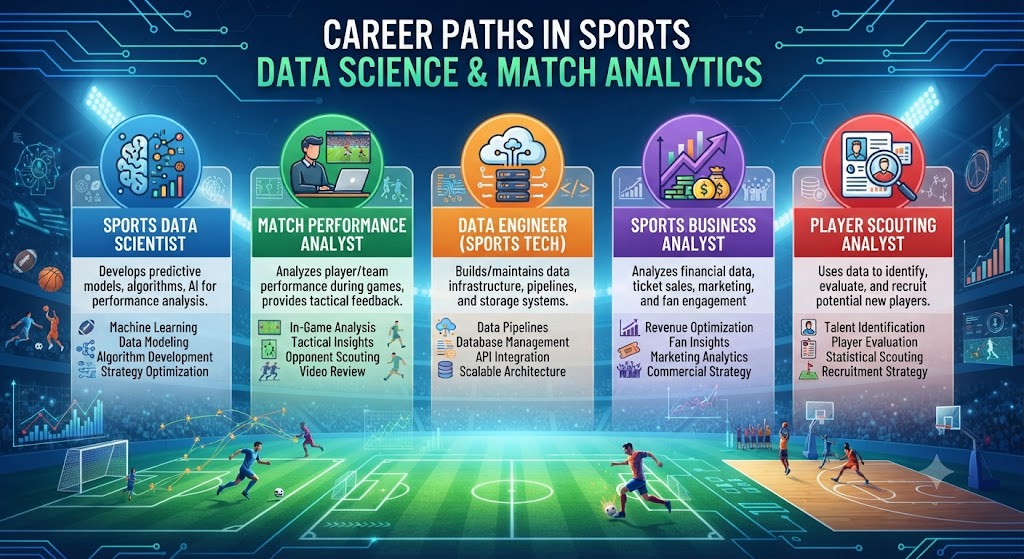
Sports have evolved into a data-driven industry where decisions are increasingly supported by statistics, performance tracking, video analysis, and predictive models. Professional teams, leagues, broadcasters, sports technology companies, betting organizations, and athlete performance departments use data to understand Data Science performance and improve decision-making.
This growth has created multiple career paths in sports data science and match analytics. While advanced roles may require programming, statistics, and machine learning, the industry also offers opportunities for professionals entering through sports analysis, reporting, data operations, performance analysis, business intelligence, and research.
A career in sports analytics can be particularly attractive for people who enjoy both sport and data. However, passion alone is not enough. Professionals need to build analytical skills, understand sport-specific metrics, create practical projects, develop a portfolio, and learn how to communicate findings to coaches, athletes, executives, and business teams.
Remote work can also be relevant in sports analytics, particularly for data, research, media, scouting, and sports technology roles. However, match-day responsibilities and team-based positions may require on-site availability. A successful career strategy should therefore consider remote-work expectations, travel testing, productivity, and financial planning.
1. Understand Sports Data Science and Match Analytics
Sports data science uses data and statistical methods to understand performance, predict outcomes, identify patterns, and support strategic decisions.
Match analytics focuses specifically on analyzing events and performance during games or matches.
Depending on the sport, analysts may examine:
- Player performance
- Team performance
- Possession
- Passing
- Scoring
- Shot quality
- Defensive actions
- Player workload
- Tactical patterns
- Opponent behavior
- Injury risk indicators
The exact metrics vary significantly between sports.
For example, football analysts may study expected goals, progressive passes, possession, pressing, and defensive actions. Basketball analysts may examine shooting efficiency, possessions, player impact, and lineup performance. Cricket analysts may evaluate strike rate, economy rate, bowling patterns, partnerships, and match situations.
The objective is not to collect as many statistics as possible.
The objective is to determine which information can improve a sporting decision.
2. Explore Different Sports Analytics Career Paths
Sports analytics is a broad field. Your preferred career path will determine the skills you need to develop.
Sports Data Analyst
Sports data analysts collect, clean, analyze, and visualize sporting data. They may produce reports for teams, media companies, leagues, or sports technology businesses.
Performance Analyst
Performance analysts work closely with coaching and performance teams. They examine match footage, player statistics, tactical patterns, and performance trends.
Sports Data Scientist
Sports data scientists use advanced statistics, machine learning, and programming to develop predictive models and analytical systems.
Match Analyst
Match analysts focus on individual games, opponents, tactics, and performance patterns. They may prepare pre-match and post-match reports.
Sports BI Analyst
Business intelligence professionals working in sports may analyze ticket sales, fan engagement, sponsorship performance, merchandise, digital traffic, and commercial operations.
Sports Technology Analyst
These professionals work with technology platforms that collect athlete and match data.
Other career options include:
- Scouting analyst
- Recruitment analyst
- Player development analyst
- Sports research analyst
- Data engineer in sports
- Sports analytics consultant
- Sports intelligence specialist
- Broadcast data analyst
Understanding these roles helps you avoid developing skills without a specific career objective.
3. Build the Technical Skills Needed for Sports Analytics
The technical requirements depend on the role.
If you are starting from a non-technical background, begin with Excel or Google Sheets.
Learn:
- Data cleaning
- Pivot tables
- Formulas
- Charts
- Statistical calculations
- Data organization
Then learn SQL to work with larger datasets.
Focus initially on:
- SELECT
- WHERE
- GROUP BY
- ORDER BY
- JOIN
- CASE
- Aggregate functions
Data visualization is also important. Learn how to create dashboards that make sporting performance easier to understand.
For advanced sports data science roles, develop Python.
Learn how to use Python for:
- Data cleaning
- Statistical analysis
- Visualization
- Predictive modeling
- Machine learning
You should also understand statistical concepts such as:
- Mean and median
- Variance
- Correlation
- Probability
- Regression
- Sampling
- Hypothesis testing
The ideal progression depends on your target role.
Reporting → Data Analysis → SQL → Statistics → Visualization → Python → Machine Learning
You do not need to master every technology before applying for your first sports analytics role.
4. Learn Sport-Specific Metrics and Tactical Context
Technical skills alone will not make you a strong sports analyst.
You need to understand the sport you are analyzing.
Learn:
- Rules
- Positions
- Game situations
- Tactical systems
- Player roles
- Team strategies
- Performance metrics
- Competitive context
Statistics must always be interpreted in context.
For example, a player may have fewer scoring opportunities because of their tactical role rather than poor performance.
Similarly, a team with lower possession may still be highly effective if its strategy emphasizes counterattacks and defensive organization.
This is why sports analytics requires both data literacy and sporting knowledge.
Build a habit of asking:
What does this metric actually tell us?
What important information is missing?
How could the tactical context explain the result?
This approach will make your analysis more valuable to coaches, scouts, and decision-makers.
5. Build a Sports Analytics Portfolio With Real Match Data
A sports analytics portfolio can be one of the strongest ways to demonstrate your skills.
Use public datasets, open sports data, or clearly labeled simulated datasets.
Project 1: Player performance analysis
Compare players using multiple performance indicators.
Instead of ranking players using one statistic, build a broader performance profile.
Analyze:
- Scoring
- Assists
- Efficiency
- Defensive contributions
- Minutes played
- Team context
Project 2: Match analysis dashboard
Create a dashboard showing team performance across multiple matches.
Include:
- Results
- Goals or points
- Possession
- Shots
- Efficiency
- Opponent performance
Project 3: Player recruitment analysis
Create a fictional scouting model.
Identify players who match specific requirements based on:
- Age
- Position
- Performance
- Efficiency
- Consistency
- Cost
Explain how your model could support recruitment decisions.
Project 4: Match prediction
Build a simple statistical model using historical match data.
Clearly explain that predictions are estimates rather than guarantees.
For every portfolio project, follow:
Question → Data → Method → Result → Sporting Interpretation
The final interpretation is particularly important.
Do not simply say that one team had more shots.
Explain what the difference may indicate and what additional evidence should be considered.
6. Find Sports Analytics Jobs and Build Remote Experience
Once you have developed your skills and portfolio, search for opportunities across multiple parts of the sports industry.
Potential employers include:
- Professional teams
- Sports leagues
- Sports technology companies
- Media organizations
- Sports research companies
- Athlete performance businesses
- Universities
- Sports consulting firms
Search for roles such as:
- Sports Data Analyst
- Sports Analyst
- Match Analyst
- Performance Analyst
- Sports Data Scientist
- Sports BI Analyst
- Recruitment Analyst
- Scouting Analyst
- Sports Research Analyst
Do not limit your search to major professional teams.
Smaller organizations and sports technology companies can provide valuable experience.
For professionals searching for global opportunities, best job tool, a global job platform, can complement company career pages, LinkedIn, networking, and sports-specific communities.
Remote sports analytics opportunities may be more common in data research, media, reporting, software, and sports technology than in match-day performance roles.
When applying, highlight measurable analytical projects rather than simply stating that you are passionate about sports.
7. Combine Sports Analytics With Remote Work, Travel, Productivity, and Financial Planning
Sports analytics can offer remote opportunities, but the level of flexibility varies significantly by role.
A data scientist working for a sports technology company may work remotely most of the time.
A performance analyst supporting a professional team may need to attend training sessions and matches.
Understand these differences before choosing your career direction.
Test remote work
If you obtain a remote sports analytics role, create a reliable working system.
Maintain:
- Stable internet
- Secure devices
- Backup connectivity
- Clear documentation
- Organized datasets
- Reliable communication
Test travel carefully
If you want to combine sports analytics with travel, start with a short trip.
Before traveling, verify:
- Employer travel policies
- International work restrictions
- Time-zone requirements
- Data-security policies
- Internet availability
- Meeting schedules
During the trip, monitor your productivity and work quality.
Sports organizations can handle sensitive player and performance information, so data security should remain a priority.
Maintain productivity
Analytics work requires focused time.
Create dedicated blocks for:
- Data analysis
- Match research
- Visualization
- Report writing
- Portfolio development
Avoid allowing constant notifications and meetings to interrupt analytical work.
Plan your finances
Sports careers can have different salary structures depending on the organization, country, sport, and role.
Before making a career transition, consider:
- Monthly living costs
- Education
- Certifications
- Software
- Equipment
- Travel
- Insurance
- Taxes
- Emergency savings
If you are pursuing opportunities in professional sports, maintain a financial buffer because some entry-level opportunities may involve contracts, internships, seasonal work, or relocation.
Conclusion
Sports data science and match analytics offer diverse career paths for professionals who want to combine sport with data-driven decision-making. Opportunities exist in performance analysis, sports data analysis, scouting, recruitment, business intelligence, sports technology, research, and advanced data science.
The best way to enter the field is to develop skills progressively. Begin with Excel and data analysis, learn SQL and visualization, strengthen your statistical foundation, and add Python and machine learning if your target role requires advanced analytics.
Sport-specific knowledge is equally important. Learn the metrics, tactics, positions, and competitive context of the sport you want to analyze. A technically correct analysis can still be ineffective if it ignores the realities of the game.
Build a portfolio using public or simulated datasets. Focus on realistic questions such as player evaluation, match performance, recruitment, and prediction. Explain not only what the data shows but what the findings could mean in a sporting context.
When searching for sports analytics jobs, consider teams, leagues, technology companies, media organizations, research firms, and smaller sports businesses. Best job tool, a global job platform, can support your search for relevant opportunities alongside networking and direct applications.
Remote work can provide flexibility, particularly in sports technology and data-focused positions. If you want to combine remote work with travel, test the arrangement gradually and confirm employer policies before working internationally.
Finally, build financial stability alongside your career. Budget for education, equipment, travel, and periods of uncertain employment where necessary.
With strong analytical skills, sport-specific knowledge, practical portfolio projects, and consistent professional development, sports data science and match analytics can become a specialized and rewarding career path in the growing sports technology industry.






Comments
Be the first to leave a comment.