

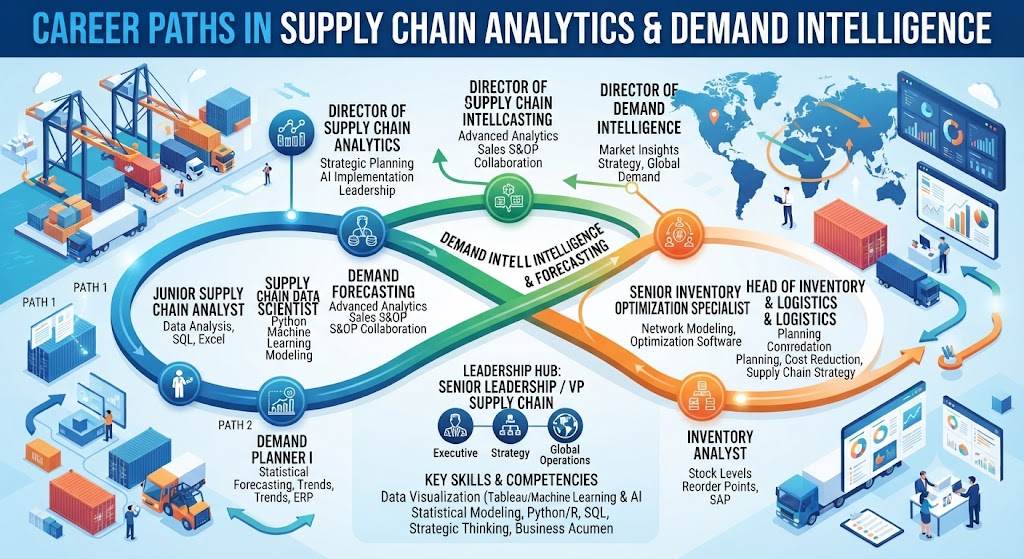
Supply chains have become increasingly data-driven. Companies now depend on accurate forecasts, inventory visibility, supplier performance data, transportation insights, and customer demand signals to make better operational decisions. As a result, supply chain analytics and demand intelligence have emerged as valuable career areas for professionals who can connect data with business decisions.
These careers are not limited to traditional supply chain professionals. People with backgrounds in business analysis, finance, operations, statistics, procurement, logistics, marketing, and business intelligence can transition into the field by developing relevant analytical skills.
For professionals interested in remote work, international opportunities, productivity, travel testing, and long-term financial planning, supply chain analytics can also provide a practical career path. Many analytical responsibilities can be performed digitally, although some roles still require collaboration with warehouses, suppliers, manufacturing facilities, or distribution teams.
1. Understanding Supply Chain Analytics and Demand Intelligence
Supply chain analytics involves collecting and analyzing operational data to improve how products, materials, information, and resources move through a business.
Demand intelligence focuses more specifically on understanding current and future customer demand. It combines historical sales data with market trends, customer behavior, seasonality, promotions, economic conditions, and other relevant signals.
Professionals may analyze:
- Inventory levels and turnover
- Sales forecasts
- Supplier performance
- Procurement costs
- Transportation efficiency
- Warehouse operations
- Order fulfillment
- Product demand
- Stockout rates
- Lead times
- Customer purchasing patterns
The objective is straightforward: help organizations make better decisions before problems become expensive.
For example, if analytics indicates that demand for a product is likely to increase significantly during a particular season, the supply chain team can adjust purchasing, inventory, transportation, and staffing plans accordingly.
This makes analytical professionals important contributors to both cost control and customer satisfaction.
2. Career Paths in Supply Chain Analytics
Supply chain analytics offers several career paths, allowing professionals to specialize according to their interests and strengths.
Supply Chain Data Analyst
A supply chain data analyst works with operational datasets to identify inefficiencies and trends. Typical responsibilities include creating reports, analyzing inventory data, monitoring KPIs, and supporting management decisions.
This is often one of the most accessible entry-level positions for people moving from general data analysis into supply chain.
Demand Analyst
Demand analysts study historical sales and market information to estimate future demand. They work closely with sales, marketing, finance, procurement, and operations teams.
Strong forecasting skills and an understanding of customer behavior are particularly valuable.
Demand Planner
Demand planners have a more strategic role in forecasting future product requirements. They may participate in planning meetings and collaborate with commercial teams to adjust forecasts based on promotions, market changes, and business objectives.
Supply Chain Analyst
Supply chain analysts examine broader operational performance, including inventory, transportation, procurement, and supplier metrics.
Inventory Analyst
Inventory analysts focus on maintaining the right stock levels. Their work helps businesses avoid both excess inventory and costly stockouts.
Supply Chain Business Intelligence Analyst
Professionals in this role combine supply chain knowledge with BI tools to create dashboards and analytical systems for decision-makers.
With experience, professionals can progress toward roles such as Supply Chain Analytics Manager, Demand Planning Manager, Supply Chain Strategy Manager, or Supply Chain Data Science Lead.
3. Skills Required for Supply Chain Analytics Careers
A successful career in supply chain analytics requires a combination of technical, analytical, and business skills.
Start with the fundamentals:
- Excel or Google Sheets
- SQL
- Power BI or Tableau
- Basic statistics
- Data visualization
- Forecasting concepts
- Inventory management
- Supply chain KPIs
- Business communication
- Problem-solving
Excel remains useful because supply chain teams frequently work with operational reports and planning models. SQL becomes increasingly important when working with large databases and enterprise systems.
You should also understand common supply chain metrics, including inventory turnover, order fulfillment rate, forecast accuracy, lead time, carrying costs, and stockout rates.
Technical skills become more valuable when you understand their commercial impact.
For example, knowing how to calculate forecast accuracy is useful. Understanding how poor forecast accuracy increases excess inventory, emergency shipments, or lost sales is even more valuable.
This business perspective can differentiate you from candidates who focus only on technical execution.
4. Building Experience Through Real-World Projects
You do not necessarily need years of professional experience to demonstrate your ability. Practical projects can help you build a portfolio that shows employers how you approach supply chain problems.
One useful project is a demand forecasting analysis.
Start with a dataset containing historical product sales. Then:
- Clean and organize the data.
- Identify seasonal patterns.
- Calculate monthly or weekly demand.
- Compare different forecasting approaches.
- Identify products with unpredictable demand.
- Create a dashboard showing forecast performance.
- Recommend inventory or planning improvements.
Another project could analyze supplier performance.
You could examine delivery times, order quantities, defect rates, and supplier reliability. Your final report could identify the strongest and weakest suppliers and recommend specific actions.
The important point is to demonstrate decision-making, not simply create attractive dashboards.
Your portfolio should answer three questions:
- What business problem did you investigate?
- What did the data reveal?
- What should the organization do next?
This approach makes your work more relevant to hiring managers.
5. Remote Work Opportunities in Supply Chain Analytics
Supply chain is traditionally associated with physical operations, but many analytical responsibilities can be performed remotely. Professionals working with forecasting, reporting, procurement analytics, inventory analysis, and business intelligence may have significant location flexibility.
However, remote supply chain work requires strong communication because analysts often collaborate with teams in different departments and locations.
To succeed in a remote role:
- Maintain clear documentation.
- Use standardized reporting processes.
- Communicate changes in forecasts promptly.
- Schedule regular stakeholder meetings.
- Track deadlines carefully.
- Keep dashboards updated.
- Protect sensitive operational and commercial data.
International companies may also employ analysts who work with teams across multiple time zones. This can create opportunities for professionals who want to build global experience without immediately relocating.
When searching for positions, consider keywords such as “Supply Chain Analyst,” “Demand Analyst,” “Demand Planner,” “Inventory Analyst,” “Supply Chain BI Analyst,” and “Supply Chain Data Analyst.”
A global job platform such as best job tool can also help professionals explore remote and international opportunities across different markets.
6. Productivity, Travel Testing, and Financial Planning
Remote supply chain analytics can provide flexibility, but professionals should test their working arrangements before combining full-time work with frequent travel.
Instead of immediately committing to long-term travel, conduct a short travel test.
Work remotely from another location for several days or one week and evaluate:
- Internet stability
- Meeting reliability
- Time-zone compatibility
- Workspace quality
- Noise levels
- Productivity
- Travel-related costs
- Access to backup connectivity
This experiment can reveal whether your preferred travel destination is genuinely suitable for professional work.
Productivity is particularly important because supply chain analytics often involves deadlines tied to procurement, inventory, production, and customer demand. Missing a forecasting deadline can affect decisions across multiple departments.
Financial planning should also be part of the decision.
Calculate your monthly income against:
- Accommodation
- Transportation
- Internet and connectivity
- Food
- Travel insurance
- Coworking expenses
- Emergency savings
- Taxes or other professional obligations
Do not assume that working remotely automatically reduces expenses. A flexible career becomes more sustainable when travel decisions are based on predictable income and realistic budgets.
For professionals working internationally, company policies regarding travel, taxation, data security, and work locations should also be reviewed before spending extended periods abroad.
7. Advancing Toward Demand Intelligence and Leadership
Career growth in supply chain analytics depends on moving beyond basic reporting. Experienced professionals should develop the ability to identify trends, evaluate risks, and influence strategic decisions.
Demand intelligence is particularly valuable because modern businesses increasingly need to respond quickly to changing customer behavior.
You can strengthen your career by learning:
- Advanced forecasting
- Scenario analysis
- Predictive analytics
- Inventory optimization
- Customer demand modeling
- Supply risk analysis
- Pricing and promotion analytics
- Machine learning fundamentals
- Advanced BI
- Data storytelling
You should also develop stakeholder-management skills. Supply chain decisions rarely belong to one department. Forecast changes may affect finance, procurement, sales, manufacturing, marketing, and logistics simultaneously.
An effective analyst therefore needs to communicate clearly with both technical and non-technical professionals.
For example, instead of simply reporting that demand is expected to increase, explain the operational consequence:
“Based on recent sales trends and seasonal demand, this product category is likely to experience higher demand next quarter. Procurement should review supplier lead times and inventory levels before the increase occurs.”
That is the difference between reporting data and providing business intelligence.
Networking can further accelerate career development. Connect with supply chain professionals, attend industry events, participate in analytics communities, and publish useful insights on LinkedIn.
Professionals searching for international or remote opportunities can also use best job tool to identify relevant positions and broaden their career search.
Conclusion
Supply chain analytics and demand intelligence offer strong career opportunities for professionals who enjoy working with data while solving practical business problems. From supply chain data analyst and demand analyst positions to demand planning, inventory analytics, and supply chain BI, there are multiple routes into the field.
The most effective approach is to build skills progressively. Start with Excel, supply chain fundamentals, KPIs, and visualization. Add SQL, forecasting, BI platforms, and advanced analytical techniques as your experience grows.
Practical projects can help demonstrate your capabilities, while remote-work skills can expand your opportunities with international organizations. If you plan to combine remote work with travel, test the arrangement first and evaluate productivity, connectivity, time zones, and financial sustainability.
Ultimately, the strongest supply chain analytics professionals do more than analyze historical data. They use demand intelligence to anticipate problems, improve planning, control costs, and help organizations make faster and more informed decisions. With continuous skill development and a strong business perspective, supply chain analytics can become a flexible and rewarding long-term career pat






Comments
Be the first to leave a comment.