

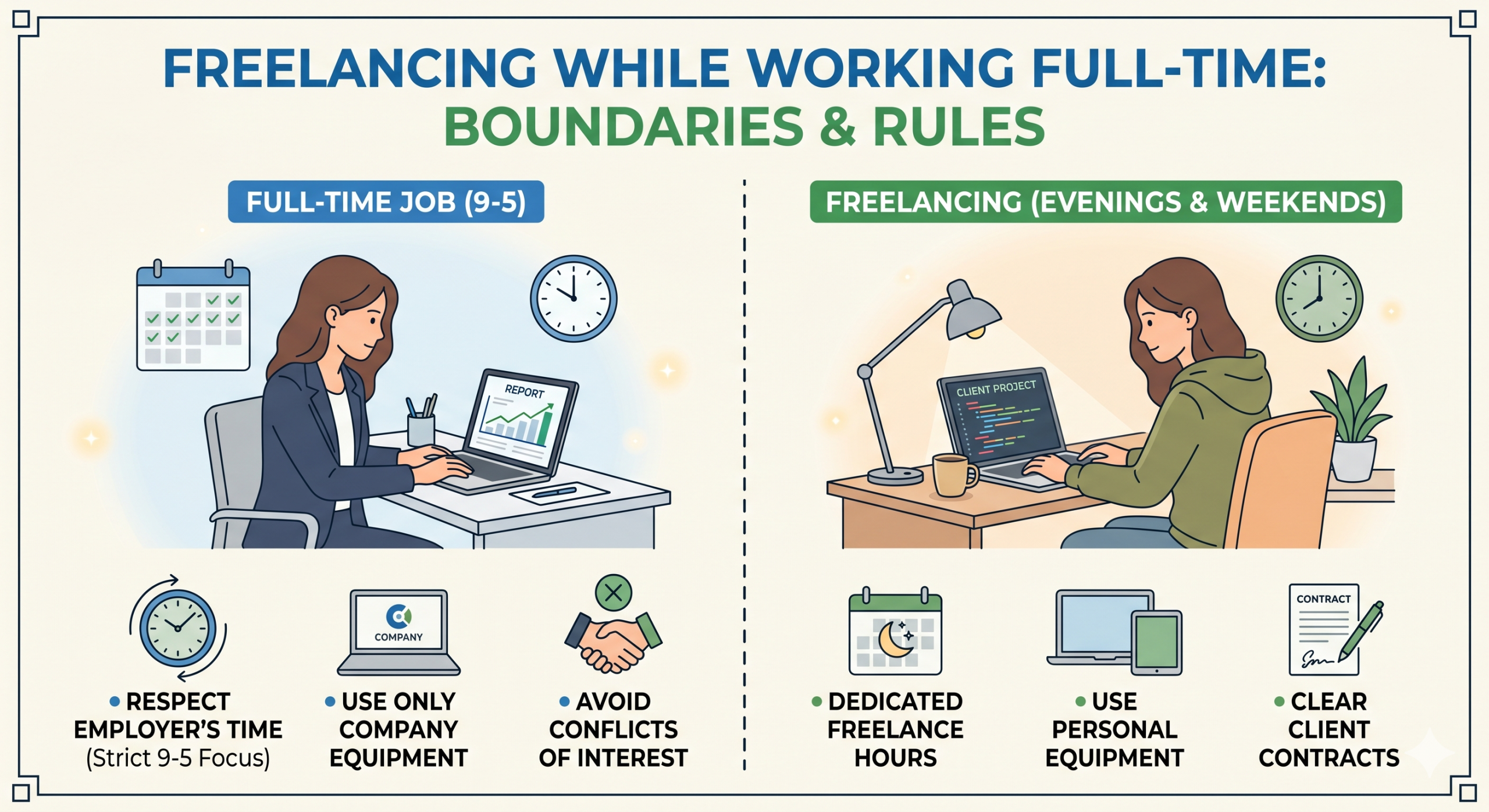
Balancing freelancing with a full-time job has become increasingly common in today’s remote-first economy. Many professionals use freelancing to build additional income streams, test new industries, boundaries strengthen skills, or prepare for long-term career transitions. It offers flexibility, financial growth, and career independence without immediately leaving the security of stable employment.
However, managing both successfully requires discipline and structure. Without clear boundaries, freelancing can quickly lead to burnout, poor work quality, declining productivity, and even conflicts with your employer. The challenge is not simply finding freelance work—it is learning how to maintain balance while protecting your energy, reputation, and long-term career goals.
Freelancing alongside a full-time role should feel sustainable, not chaotic. The right systems and rules allow professionals to grow strategically without sacrificing health or professional performance.
Understand Why You Are Freelancing
Before taking on freelance work, define the reason behind it. Many people start freelancing impulsively and eventually become overwhelmed because they never established a clear purpose.
Your goal may be:
- Building an emergency income source
- Testing a new career path
- Developing new skills
- Creating financial freedom
- Exploring remote work opportunities
- Preparing for future self-employment
When your purpose is clear, decision-making becomes easier. You know which projects to accept, how much time to invest, and what success actually looks like.
Freelancing without direction often turns into endless overwork with no meaningful progress.
Check Your Employment Contract First
One of the biggest mistakes professionals make is ignoring company policies before starting freelance work. Some employers allow freelancing freely, while others have restrictions related to competition, confidentiality, or time commitments.
Before accepting clients, review:
- Non-compete agreements
- Confidentiality clauses
- Conflict-of-interest policies
- Moonlighting restrictions
- Intellectual property ownership terms
Ignoring these details can create legal and professional problems later.
Even when freelancing is allowed, maintaining ethical separation between your job and freelance work is critical.
Never Mix Full-Time Work With Freelance Tasks
This is one of the most important boundaries.
Do not:
- Work on freelance projects during office hours
- Use company devices for freelance work
- Use employer resources or software
- Take freelance calls during full-time meetings
- Let freelance deadlines affect job performance
Your reputation at your primary job should remain protected at all times. Freelancing should never interfere with your professional responsibilities.
Strong separation builds long-term sustainability and prevents unnecessary stress.
Create Strict Time Boundaries
Time management becomes essential when balancing two professional commitments. Without structure, work can consume your entire day.
A better approach is creating fixed freelance windows.
For example:
- Weekdays: 7 PM – 10 PM
- Weekends: Dedicated client work blocks
- One evening completely work-free
Boundaries prevent freelancing from expanding endlessly into personal time.
Many professionals fail because they treat every free hour as working time. Sustainable freelancing requires recovery periods as much as productivity.
Choose Freelance Projects Carefully
Not every project deserves your time. When balancing a full-time role, low-quality freelance work quickly becomes exhausting.
Prioritize projects that offer:
- Good communication
- Clear deliverables
- Flexible timelines
- Long-term growth potential
- Strong portfolio value
Avoid clients who:
- Expect instant responses 24/7
- Continuously expand project scope
- Underpay heavily
- Ignore boundaries
A smaller number of quality clients is far more manageable than multiple stressful projects.
Using a Best Job Tool can help identify opportunities that align with your schedule and long-term goals more effectively.
Protect Your Mental and Physical Energy
Burnout is one of the biggest risks for professionals managing both freelancing and full-time work. Long hours without recovery eventually reduce productivity everywhere.
Common signs of burnout include:
- Constant fatigue
- Missed deadlines
- Reduced focus
- Irritability
- Loss of motivation
Protecting energy requires intentional habits.
Important practices include:
- Maintaining sleep schedules
- Taking short breaks between work sessions
- Avoiding excessive multitasking
- Keeping at least one low-work day weekly
- Exercising regularly
Freelancing should improve your life, not destroy your health.
Learn to Say No Professionally
Many beginners accept every freelance opportunity because they fear missing income or experience. This usually leads to overload.
Saying no is a professional skill.
You should decline projects when:
- Timelines are unrealistic
- Workload exceeds capacity
- Pricing is too low
- The client seems disorganized
- The project conflicts with your goals
Respecting your limits protects both work quality and mental stability.
Professionals who say yes to everything eventually damage both their freelance reputation and full-time performance.
Build Systems Instead of Depending on Motivation
Motivation is unreliable when balancing multiple responsibilities. Systems create consistency.
Useful systems include:
- Task management tools
- Weekly planning sessions
- Time-blocking calendars
- Predefined client communication templates
- Organized project folders
Systems reduce mental overload and improve execution speed.
A Best Job Tool can also help centralize applications, project tracking, scheduling, and productivity workflows in one place.
Set Client Expectations Early
Freelance clients should understand that you are balancing another professional role. This does not mean revealing unnecessary details, but transparency about communication timing helps prevent misunderstandings.
You can communicate professionally by saying:
“I usually respond during evenings and weekends.”
Setting expectations early prevents clients from assuming constant availability.
Boundaries create healthier working relationships and reduce stress significantly.
Keep Freelancing Financially Purposeful
Freelancing income should serve a clear financial strategy instead of disappearing into random spending.
Strong financial uses for freelance income include:
- Building emergency savings
- Paying off debt
- Investing in skill development
- Funding travel or remote work experiments
- Creating a future business runway
Without a financial purpose, freelancing can start feeling exhausting because the extra work lacks meaningful direction.
Tracking freelance income separately also helps measure growth accurately.
Avoid Turning Every Hobby Into Paid Work
One hidden danger of freelancing is losing all personal recovery time. Some professionals monetize every skill or hobby they have, leaving no space for rest.
Not everything needs to become productive.
Maintaining non-work activities helps:
- Prevent burnout
- Improve creativity
- Maintain mental balance
- Sustain long-term motivation
Healthy boundaries include protecting personal time, not only managing work time.
Test Remote and Flexible Work Gradually
Freelancing while employed also provides a low-risk way to test remote work lifestyles. Many professionals use freelance projects to experiment with location flexibility before fully transitioning into remote careers.
You can test:
- Working from different cities temporarily
- Managing flexible schedules
- Productivity outside traditional office environments
- Communication across time zones
These experiences help determine whether long-term remote or freelance work fits your lifestyle and personality.
Focus on Reputation More Than Quick Income
Your long-term freelance reputation matters far more than short-term earnings.
Clients remember:
- Reliability
- Communication quality
- Professionalism
- Consistency
One excellent long-term client relationship often creates more opportunities than multiple rushed projects.
Strong reputation eventually leads to referrals, better rates, and more stable freelance income.
Know When to Scale Back
There may be periods when your full-time workload increases significantly. During these phases, reducing freelance commitments temporarily is often the smartest decision.
Trying to maintain maximum output constantly usually leads to declining quality everywhere.
Professional growth requires flexibility. Scaling back temporarily does not mean failure—it means protecting long-term sustainability.
Conclusion
Freelancing while working full-time can be an incredibly effective strategy for building skills, increasing income, testing new career paths, and creating long-term independence. However, success depends heavily on boundaries, discipline, and structure.
Without clear rules, freelancing quickly becomes overwhelming. Professionals who manage both successfully understand the importance of time management, energy protection, communication, and intentional project selection.
The goal is not to work endlessly. The goal is to create sustainable growth while maintaining performance, health, and financial stability.
By building strong systems, setting professional boundaries, and using organized workflows supported by tools like a best job tool, professionals can balance freelancing and full-time employment in a way that supports both career advancement and personal well-being.






Comments
Be the first to leave a comment.