

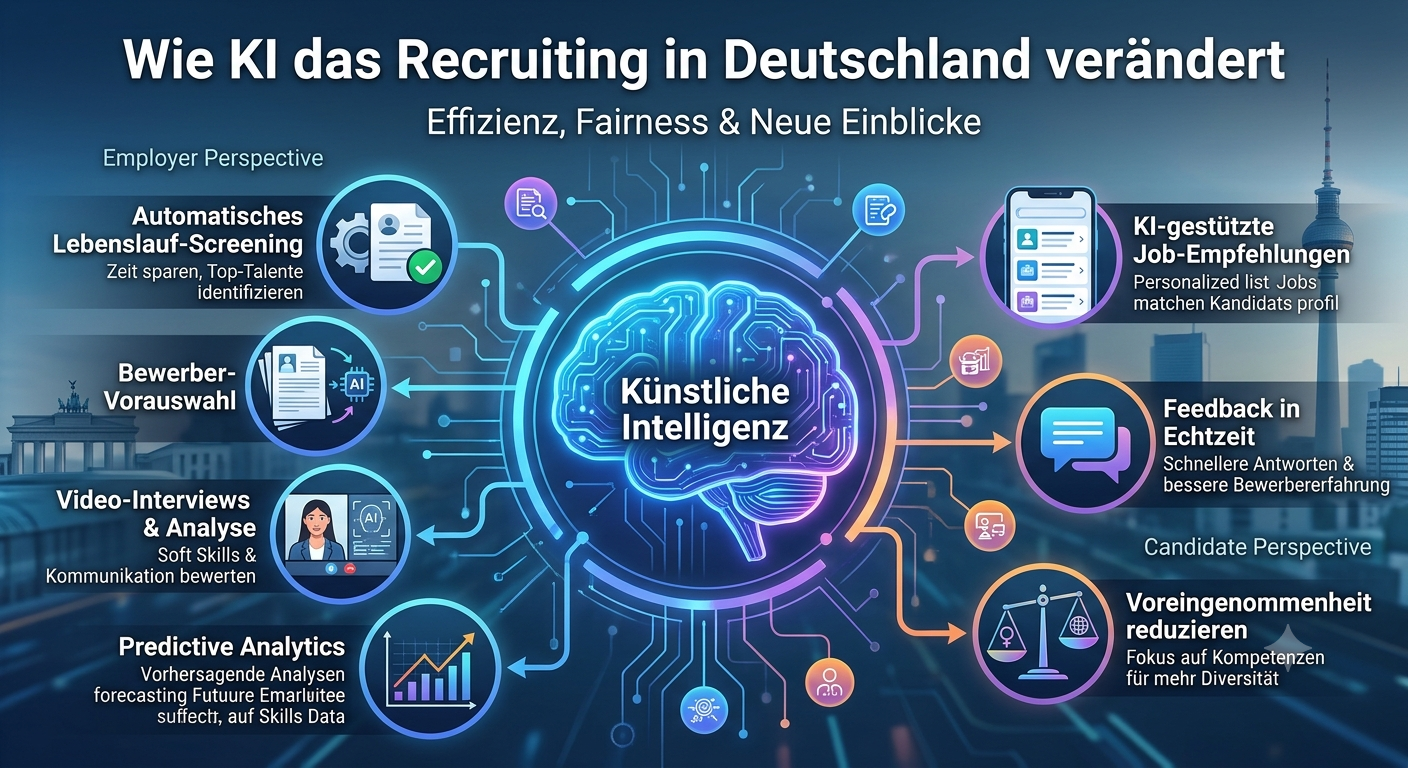
Introduction: AI Is Changing Hiring
With the rise in popularity of artificial intelligence (AI) in modern-day recruitment, the recruitment industry in Germany is experiencing a major transformation. Large multinational companies and SMEs are increasingly looking to use AI tools to improve recruitment, reduce administrative tasks and find the right candidates. AI is changing hiring by making recruitment processes smarter, faster and more efficient.
Germany is one of the leading economies in Europe and has a wide range of industries. There is an increasing demand for skilled professionals in the technology, engineering, healthcare, manufacturing and finance sectors. Therefore, AI is becoming an important tool for addressing recruitment challenges and helping businesses find suitable employees.
How AI Is Changing Hiring in Germany?
1. The Increasing Use of AI in Recruitment
Traditional recruitment processes can be long and tedious. Reviewing hundreds of CVs and interviewing multiple applicants can become costly and time-consuming, especially when companies need to fill several vacancies. With the use of AI, many repetitive recruitment tasks can now be automated.
This allows HR staff to focus on other important aspects of recruitment. AI recruitment tools can review CVs, match candidates to job descriptions, organise applications and help with shortlisting. AI is changing hiring by reducing manual work and helping recruiters identify suitable candidates more efficiently. In Germany, this can be a valuable way for businesses to improve their recruitment processes. However, AI should always be used alongside human judgement and professional expertise.
2. AI Tools to Screen CVs and Match Candidates
One of the most noticeable changes in recruitment is the use of AI to screen CVs. Often, companies receive hundreds of applications for a single vacancy. AI tools can analyse large numbers of applications and identify relevant skills, qualifications, experience and keywords. They can then compare candidates’ profiles with the requirements of a specific role. AI is changing hiring by helping employers screen applications quickly and identify candidates whose skills match the job requirements.
It can reduce the time spent shortlisting candidates and allow recruiters to focus on applicants with relevant experience. Some tools can also support international recruitment by translating applications and helping recruiters review candidates from different countries. However, AI tools should not be left unmonitored. If a tool uses incorrect criteria or relies too heavily on previous recruitment trends, it could overlook talented candidates. Recruiters should review AI recommendations and ensure that qualified applicants receive fair consideration.
3. Improved Candidate Experience
Providing a positive candidate experience is essential for attracting skilled professionals. Candidates want to receive regular updates, clear information and timely responses throughout the recruitment process. AI tools such as chatbots and virtual assistants can answer common questions, explain application requirements and provide information about interview schedules. Some tools can also assist with application forms and keep candidates updated on their progress.
AI is changing hiring by making communication between employers and candidates faster, more accessible and more convenient. Candidates can receive basic information outside normal working hours, while recruitment teams can spend more time having meaningful conversations with applicants. However, AI tools should remain clear, helpful and easy to use. Candidates should also have the option to contact a human recruiter when they have complicated questions or need additional support.
4. Fair Recruitment
Fair recruitment is important for employers in Germany. Candidates should be assessed according to relevant professional criteria, without discrimination based on characteristics such as gender, age, ethnicity, disability or religion. When used correctly and monitored regularly, AI tools may help make parts of recruitment more consistent. Structured assessments can help ensure that candidates are evaluated according to their skills, qualifications and suitability for the role.
AI is changing hiring by creating opportunities for more consistent and skills-based recruitment decisions. However, using AI does not automatically guarantee fairness or eliminate discrimination. If AI systems rely on historical employment data that reflects existing inequalities, they may reproduce biased decisions. Similarly, using inappropriate shortlisting criteria could disadvantage certain groups of applicants. German employers should regularly review their recruitment tools, monitor outcomes and document important decisions. Qualified HR professionals should remain involved in reviewing AI recommendations to support fair and responsible hiring.
5. Data Protection Regulations in Germany
Germany has strict requirements regarding the protection of personal data. Employers must consider the General Data Protection Regulation (GDPR), German employment law and other relevant requirements when using AI in recruitment. The European Union has also introduced regulations governing the use of AI systems. Certain AI systems used in employment and recruitment may be classified as high-risk and must comply with applicable legal requirements and implementation deadlines.
AI is changing hiring by making data protection, transparency and responsible data management increasingly important for employers. Companies need to understand what candidate information they collect, how it is processed and who can access it. Employers should provide clear privacy information, limit data collection to what is necessary, assess potential risks and ensure appropriate human oversight. They should also understand the legal requirements that apply to each AI recruitment tool before implementing it.
6. Impact on HR Staff
The use of AI is changing the roles and responsibilities of recruiters and HR professionals. Instead of spending most of their time on administrative tasks, they can focus more on candidate relationships, workforce planning, employer branding and strategic decision-making. AI is changing hiring by transforming the responsibilities of HR professionals and increasing the importance of digital recruitment skills. These skills include data analysis, knowledge of recruitment technology, understanding algorithms and evaluating AI-generated recommendations.
Recruiters need to understand both the benefits and limitations of AI. Companies may also need to invest in employee training so that HR teams can use these tools effectively and recognise potential errors. However, human qualities such as empathy, communication, negotiation and cultural understanding will remain valuable. Although AI can support candidate selection, it cannot fully replace the human ability to understand a candidate’s motivations, values, personality and future potential.
7. Challenges and Future Opportunities
Despite the benefits of AI, German businesses may face several challenges when introducing it into recruitment. The cost of implementation, integration with existing HR systems, concerns about candidate data and inaccurate recommendations can make adoption difficult. Small and medium-sized businesses may face additional challenges because of limited budgets, technical resources and specialist knowledge.
Nevertheless, AI is changing hiring by creating new opportunities for businesses to manage recruitment more efficiently and make better-informed decisions. In the future, AI may help employers forecast workforce requirements, identify skills gaps, prepare for interviews and find candidates with the right skills. The success of these developments will depend on selecting appropriate tools, maintaining transparency and ensuring that AI genuinely improves recruitment quality. Businesses should evaluate outcomes using measures such as time-to-hire, candidate satisfaction, workforce diversity and employee retention.
8. Best Job Tools to Improve AI Recruitment in Germany
Finding the best job tools is becoming an important part of improving the recruitment process for businesses. Using AI job tools can help employers promote roles, sort through CVs, find the right matches and manage applications. This can save time and reduce admin tasks.
As businesses in Germany are using AI to transform their recruitment process and looking to use digital recruitment platforms, the best job tools can help with communication, monitor progress and give useful insights into recruitment. However, these tools should be selected based on your business’ needs in recruitment, budget, data security and how easy they are to use. Candidates must be fairly assessed, therefore human input is essential. AI recommendations should also be carefully considered.
Conclusion: AI Is Changing Hiring
Overall, AI is becoming a powerful tool within Germany’s recruitment industry. It can streamline CV screening, improve candidate communication, support consistent assessments and help HR teams use their time more effectively. However, it is essential to ensure that AI is used fairly, transparently and responsibly, with proper data protection and human oversight.
AI is changing hiring in Germany by combining intelligent automation with human expertise to create more efficient, fair and candidate-focused recruitment processes. As AI technology continues to develop, the future of recruitment will depend not only on the technology businesses adopt but also on how responsibly they use it to attract, assess and select the right talent.
AI is changing hiring in Germany, helping businesses streamline recruitment, improve candidate experience and find the right talent faster. Using the Best Job Tools and AI-powered recruitment solutions can help companies simplify hiring, identify qualified candidates and make better recruitment decisions. Is your business ready to embrace the future of recruitment? Explore the best job tools today and discover how combining intelligent technology with human expertise can help you attract and hire the right talent.






Comments
Be the first to leave a comment.