

Introduction: Rethinking Retirement
How companies are rethinking retirement in an aging workforce is an issue that ignites the attention of many employers nowadays. The process of retiring is growing more diverse as people both age and work longer than previous generations. Meanwhile, companies have started to see older workers as valuable contributors to the workplace. How Companies Are Rethinking Retirement in an Aging Workforce is an essential question to consider in modern business.
For many years, society regarded retirement as a specific period in life. Simply put, people worked, and when they reached a certain age, they stopped. However, today, it is no longer the case, as some individuals choose to prolong their working period for various reasons. For instance, they might enjoy the work environment and processes, and, therefore, want to stay longer. Furthermore, some people retire later to obtain a higher income or to have a sense of achievement through work. Consequently, companies seem to accept the need to rethink retirement.
How Companies Are Rethinking Retirement in an Aging Workforce?
1. Flexible Retirement Options
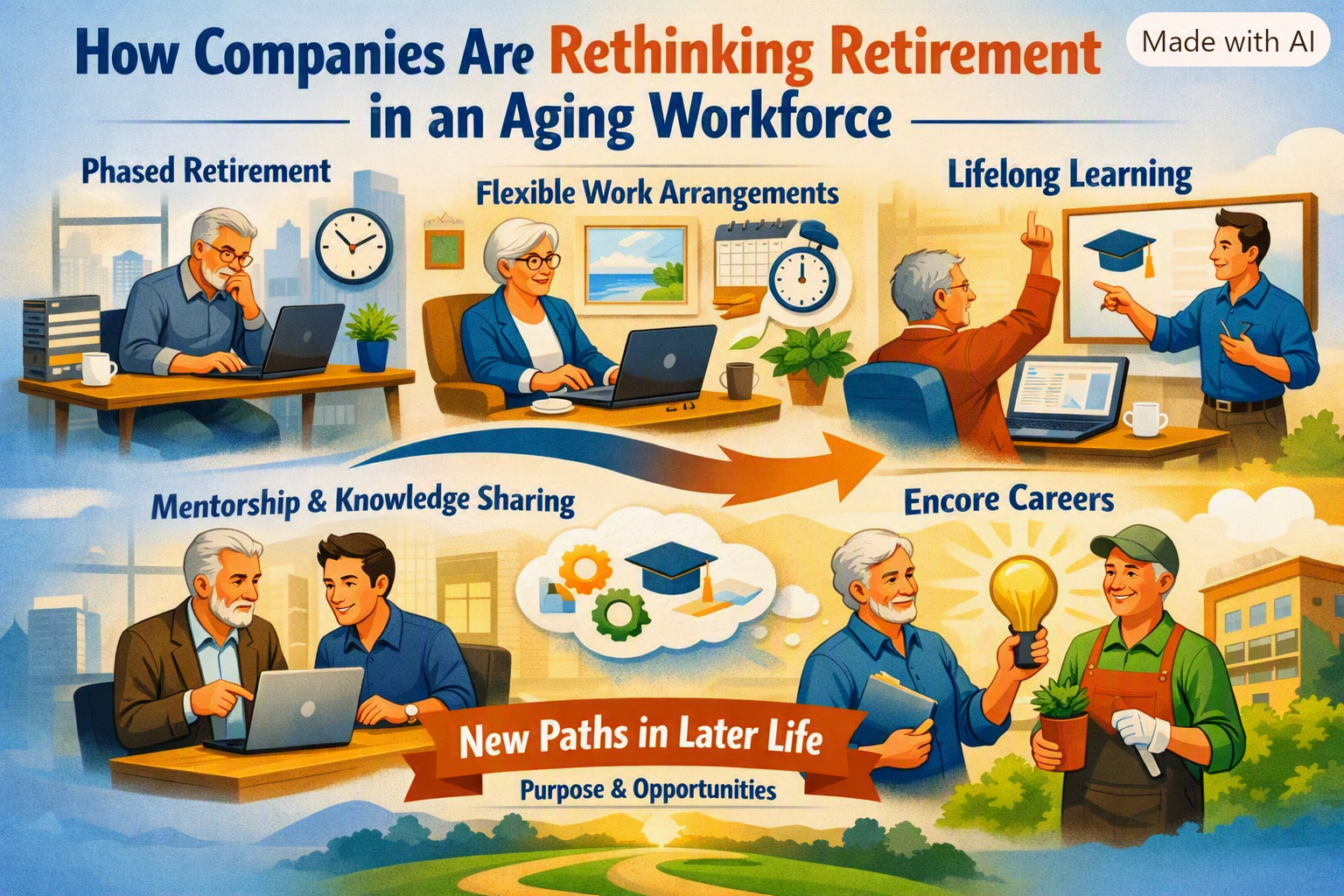
Filling flexible retirement options is one of the primary ways in which employers address the issue. In other words, instead of dismissing experienced and knowledgeable older workers, organizations offer them to continue working with fewer hours, part-time, or as consultants.
For example, a company might propose to an employee who has been working there for 25 years and wants to retire to continue working part-time. In turn, the business benefits from the expertise of a long-term worker, and the employee has more free time for hobbies and other activities.
Moreover, it is worth noting that phased retirement also promotes a better work-life balance and helps the organization to avoid a sudden loss of a critical specialist.
2. Keeping the Valuable Experience of Older Workers
Experienced and older workers have a tremendous amount of knowledge that sometimes younger employees cannot acquire quickly by themselves. In this regard, companies are finding innovative ways to utilize the wisdom of their long-term specialists.
For instance, mentoring programs are an excellent opportunity for older workers to share their expertise with the company’s younger employees. This practice also allows organizations to fill the knowledge gap between different generations in the workplace.
In addition, older employees who provide guidance to their colleagues are likely to have a meaningful retirement as they prolong their work-life beyond the traditional retirement age. In addition, mentoring programs allow older workers to prolong their professional life and simultaneously enable younger employees to advance in their careers.
3. Changing Benefits and Other Ideas to Help Employees in Their Transition
Company leaders also understand that benefits and other financial matters are crucial for employees in their transition. Employers acknowledge that the individuals starting their careers and those that are closer to retirement have dramatically different needs.
For example, a 25-year-old worker is unlikely to have the same retirement expectations as does a 60-year-old employee. Therefore, companies are rethinking their benefits to better suit the needs of all the generations.
Moreover, employers are constantly educating and advising their employees on how they can prepare financially for retirement and when they should consider transitioning to full-time retirement or not.
4. Age-Inclusive Workplace
Promoting an age-inclusive workplace is another strategy that modern companies utilize to rethink retirement. For example, employers are beginning to acknowledge that older workers have different learning and career needs than their younger counterparts.
Organizations should prepare training programs tailored specifically for older workers to address their unique career needs. For instance, older employees might want to learn new technologies, including artificial intelligence and machine learning opportunities. Older workers might also want to expand their knowledge in leadership matters, management, or even learn a new skill.
An age-inclusive workplace is also critical to promote a fairer assessment of older workers’ abilities during the job interview process.
5. Technology
Technology is another vital aspect to consider in rethinking retirement. Virtualization, remote work, and automatization allow older employees to continue working longer as technology eliminates some of the physical workloads.
However, it is vital to remember that technology does not rule the brainpower of humans. Although remote work can be appropriate in some situations, older workers still need proper training, guidance, and mentorship to maximize the power of technology. In this regard, it is essential not to overestimate the value of proper training.
6. Creating Second Careers for Older Workers
Employers can rethink retirement by creating second careers for older workers. In other words, after a certain period, older workers can move from lower management to executive management positions.
Moreover, some organizations offer consulting services to retirees to support their transition. For example, a company can provide a mentoring program for younger employees or even new managers. In this regard, older workers have a great opportunity to prolong their careers and gain tremendous work-life experience.
Conclusion: Rethinking Retirement
In summary, the article discussed how companies are rethinking retirement in an aging workforce. The process of retiring is becoming more flexible, and employers now offer a variety of options to help older workers prolong their careers. Individuals considering retirement should also keep in mind that this is their choice, and they are free to decide when the time is appropriate.
As companies rethink retirement to support an aging workforce, professionals can also take proactive steps to plan their next career move. Explore opportunities, discover relevant roles, and make your career transition easier with the Best Job Tool platform.






Comments
Be the first to leave a comment.