

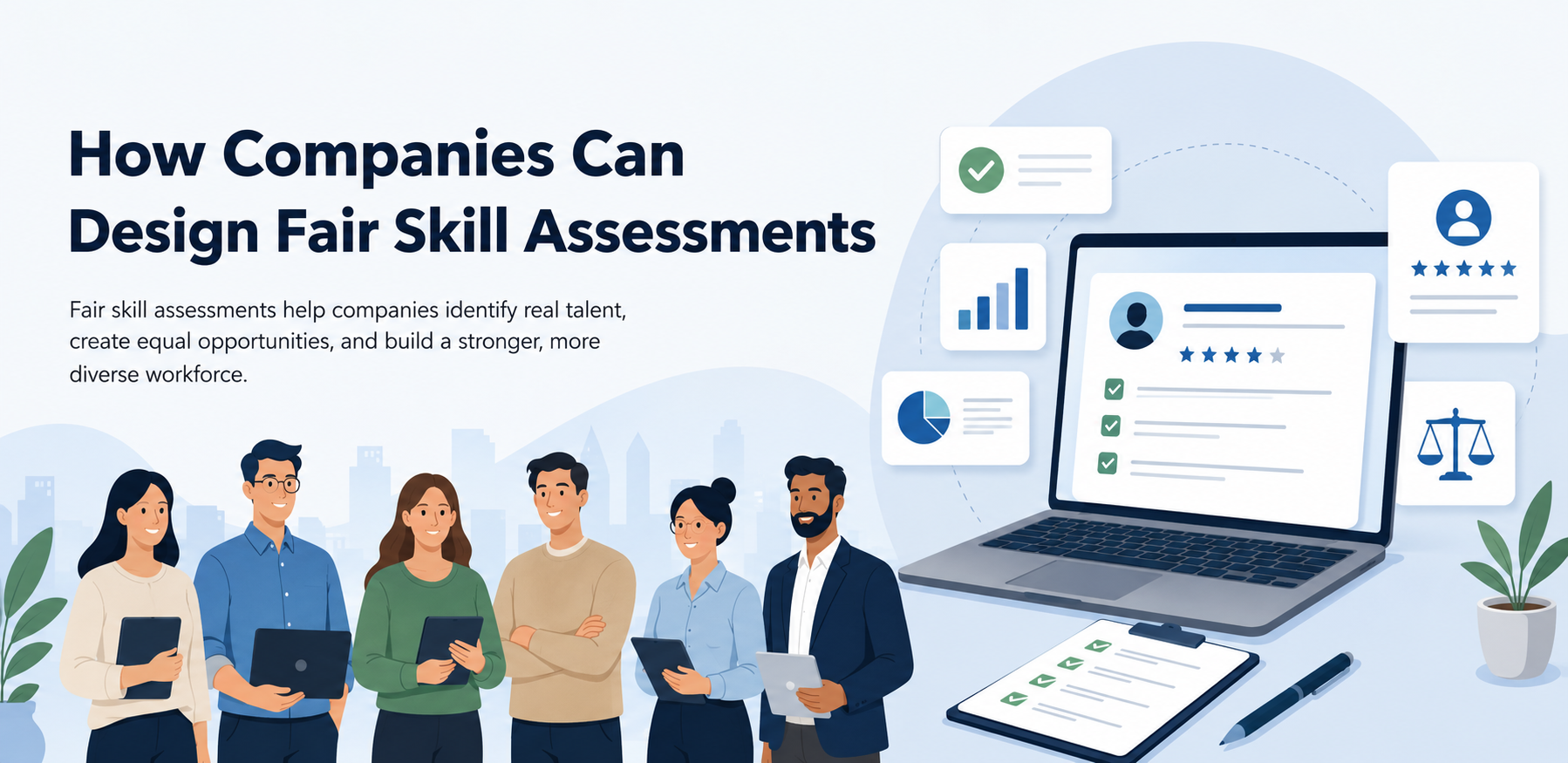
Introduction: Design Fair Skill Assessments
A resume is a very important document for every person because it helps recruiters understand about a candidate. Based on the resume, companies decide whether to call a candidate for an interview or not.
However, in today’s job market, many roles have emerged where a resume alone is not enough to judge a candidate’s ability. It is difficult to know whether the candidate can actually perform well in the job. Some popular roles include content writing, graphic designing, copywriting, and many more.
That is why, for such roles, companies conduct skill assessments along with the resume. This helps them understand what kind of work a candidate can actually do. But these skill assessments should be fair. Many companies fail to design fair assessments because of some common reasons.
If you want to conduct an assessment test for candidates, you should know how to design a fair skill assessment.
In this article, we will explore some practical ways through which companies can design fair skill assessments.
How Companies Can Design Fair Skill Assessments?
1. Start With a Clear Job-Related Skill Map
The first step is to start with a clear job-related skill map. This means that if a company wants to take an assessment test of a candidate, it should first clearly define what skills are required for that job role. Then, based on those requirements, the skill assessment should be prepared.
After candidates complete and submit the skill assessment, they should be evaluated only on the same requirements that were decided earlier.
For example, if a company is taking an assignment test for a content writing role and the requirement is blog writing, then after the candidate submits the task, the focus should be on things like writing structure and grammar, not on advanced SEO tools.
2. Remove Bias From the Assessment Design
Secondly, companies should remove bias from the assessment design if they want to create a fair skill assessment.
To remove bias, every candidate should be treated equally. No particular group should be given priority, and different tests should not be given to different candidates. The language used in the assessment should be neutral. When everyone is treated equally, only then a fair skill assessment can be created. Otherwise, there is a chance that a good candidate may be missed by the company.
3. Standardize Evaluation Criteria
Another step is to standardize the evaluation criteria so that every candidate can be evaluated equally and no one gets special treatment. For this, before conducting the assessment, a rubric or set of criteria should be decided.
For example:
20% for structure, 20% for creativity, 30% for accuracy, and 30% for clarity.
This helps a lot in reviewing candidates honestly because when the criteria are decided in advance, the same standards are used to evaluate every candidate after the assessment. No one gets special treatment. All recruiters must follow the same criteria while evaluating candidates, which helps in conducting a fair skill assessment.
4. Keep Time Limits Reasonable
Tests are given everywhere, whether in an exam hall or for a job assessment, and every test has a time limit. But while creating an assessment, companies should keep in mind that the time limit should be reasonable.
The time should not be too short or too long. Candidates should be given enough time so they can understand the questions, analyze them properly, and complete their tasks in the right way.
If companies give unrealistic deadlines, candidates feel too much pressure and are not able to perform well. As a result, the company may miss out on a talented and good candidate.
5. Offer Multiple Ways to Demonstrate Skill
Another important step to conduct a fair skill assessment is to offer multiple ways for candidates to demonstrate their skills.
“Multiple ways” means options like writing format, video format, live problem-solving sessions, or portfolio submission. Every candidate has a different personality and behavior, so not everyone is comfortable with the same format. Because of this, some candidates may not be able to show their skills properly.
If candidates are given multiple ways to show their skills, they can choose the format they are most comfortable with. This helps them present their abilities in a better and more confident way.
Conclusion: Design Fair Skill Assessments
A fair skill assessment is very important for selecting the right candidates. Companies should focus on clear job-related skills, remove bias, use standard evaluation criteria, provide reasonable time limits, and offer multiple ways for candidates to show their abilities.
When these steps are followed, the assessment becomes more fair and accurate, and companies are able to identify truly talented candidates without missing good opportunities.
“Fair skill assessments lead to better hiring decisions and stronger teams. Build more inclusive evaluation systems with Best Job Tool.”






Comments
Be the first to leave a comment.