

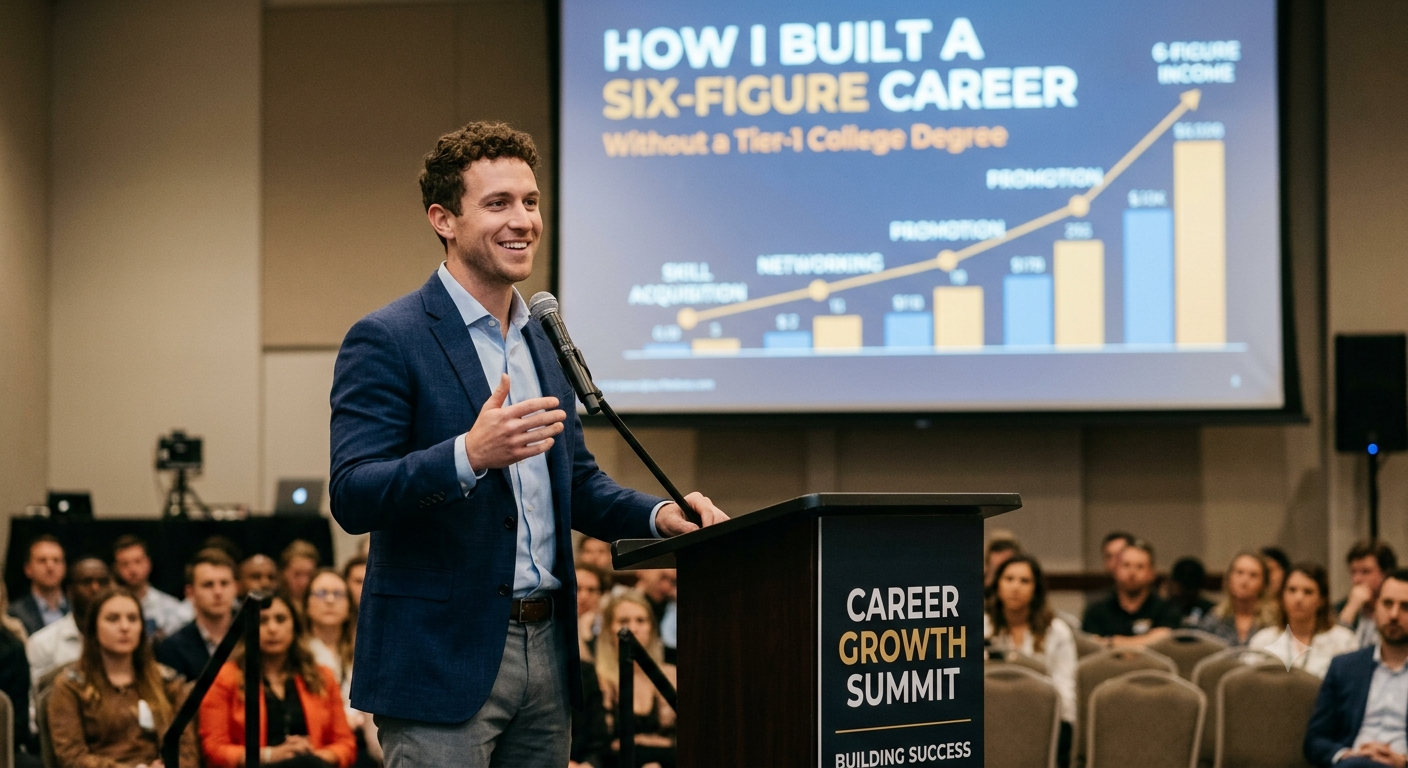
Introduction: Six-Figure Career
Planning a career path is not essential, but it can improve your chances of success. Many students start planning in university to secure better job opportunities after graduation. However, professional success is not necessarily dependent on the educational institution one attends. This is the path that allowed me to create a six-figure income without a tier-1 college degree. A Six-Figure Career is possible without graduating from a Tier-1 college.
To begin with, I believe you should alter your mindset in regards to career building and learning. Although it is common for some employers to make a distinction based on the prestige of the educational institutions, they also consider one’s skills, communication, responsibility, and ability to deliver results.
Instead of comparing myself to my peers from prestigious universities, I began focusing on what I had at my disposal at that time. I saw opportunities instead of shortcomings and began to believe that I can control the outcome of my professional development.
How to Build a Six-Figure Career Without a Tier-1 Degree?
1. Focus on skills desired by the employers
I identified the skills employers value in my target industry. Instead of collecting random certificates, I focused on learning skills that would help me succeed at work. These skills may include communication, marketing, data science, leadership, coding, or writing. I focused on learning the skills employers value to strengthen my professional profile.
I took advantage of internet resources like videos, books, and course materials. Additionally, I would take a closer look at the job descriptions and skill requirements for the positions I was interested in to understand what I need to learn. This helped me narrow down the learning process and concentrate on developing the necessary skills rather than trying to obtain as much information as I can and fail in the process. Building a Six-Figure Career depends on skills, experience, and consistent effort.
2. Gain practical experience
Having the right skills is important, but employers also value results. I focused on applying my knowledge through personal projects, internships, and practical assignments. This experience improved my workplace readiness, regardless of my educational background. This, too, helps narrow the focus and helps achieve better results in a shorter span of time. Aspiring writers can create blog posts and build a portfolio to showcase their skills. Digital marketers can gain practical experience through personal projects.
Practical application of the knowledge one has acquired will significantly improve interview prospects. Having a portfolio of completed assignments makes it easier to talk about one’s experience with confidence and demonstrate the practical understanding of the subject matter. Furthermore, the more practical one is with the material, the closer the distance between people with various educational backgrounds becomes. Developing in-demand skills can help me move closer to a Six-Figure Career.
3. Build a portfolio
A portfolio helps demonstrate more than the standard academic performance and experience. Once the basic projects have been completed, one would benefit from compiling these experiences and knowledge into a comprehensive portfolio that demonstrates not only professional skills but also personality and the ability to deliver results.
I have made sure to create a strong impression by putting together a presentation of who I am, the accomplishments I am proud of, and what skill sets I possess. For instance, a writer’s portfolio can include a list of published works or projects and a brief description of each. It can also describe what writing pieces are personal and which are professional. It can provide the contact information and any other relevant information.
A portfolio does not have to include hundreds of hours’ worth of assignments, but it should contain a list of relevant projects, experiences, and information. It is also important to keep the portfolio up to date. Practical experience can strengthen my chances of achieving a Six-Figure Career.
4. Learn the art of networking
The right connections can enable one to achieve professional success. However, it is not enough to simply try to network; one has to know how to establish and maintain professional relationships with people in order to achieve one’s career aspirations. Networking also means that one uses their contacts to help them reach their goals rather than asking for favors. It is important to engage oneself with the community both online and offline and participate actively in the discussion. One should also try to offer something, whether it is time or experience, to the community rather than simply taking, in order to build relationships and gain credibility. A strong portfolio can help me stand out while pursuing a Six-Figure Career.
Using professional social networks like LinkedIn can also prove to be quite beneficial as they help to connect with others and build professional presence simultaneously. Engaging in professional discussions also helps to increase credibility by demonstrating one’s knowledge and experience in the area. One can also attend virtual or physical social gatherings to meet new people, engage in meaningful communication, and build trust with others. However, it is important to understand that networking does not always get one a job directly, but it often opens the door to better opportunities.
5. Learn to show your value during interviews
Getting a job often boils down to performing well during job interviews. Having an impressive resume will certainly make one appear attractive to the recruiters, but it is also essential to be able to demonstrate one’s value to the employer. The good news is that it is not as difficult as most people make it out to be. Instead of focusing on my education, I highlighted my skills and their workplace value. I shared examples of past projects to show how I could contribute to the employer’s goals.
One can also prepare answers with the use of the STAR method (Situation, Task, Action, Result). Furthermore, it is important to research the employer and the job posting prior to the interview in order to prepare relevant questions to ask. Finally, the subject of salary has to be approached with equal parts of caution and confidence. It is important to understand what one deserves based on one’s professional experience, educational background, and field of work and match it with the general salary expectations. Networking can open doors to valuable opportunities and support my Six-Figure Career goals.
6. Maximize income potential for long-term growth
As I begin to build a stronger professional presence, it is time to maximize the potential and get paid more for my skills and time. Earning a six-figure salary is more of a process than a one-time achievement. This means that people should continue to enhance their skills, gain more experience, and take on more responsibility in order to continue progressing in their careers. Once there is a solid level of qualification, it may be time to negotiate higher compensation or seek out opportunities with higher pay. The same goes for learning to become a better negotiator.
Since I have already engaged in continuous learning and practice, I was able to achieve a certain degree of professional readiness to navigate the process. It is also important to keep the finger on the pulse of the market and understand the opportunities that arise as a result of changing markets, technological advancements, and new opportunities, without compromising career growth and stability.
7. Using personal branding for self-promotion essay
I realized personal branding helped me stand out during screening. My resume showed my qualifications but not my personality or the value I could offer employers. I started to build my professional reputation by publishing content on the website, sharing specific tweets, and contributing to professional publications. I learned how to position myself as an expert with vast expertise in particular field. Continuous learning and career growth can help professionals build a sustainable Six-Figure Career.
At the same time, I understood that my brand had to be genuine, so I could not simply make things up. Instead, I curated my credentials so that they could become a valuable asset to my future employer. My experience showed that personal branding can help secure jobs, promotions, and clients. Graduates from average colleges can also use it to strengthen their professional image.
8. Learning From Feedback and Accepting Rejections
Rejections are common and can be discouraging. Instead of seeing them as failures, I use feedback to identify skill gaps and grow professionally. Feedback from recruiters, managers, and clients helps me identify areas for improvement. I can strengthen my communication, technical skills, and presentation to perform better in future interviews.
I learned to accept feedback from managers and coworkers and use it to improve. Not every job application will succeed, and that is okay. The key is to learn from rejection and move on to the next opportunity.
Using feedback to improve your skills builds confidence and prepares you for future projects and interviews. This can help you increase your income and advance your career.
Conclusion: Six-Figure Career
Overall, there are plenty of ways to build a six-figure income without a tier-1 college degree. Write it in short means the sentences I need to be short. A Six-Figure Career is achievable with the right skills, practical experience, and a willingness to learn.
Instead of letting circumstances hold me back, I focused on professional growth. Changing my mindset helped me take action. I developed skills, gained experience, built a portfolio, networked, and demonstrated my value in interviews. Success takes time and practice. Ultimately, my college shaped my starting point, not my career’s destination.
Ready to build a successful career? Focus on developing in-demand skills, gaining practical experience, and building your personal brand. Start today and take the next step toward your career goals with the right best job tools!





Comments
Be the first to leave a comment.