

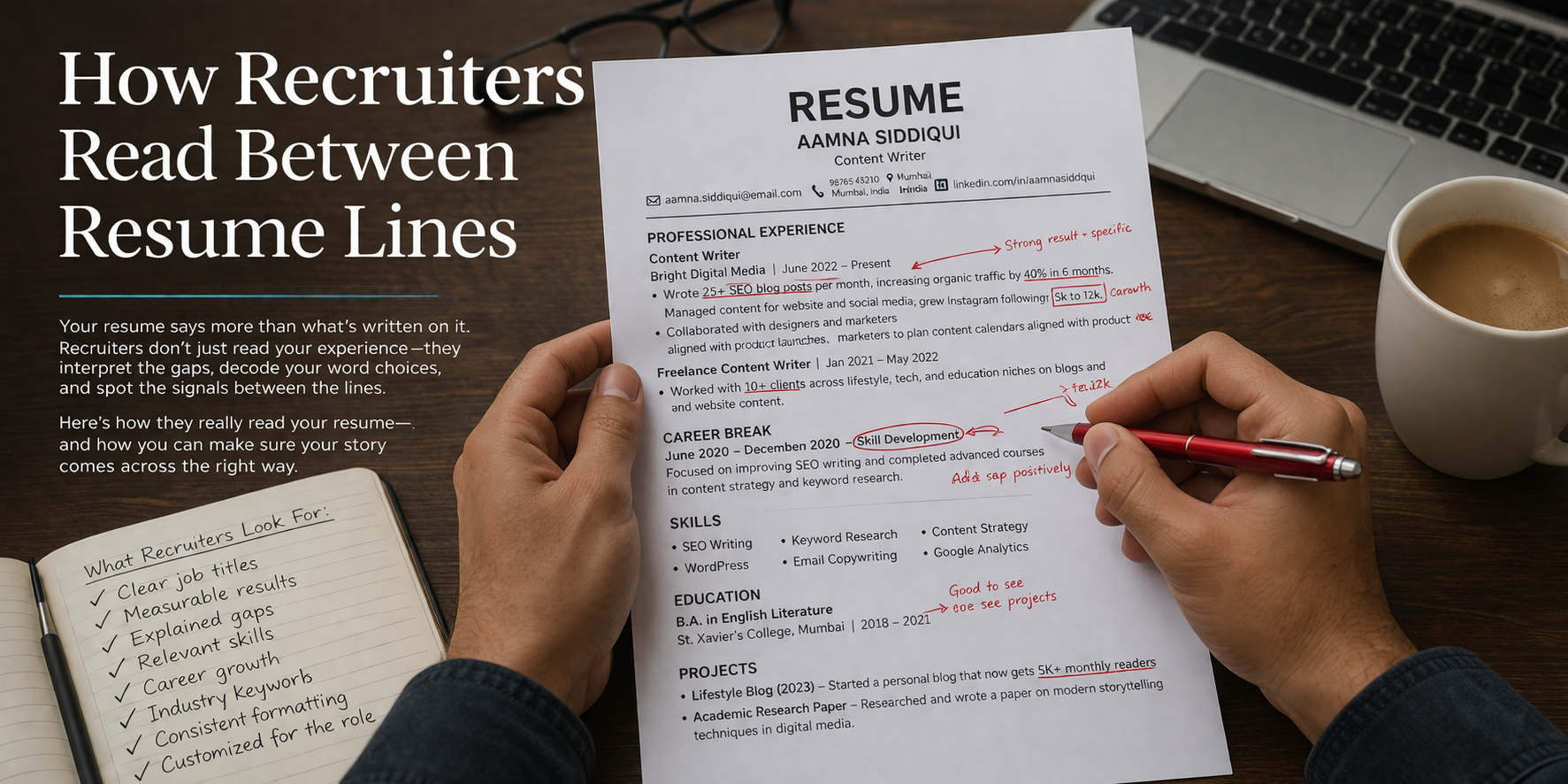
Introduction
When you apply for a job, your resume feels like your voice. It carries your education, your skills, your experience—and your hopes. You carefully choose words, highlight achievements, and try to present yourself in the best possible way.
But here’s something many job seekers don’t realize:
Recruiters don’t just read resumes—they interpret them.
They read between the lines.
Every bullet point, every gap, every word choice sends signals beyond what’s written. A resume is not just a document—it’s a story. And recruiters are trained to understand not only what you say, but also what you don’t say.
Let’s explore how recruiters read between resume lines, and what your resume might be silently communicating.
1. Job Titles Reveal More Than You Think
At first glance, job titles seem straightforward. But recruiters don’t take them at face value.
For example, if someone writes:
“Content Writer”
A recruiter might ask:
- What type of content?
- Blogs, SEO, social media, or technical writing?
- Was it freelance or full-time?
Now compare that with:
“SEO Content Writer (Blog & Website Content)”
This gives clarity and signals specialization.
What recruiters are actually reading:
- Your level of responsibility
- Your area of expertise
- Your career progression
If your job titles are vague or inconsistent, recruiters may assume:
- You lack clarity in your role
- Your experience may not be deep
- You may not fully understand your own work
What to do:
Be specific, but honest. A clear title helps recruiters understand your value quickly.
2. Bullet Points of Resume Shows Your Thinking Style
Most candidates list responsibilities like this:
- Wrote articles
- Managed social media
- Worked with team
This tells recruiters what you did—but not how well you did it.
Now look at this:
- Wrote 20+ SEO-optimized articles increasing website traffic by 35%
- Managed Instagram content strategy, growing followers from 2k to 8k in 3 months
- Collaborated with a team of 5 to deliver weekly content campaigns
What recruiters are reading:
- Are you results-focused or task-focused?
- Do you understand impact?
- Can you measure your work?
A resume filled with generic tasks signals:
- Low ownership
- Limited contribution
- Lack of awareness of results
While measurable achievements signal:
- Confidence
- Clarity
- Professional maturity
What to do:
Always try to connect your work with outcomes.
3. Gaps Tell a Story (Even If You Don’t Explain Them)
Many candidates try to hide gaps. But recruiters always notice them.
A gap like:
2022 – 2023 (No mention)
Raises silent questions:
- Were you unemployed?
- Were you learning something?
- Did something go wrong?
But a gap like:
2022 – 2023: Skill Development (Content Writing & SEO)
Changes the story completely.
What recruiters are reading:
- Are you proactive or passive?
- Did you use your time well?
- Are you hiding something?
A gap itself is not a problem.
Silence is.
What to do:
Own your timeline. Even if you took a break, explain it briefly and positively.
4. Skills Section of a Resume Reflects Your Direction
Many resumes include long skill lists:
- Communication
- Leadership
- Hardworking
- Team player
These are common—but not convincing.
Now compare with:
- SEO Writing
- Keyword Research
- WordPress Publishing
- Email Copywriting
What recruiters are reading:
- Do you have real, usable skills?
- Are your skills aligned with the job?
- Are you just filling space?
A generic skill list signals:
- Lack of specialization
- Beginner-level understanding
- Copy-paste approach
A focused skill list signals:
- Direction
- Awareness
- Professional intent
What to do:
List skills that you can actually demonstrate.

5. Resume Length Shows Your Judgment
A resume that is too long or too short sends signals.
- 1 page with very little detail → May look inexperienced or unprepared
- 4 pages with too much detail → May look unfocused or unaware of priorities
What recruiters are reading:
- Can you prioritize information?
- Do you understand what matters?
- Are you concise?
A well-balanced resume shows:
- Clarity
- Professional communication
- Respect for the recruiter’s time
What to do:
Keep your resume clear and relevant. Quality matters more than quantity.
6. Consistency Reflects Professionalism
Small inconsistencies matter more than you think.
For example:
- Different fonts
- Uneven spacing
- Mixed date formats (Jan 2022 / 03-2023 / April 2024)
These may seem minor, but recruiters notice them instantly.
What recruiters are reading:
- Attention to detail
- Care in presentation
- Professional discipline
An inconsistent resume signals:
- Carelessness
- Lack of effort
- Poor organization
What to do:
Make your resume clean, consistent, and easy to read.
7. Career Growth Signals Ambition
Recruiters don’t just look at where you worked—they look at how you grew.
Example:
Company A (2021–2024)
- Content Writer
vs.
Company A (2021–2024)
- Junior Content Writer (2021–2022)
- Content Writer (2022–2023)
- Senior Content Writer (2023–2024)
What recruiters are reading:
- Did you grow or stay the same?
- Did your responsibilities increase?
- Were you recognized for your work?
Growth signals:
- Ambition
- Performance
- Trust from employers
No growth signals:
- Stagnation
- Limited impact
- Comfort zone
What to do:
Highlight promotions, increased responsibilities, or expanded roles.
8. Resume Keywords Show Industry Awareness
Many companies use ATS (Applicant Tracking Systems). But even human recruiters look for keywords.
For example, in content writing:
- SEO
- Keywords
- Content strategy
- Analytics
If your resume lacks these, it may look like you’re not aligned with industry standards.
What recruiters are reading:
- Do you understand your field?
- Are you updated with trends?
- Can you speak the industry language?
Missing keywords signal:
- Lack of exposure
- Outdated knowledge
- Weak positioning
What to do:
Use relevant keywords naturally in your resume.
9. Education Section of a Resume Shows Foundation, Not Everything
Freshers often rely heavily on education. But recruiters don’t just look at degrees.
They look at:
- Projects
- Internships
- Practical exposure
Example:
B.A. in English
vs.
B.A. in English + Blog Writing Projects + Internship Experience
What recruiters are reading:
- Did you apply your knowledge?
- Did you go beyond academics?
- Are you job-ready?
Education alone signals:
- Theoretical knowledge
Practical experience signals:
- Readiness
- Initiative
- Real-world understanding
What to do:
Add projects, internships, or self-initiated work.
10. Resume Language Reflects Confidence
The tone of your resume matters.
Compare:
- Responsible for writing content
vs. - Created engaging content that improved reader retention
What recruiters are reading:
- Confidence level
- Ownership
- Communication ability
Weak language signals:
- Lack of confidence
- Passive mindset
Strong language signals:
- Ownership
- Clarity
- Impact
What to do:
Use action verbs and confident phrasing.
11. Resume Customization Shows Effort
Many candidates send the same resume to every job.
Recruiters can tell.
What recruiters are reading:
- Did you tailor your resume?
- Do you really want this role?
- Are you serious or just applying everywhere?
A generic resume signals:
- Low effort
- Lack of interest
A customized resume signals:
- Intent
- Effort
- Alignment with the role
What to do:
Adjust your resume slightly for each job.
12. What You Leave Out Also Matters
Sometimes what’s missing speaks louder than what’s included.
For example:
- No achievements
- No projects
- No clear skills
What recruiters are reading:
- Do you lack experience?
- Or did you just not present it well?
Silence creates doubt.
What to do:
Don’t hide your strengths. Present them clearly.
Conclusion
Your resume is more than a document—it’s a conversation without words.
Recruiters don’t just read what you write. They interpret:
- Your choices
- Your structure
- Your clarity
- Your intent
They look for patterns, signals, and hidden meanings.
So when you create your resume, don’t just ask:
“What should I write?”
Ask:
“What is my resume silently saying about me?”
Because in the end, getting shortlisted is not just about qualifications.
It’s about how well your resume tells your story—even between the lines.






Comments
Be the first to leave a comment.