

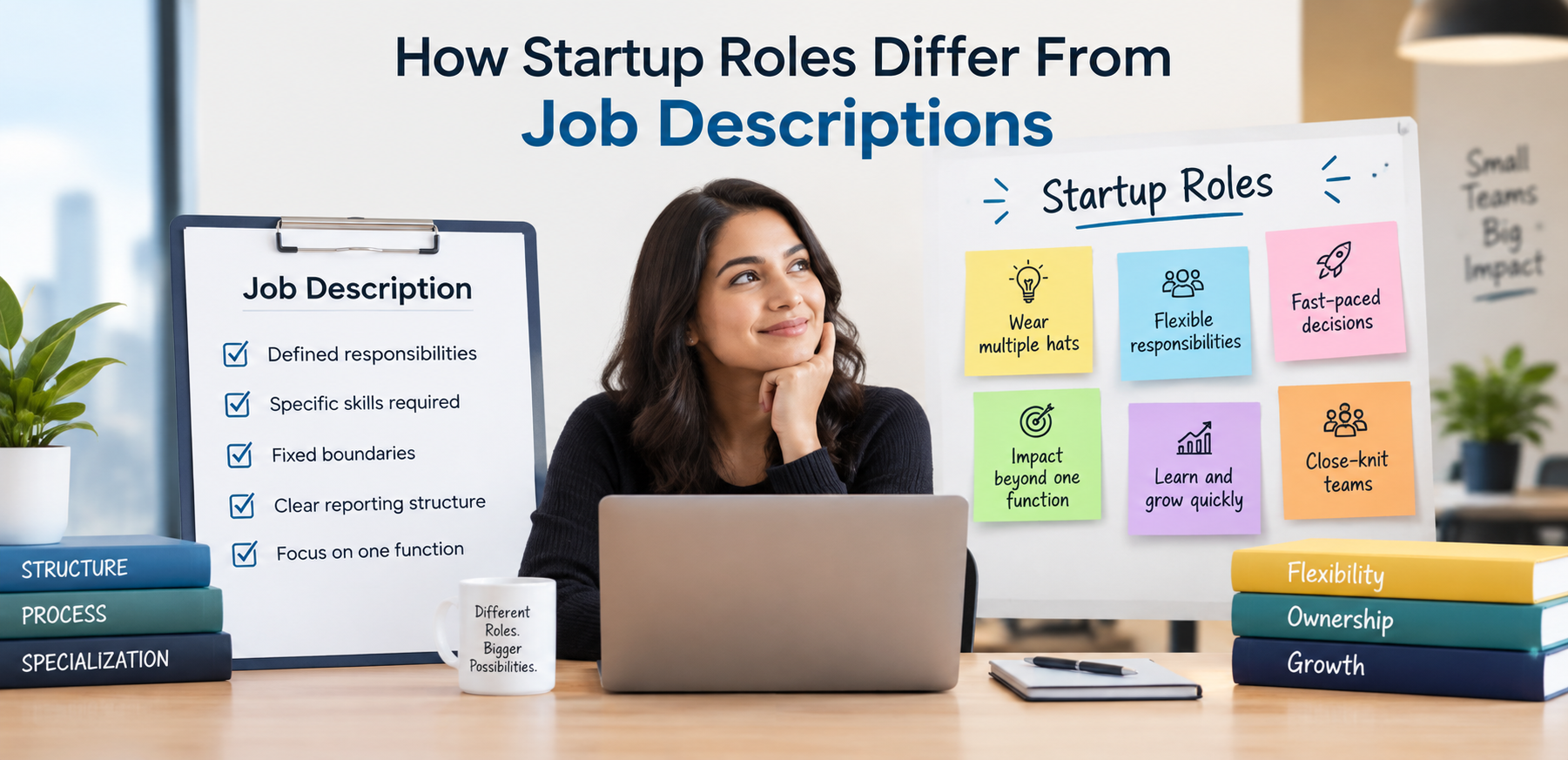
Introduction: Startup Roles
When applying for a vacancy, every prospective candidate studies the job description to understand the duties, responsibilities, and skills required for the position. Nevertheless, after getting hired, one may notice that the role is significantly different from the one described in the job description.
How startup roles differ from what the job description says is crucial knowledge for every aspiring professional about to join a growing company. Since start-ups are usually small, they may require employees to take on several duties that differ from those outlined in the job description.
How Startup Roles Differ From What the Job Description Says Research Paper?
1. Job Descriptions Are Often Just a Starting Point
Unlike large corporations that have clearly defined departments and duties for every worker, start-ups may not have a detailed outline of responsibilities.
A company may offer a vacancy as a marketing executive, but the duties may go beyond marketing and involve social media management, sales, event planning, report writing, and so forth. Such situations are common in start-ups since they are growing companies that may look for multi-skilled professionals who will stick with the company for a long time. Thus, the responsibilities attributed to a specific position may transform as the company grows or when new objectives emerge.
2. You May Have More Responsibilities
Among the most apparent differences between corporate and start-up jobs, the responsibilities. In big companies, employers structure and clearly define every detail, while start-ups may provide only a broad outline of duties.
For instance, the responsibilities may involve writing, but the company may ask to perform multiple tasks, ranging from content creation to graphic design, video editing, website maintenance, and social media management. Although such situations may be overwhelming for some, they allow the professionals to gain greater work experience and acquire new skills.
3. Priorities Can Change Quickly
The primary characteristic of a start-up is a consistently changing set of priorities. Unlike big corporations that have a well-defined mission and objectives, scaling companies may have to adjust their priorities in response to the emerging demands in the market or customer preferences.
For example, the marketing department of a start-up may revise its campaign objectives several times a year. A marketing executive may be engaged in extensive market research to identify the most appropriate segment for the company to focus on. Thus, in a matter of days, the marketing executive may have to change the research objectives and revise the promotional campaign. This is an example of how quickly the priorities in a start-up may change.
4. You May Work Directly With Founders
Working in a start-up implies collaborating directly with the founders on a regular basis. This situation differs from working in a big company, where employees have limited communication with top management. The founders may provide directions for every aspect of the start-up’s functioning. Therefore, the professionals in start-ups must be flexible and ready to adapt to the ever-changing needs of the company.
At the same time, interacting directly with the founders is an advantage of working in a start-up. The employees may learn how the business works from the inside. They can also gain a valuable perspective of how managers make decisions and manage the different departments.
5. You May Need to Solve Problems Without Detailed Instructions
While most jobs provide clear instructions on how to accomplish specific tasks, the situation in start-ups is usually different. The founders may entrust the employees with a wide range of responsibilities but offer little guidance on how to perform the duties.
For instance, a vacancy may require sales experience, but the company may not have well-defined procedures for selling its products or services. Instead, the sales executive may be required to develop appropriate strategies for promoting the products or services. Therefore, the professional should be creative and capable of finding solutions to problems.
In addition, such employees should be independent since their work environment rarely offers guidelines, instructions, or supervision. Thus, whenever a complex issue emerges, they should be able to solve it independently without waiting for the instructions from managers or founders.
6. Titles May Not Tell the Whole Story
The title and description of a vacancy in a start-up may appear vague. For instance, a business development manager in a start-up may involve in multiple activities, ranging from sales to administrative duties. Therefore, the job description may include vague statements or lists of several responsibilities, not related to each other.
Aspiring candidates should learn more about the actual duties of a specific position in a start-up, which may differ significantly from the job description. It is essential to keep in mind that most start-up job vacancy descriptions are created as a guideline for the applicants and not a comprehensive outline of duties.
Conclusion: Startup Roles
Startup roles often differ from their job descriptions because employees may need to handle changing priorities, multiple responsibilities, and tasks outside their original scope. While a job description provides a general outline of the position, the actual role is often shaped by the startup’s stage, team size, business needs, and growth. Therefore, professionals should look beyond the listed responsibilities and assess the broader expectations of the role.
Ready to explore startup opportunities with a clearer understanding of what the role may actually involve? Use the insights from this research to evaluate job descriptions carefully, identify responsibilities beyond the listed requirements, and prepare for the flexibility that startup roles often demand. For your next career move, explore the best job tool platform to discover relevant opportunities, compare roles, and make more informed career decisions.






Comments
Be the first to leave a comment.