

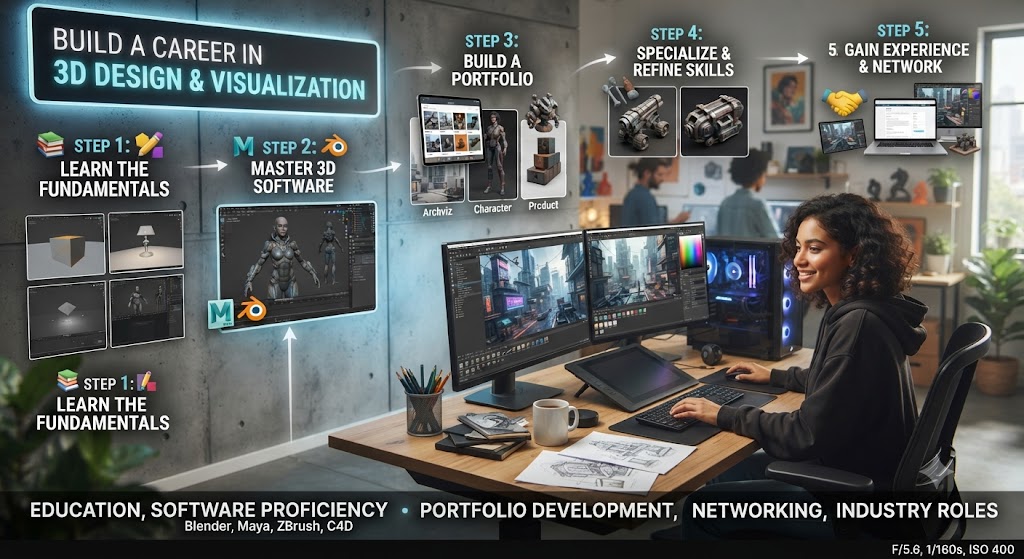
A career in 3D design and visualization offers opportunities across architecture, gaming, product design, advertising, entertainment, manufacturing, real estate, and technology. As businesses increasingly use realistic digital environments and visual experiences, skilled 3D professionals can work across many creative and technical industries.
Building a career in 3D design and visualization requires more than learning 3D software. Professionals need a strong portfolio, knowledge of modeling and rendering, attention to detail, creative problem-solving, and an understanding of how 3D visuals support business objectives.
The field also offers opportunities for remote work. Many modeling, rendering, animation, and visualization projects can be completed digitally, allowing professionals to work with international companies and creative teams. With the right skills and career strategy, 3D design can become a flexible and sustainable profession.
1. Understand the 3D Design and Visualization Career Path
The first step toward a career in 3D design and visualization is understanding the different specializations available. 3D professionals work in many industries, so choosing a specific direction can help you build relevant skills and a focused portfolio.
Popular career options include:
- 3D Designer
- 3D Modeler
- 3D Visualizer
- 3D Animator
- Architectural Visualizer
- Product Visualization Artist
- Environment Artist
- Character Artist
- Rendering Artist
- Motion Designer
- 3D Generalist
- Visualization Specialist
Architectural visualization focuses on creating realistic representations of buildings and interior spaces. Product visualization involves creating digital models and renders of products for marketing, e-commerce, and presentations.
Gaming and entertainment offer opportunities in character modeling, environment design, animation, and visual effects.
Because these roles require different skills, identify your preferred industry before investing significant time in advanced training.
2. Learn the Essential 3D Design Skills
Developing a career in 3D design and visualization starts with a strong technical foundation. You do not need to learn every 3D application available. Instead, focus on the tools and techniques relevant to your chosen specialization.
Important skills include:
- 3D modeling
- Texturing
- Lighting
- Rendering
- Materials
- Composition
- Animation
- Camera setup
- Basic visual effects
- Post-production
You should also understand fundamental design principles such as proportion, perspective, color, lighting, and composition.
For example, a technically accurate 3D model may still look unrealistic if the lighting and materials are poorly designed. Therefore, technical software knowledge should be combined with visual judgment.
Start with simple projects and gradually increase complexity. Build basic objects first, then progress to complete environments, products, interiors, characters, or animated scenes.
Consistent practice is more effective than attempting advanced projects before understanding the fundamentals.
3. Build a Professional 3D Portfolio
A strong portfolio is essential when applying for 3D design and visualization jobs. Employers want to see the quality of your final work, not simply a list of software programs you know.
Your portfolio should focus on your target specialization.
For example, an architectural visualization portfolio could include:
- Exterior renders
- Interior renders
- Floor-plan visualizations
- Lighting studies
- Day and night scenes
A product visualization portfolio could include:
- Product models
- Studio renders
- Product animations
- Material variations
- Marketing visuals
If you are interested in gaming, consider including environments, props, characters, and scene development.
When you do not have professional clients, create self-initiated projects. Choose a realistic brief and complete the project from concept to final render.
Show selected stages of your process when useful. Including modeling, materials, lighting, and final rendering can demonstrate technical knowledge and creative decision-making.
Keep your portfolio focused. A smaller collection of high-quality work is generally more effective than a large collection of unfinished projects.
4. Find Remote 3D Design Opportunities
Remote work has created new possibilities for professionals pursuing a career in 3D design and visualization. Many digital projects can be completed remotely, particularly modeling, rendering, product visualization, animation, and post-production.
Remote opportunities may be available with:
- Architecture firms
- Interior design companies
- Advertising agencies
- Gaming studios
- Product companies
- E-commerce businesses
- Technology companies
- Real estate companies
- Animation studios
Remote 3D work requires strong file management because projects can contain large models, textures, renders, and animation files.
Create an organized workflow with clear project folders, naming conventions, backups, and version control.
You should also communicate project progress regularly. Share previews before completing the entire project so that clients or team members can identify changes early.
When searching for jobs, use specific keywords such as “3D Designer,” “3D Visualizer,” “3D Artist,” “3D Modeler,” “Architectural Visualizer,” and “Product Visualization Artist.”
A global job platform such as best job tool can help professionals explore remote and international opportunities in 3D design and visualization.
5. Improve Productivity in 3D Projects
3D projects can require significant amounts of time, especially when models are detailed or rendering is complex. Productivity therefore depends on having an organized workflow.
Divide each project into clear stages:
- Understand the project brief.
- Collect references.
- Create initial concepts.
- Build the 3D model.
- Apply materials and textures.
- Set up lighting and cameras.
- Create test renders.
- Make revisions.
- Produce final renders.
- Complete post-production and delivery.
Do not wait until the final render to discover major problems. Test lighting, materials, composition, and camera positions early.
Reusable assets can also save time. Build organized libraries of commonly used materials, models, textures, lighting setups, and templates.
However, make sure any third-party assets you use have appropriate commercial licensing.
Time management is particularly important when working remotely. Establish daily priorities and separate creative production time from administrative tasks such as emails, meetings, and revisions.
6. Test Travel While Working Remotely
A career in 3D design and visualization can offer location flexibility, but working while traveling requires additional preparation.
Before planning long-term travel, test your remote working setup for several days or one week.
Evaluate:
- Internet stability
- Upload and download speeds
- Workspace quality
- Electricity reliability
- Backup connectivity
- Time-zone differences
- Meeting schedules
- Productivity
- Accommodation costs
Large 3D project files can make reliable internet particularly important. Cloud-based collaboration and file transfers may become difficult when connectivity is inconsistent.
Your computer setup should also be considered. If your work requires powerful hardware for rendering, traveling with a suitable workstation or laptop may affect transportation and equipment costs.
Therefore, travel should be treated as a practical work experiment. Test your setup before committing to a long-term location-independent lifestyle.
7. Plan Your Finances and Long-Term Career Growth
Financial planning is an important part of building a sustainable career in 3D design and visualization. Professional software, hardware, storage, training, and portfolio development can require significant investment.
Create a budget that includes:
- Software subscriptions
- Computer upgrades
- Rendering resources
- Storage and backup
- Training courses
- Portfolio expenses
- Internet costs
- Travel expenses
- Emergency savings
- Long-term investments
Do not upgrade equipment simply because newer technology is available. Invest when an upgrade improves productivity or allows you to complete work that your current setup cannot handle efficiently.
Career growth should also be planned.
In the beginning, focus on fundamental modeling, rendering, and portfolio development. As your experience grows, specialize in a profitable industry and develop advanced skills.
Possible long-term directions include:
- Senior 3D Designer
- Lead 3D Artist
- Art Director
- Visualization Director
- Creative Director
- Technical Artist
- 3D Production Manager
You can also expand into independent products, training, asset creation, or specialized consulting.
The most valuable professionals combine strong visual skills with an understanding of deadlines, budgets, client requirements, and business objectives.
Conclusion
Building a career in 3D design and visualization requires a combination of technical expertise, creative ability, portfolio development, and professional planning. The industry offers opportunities in architecture, product design, gaming, advertising, entertainment, real estate, technology, and many other sectors.
Start by choosing a specialization and learning the core skills required for that industry. Then create a focused portfolio that demonstrates the quality and relevance of your work. Practical self-initiated projects can help you gain experience when professional opportunities are limited.
Remote work can expand your access to international companies and creative teams. However, successful remote work requires organized file management, reliable communication, productivity systems, and suitable hardware.
If you plan to combine your 3D career with travel, test your remote setup before making long-term commitments. Evaluate internet reliability, workspace quality, equipment requirements, time zones, and expenses.
Finally, create a realistic financial plan and continue developing your skills as technology changes. A career in 3D design and visualization can become a sustainable long-term profession when creative talent is supported by technical expertise, business awareness, and strategic career planning.






Comments
Be the first to leave a comment.