

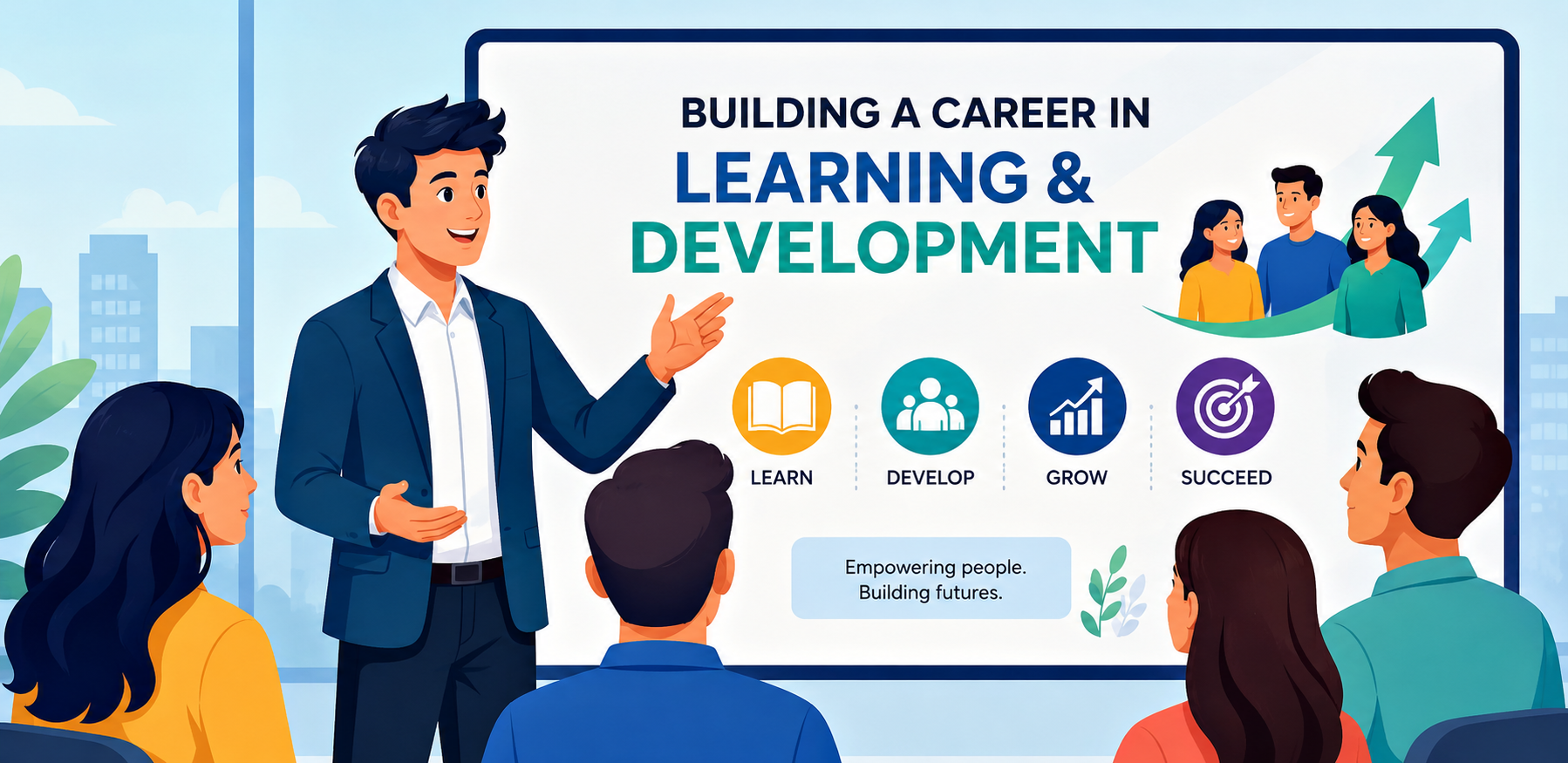
Introduction: Career in Learning and Development
Do you want to build a career in Learning and Development?
Many people want to build a career in Learning and Development because it is a growing career field today. In this field, professionals help employees learn new skills and improve their performance.
If you are also serious about building a career in L&D, this article will help you. In this article, we will share some effective and practical tips to help you start and grow your career in Learning and Development.
How to Build a Career in Learning and Development?
1. Understand the Different Roles in L&D
If you want to build a career in Learning and Development, the first step is to understand the different roles available in this field. This will help you choose the right direction for your career.
Some popular and growing roles include Training Coordinator, Learning and Development Specialist, Instructional Designer, Corporate Trainer, Learning Experience Designer, and Learning and Development Manager.
Take time to learn about these roles and understand their responsibilities. Once you find a role that matches your interests and career goals, you can follow the necessary steps to build your career in that area.
2. Develop Strong Communication Skills
To build a career in Learning and Development, you need to develop strong communication skills. In most Learning and Development roles, your main responsibility is to interact with employees and managers and explain different concepts and processes.
If your communication skills are not strong, it can lead to misunderstandings and make it difficult to handle your work effectively.
That is why improving your communication skills is very important. Strong communication helps you interact clearly with others and avoid confusion.
You can improve your communication skills in several ways, such as writing regularly, listening actively, and practicing public speaking.
3. Learn Adult Learning Principles
In Learning and Development roles, you do not train children—you train employees, who are adults. That is why it is important to learn about adult learning principles before you start working in this field.
There is a big difference between teaching children and teaching adults. Children can learn through stories, theory, and imaginary examples. However, when training employees, you need to use practical, relevant, and real-world examples that connect to their daily work.
Understanding adult learning principles helps you create and deliver effective training programs that meet the needs of employees and improve learning outcomes.

4. Build Knowledge of Instructional Design
If you want to build a career in Learning and Development (L&D), it is important to have knowledge of instructional design. In this field, you are responsible for planning, creating, and organizing learning content effectively.
To do this, you need to learn instructional design principles. Instructional design teaches you how to design courses, create effective assessments, set clear learning objectives, and develop storyboards for training programs.
Having these skills helps you create learning experiences that are engaging, structured, and effective for employees.
5. Become Comfortable With Learning Technology
Today, technology has become a very important part of the workplace. New tools and technologies are introduced regularly, and it is important for employees to understand them so they can perform their jobs effectively and handle work more efficiently.
Providing technology-related training to employees is often the responsibility of the Learning and Development (L&D) team. Therefore, it is important to have a good understanding of technology.
Having knowledge of modern tools and technologies will help you design relevant training programs and teach employees how to use these tools effectively in their daily work.
Conclusion: Career in Learning and Development
Building a career in Learning and Development can be a great choice because it is a growing field with many opportunities. To succeed, you should understand the different roles available, improve your communication skills, and learn the principles of adult learning.
These skills and knowledge will help you create effective training programs and support employee growth. With continuous learning and practice, you can build a successful and rewarding career in Learning and Development.
“If you enjoy helping others learn and grow, Learning and Development can be a rewarding career path. Explore opportunities and insights with Best Job Tool.”






Comments
Be the first to leave a comment.