

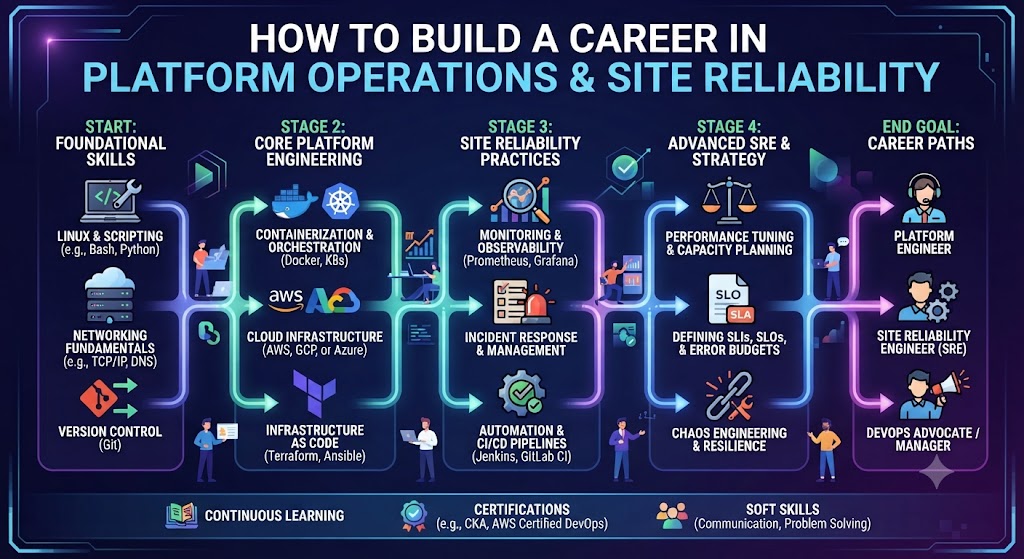
Modern businesses depend on digital platforms that must remain available, secure, scalable, and reliable around the clock. From financial services and e-commerce to SaaS products and AI applications, organizations need professionals who can keep technology infrastructure operating efficiently while reducing downtime and operational risk. This has created strong career opportunities in platform operations and site reliability.
Platform operations focuses on maintaining and improving the systems that support applications and services. Site reliability engineering, commonly known as SRE, applies software engineering and operational practices to improve system reliability, performance, scalability, and resilience.
Although SRE is often associated with coding, platform operations offers multiple career paths for professionals with backgrounds in IT support, infrastructure, cloud operations, system administration, technical support, and technology operations. With the right skills, professionals can gradually move into reliability-focused positions without needing to become expert programmers immediately.
This career path can also support remote and distributed work. However, success requires strong technical fundamentals, disciplined incident management, continuous learning, productivity systems, and thoughtful financial planning.
1. Understand Platform Operations and Site Reliability
Before entering the field, understand how platform operations and SRE differ from traditional IT support.
Platform operations teams manage the infrastructure, tools, processes, and environments that allow applications to run effectively. Their work may include cloud infrastructure, deployment platforms, monitoring systems, access management, automation, configuration, and operational support.
SRE takes this further by treating reliability as an engineering objective.
Typical responsibilities can include:
- Monitoring application and infrastructure performance
- Responding to production incidents
- Improving system availability
- Managing cloud infrastructure
- Automating repetitive operational tasks
- Supporting deployments and releases
- Investigating system failures
- Developing monitoring and alerting strategies
- Managing capacity and scalability
- Conducting post-incident reviews
- Improving operational processes
A key SRE concept is the service level objective (SLO). Instead of simply saying that a system should be “reliable,” teams define measurable reliability targets.
For example, a service might have a target of 99.9% availability. The team can then use monitoring data to determine whether the system is meeting that objective.
Understanding these principles will help you approach reliability as a measurable business outcome rather than simply a technical responsibility.
2. Build the Technical Foundation Step by Step
You do not need to learn everything simultaneously. Build your knowledge progressively.
Start with operating systems
Understand:
- Linux fundamentals
- Processes and services
- File systems
- Permissions
- Logs
- Networking commands
- System resource monitoring
- Shell basics
Linux knowledge is particularly useful because many cloud and server environments rely heavily on Linux-based systems.
Learn networking
You should understand concepts such as:
- IP addresses
- DNS
- HTTP and HTTPS
- Ports
- Firewalls
- Load balancing
- Routing
- TCP/IP
- Proxies
You do not need to become a network engineer, but you should be able to investigate common connectivity and application problems.
Learn cloud platforms
Choose one major cloud environment and build foundational knowledge.
Focus on:
- Compute
- Storage
- Databases
- Virtual networks
- Identity and access management
- Load balancing
- Monitoring
- Security
- Backup and recovery
Once you understand the fundamentals of one cloud platform, learning another becomes easier.
Develop automation skills
Start with basic scripting rather than trying to become a software developer overnight.
Learn enough Python, Bash, or another scripting language to automate repetitive operational work.
For example, you could create scripts that:
- Check system health
- Process logs
- Monitor disk usage
- Generate reports
- Automate routine configuration tasks
The objective is to reduce manual work and improve consistency.
3. Learn the Tools Used in Modern Platform Operations
Employers often look for candidates who understand the ecosystem surrounding modern infrastructure.
You may encounter tools for:
- Version control
- Infrastructure as code
- Containers
- Container orchestration
- CI/CD
- Monitoring
- Logging
- Incident management
- Configuration management
You do not need expertise in every tool listed in a job description.
Instead, understand the purpose of each category.
For example, infrastructure-as-code tools allow teams to define infrastructure through configuration rather than manually creating resources. Containers package applications and their dependencies consistently. CI/CD systems automate parts of the build, testing, and deployment process.
Monitoring and observability tools help teams understand system behavior through metrics, logs, traces, and alerts.
Learning the concepts first makes it easier to adapt when an employer uses a different tool.
4. Build Practical Projects to Demonstrate Reliability Skills
Certifications can help, but practical projects make your skills easier to evaluate.
Create a small cloud-based project and document how you would operate it in production.
For example, build a simple web application and create an operational plan covering:
- Infrastructure architecture
- Deployment process
- Monitoring
- Logging
- Backup strategy
- Security controls
- Incident response
- Recovery procedures
- Performance monitoring
Then intentionally introduce a problem and document how you would diagnose it.
You could simulate:
- A service becoming unavailable
- High CPU utilization
- Increased application latency
- Database connectivity failure
- Expired credentials
- Storage capacity problems
Your project documentation should explain:
Problem → Detection → Investigation → Resolution → Prevention
This demonstrates the mindset employers expect from reliability professionals.
A portfolio can also contain architecture diagrams, incident reports, runbooks, automation scripts, and post-incident reviews.
You do not need to expose confidential information from an employer. Build your portfolio using personal projects or fictional scenarios.
5. Choose the Right Career Entry Point
Not everyone should apply directly for an SRE position.
If you are starting with limited infrastructure experience, consider roles that provide a natural transition.
Potential entry points include:
- IT Operations Analyst
- Cloud Operations Analyst
- Systems Administrator
- Infrastructure Analyst
- Technical Operations Analyst
- DevOps Associate
- Platform Support Engineer
- Cloud Support Engineer
- NOC Engineer
- Junior Site Reliability Engineer
Professionals already working in IT support can use their existing troubleshooting experience as a foundation.
For example, experience diagnosing application problems, managing user access, resolving infrastructure tickets, documenting incidents, and escalating technical issues can transfer into platform operations.
The next step is to add cloud, Linux, networking, automation, and monitoring knowledge.
When applying, customize your resume around outcomes.
Instead of writing:
Managed technical support tickets.
A stronger description might explain that you investigated recurring technical incidents, identified patterns, documented root causes, and improved resolution procedures.
This demonstrates operational thinking rather than simply listing responsibilities.
6. Build a Remote Career Without Sacrificing Reliability
Platform operations and SRE can be compatible with remote work because monitoring, documentation, incident coordination, deployment support, and infrastructure management can often be performed remotely.
However, remote SRE work can also involve on-call responsibilities.
Before accepting a remote position, understand:
- On-call frequency
- Expected response times
- Incident escalation procedures
- Time-zone requirements
- Maintenance windows
- Weekend responsibilities
- Team communication practices
- International work restrictions
Remote does not necessarily mean you can work from any country.
Organizations may restrict international access because of security, regulatory, tax, employment, or customer requirements.
Create a reliable remote setup
Your workspace should support focused technical work.
Prioritize:
- Stable primary internet
- Backup connectivity
- Reliable power
- Secure authentication
- Appropriate workstation equipment
- Noise control
- Secure handling of company information
If you are searching for global remote technology opportunities, best job tool, a global job platform, can be one part of a broader job-search strategy alongside company career pages and professional networks.
Use specific search terms such as:
- Remote Platform Engineer
- Remote Cloud Operations Engineer
- Remote SRE
- Site Reliability Engineer
- Cloud Infrastructure Engineer
- Platform Operations Analyst
- DevOps Engineer
Focus on roles that match your current skill level rather than applying only to senior positions.
7. Test Travel Flexibility, Productivity, and Financial Sustainability
Technology operations can sometimes provide location flexibility, but reliability work has a unique challenge: incidents can happen at inconvenient times.
If you want to combine remote technology work with travel, test the arrangement before committing to a major lifestyle change.
Start with a short trip and maintain your normal working schedule.
Evaluate:
- Internet stability
- Power reliability
- Workspace quality
- Time-zone compatibility
- Meeting attendance
- Productivity
- Incident response capability
- Personal stress
- Travel-related expenses
For on-call professionals, backup connectivity is especially important. Missing an incident because of unreliable internet can affect both your performance and the wider team.
Always confirm your organization’s remote-work and international-work policies before traveling.
Build a financial buffer
Location flexibility works better when you have financial stability.
Before making a major transition, calculate:
- Monthly essential expenses
- Accommodation costs
- Travel expenses
- Internet and equipment
- Insurance
- Taxes
- Emergency savings
- Professional training
Maintain an emergency fund that can cover a reasonable period of essential expenses. This reduces pressure if you experience a job transition, contract gap, or unexpected travel cost.
You can also use best job tool to explore global opportunities while maintaining a separate financial plan for career transitions and travel.
Conclusion
Building a career in platform operations and site reliability requires a combination of technical knowledge, troubleshooting ability, automation, communication, and operational discipline. You do not have to master every technology before entering the field. A structured learning path can take you from IT support or operations into cloud operations, platform engineering, DevOps, or SRE.
Start with Linux, networking, cloud fundamentals, monitoring, version control, automation, and incident management. Then reinforce your knowledge through practical projects that demonstrate how you would detect, investigate, resolve, and prevent operational problems.
Remote work can provide valuable flexibility, but reliability professionals must take on-call responsibilities, security requirements, time zones, and infrastructure dependencies seriously. Test travel gradually, maintain a dependable working environment, and confirm employer policies before working internationally.
Finally, treat your career development as a long-term process. Continue building technical depth, document measurable achievements, strengthen your professional portfolio, and maintain financial reserves. With consistent skill development and practical experience, platform operations and site reliability can become a strong and flexible technology career path.






Comments
Be the first to leave a comment.