

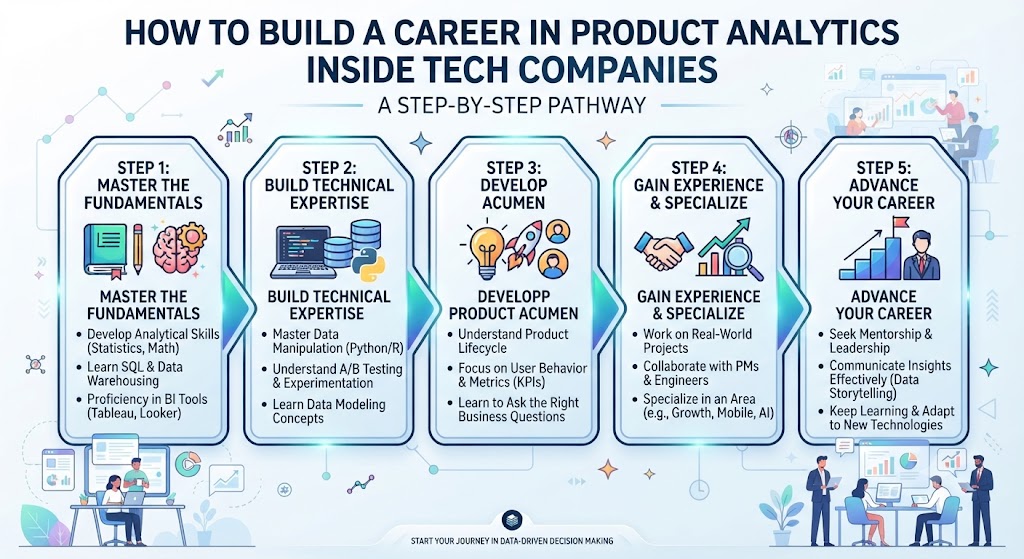
Product analytics has become one of the most important data-driven functions in modern technology companies. As businesses launch new applications, SaaS platforms, mobile products, and digital services, they need professionals who can understand how users interact with their products and turn that information into better business companies decisions.
A career in product analytics combines data analysis, user behavior, business strategy, experimentation, and product development. Unlike some highly technical data careers, product analytics does not require professionals to become software engineers. However, strong analytical skills, SQL knowledge, data visualization, statistics, and product thinking are increasingly important.
For professionals coming from business intelligence, marketing analytics, operations, finance, customer success, or traditional reporting, product analytics can provide a logical career transition. It can also offer opportunities for remote work with technology companies operating across different countries.
Building this career successfully requires more than learning analytics software. You need to understand product metrics, develop practical projects, communicate insights, and demonstrate how your analysis can improve user experiences and business performance.
1. Understand What Product Analytics Is and Why It Matters
Product analytics is the process of analyzing data generated by users interacting with a product. The objective is to understand user behavior, identify problems, measure product performance, and support product decisions.
A product analyst may examine questions such as:
- How many users complete onboarding?
- Which features are used most frequently?
- Where do users abandon a process?
- What causes customers to stop using a product?
- Which features increase engagement?
- How does a new feature affect retention?
- Which customer segments generate the most revenue?
This makes product analytics different from traditional business reporting.
A reporting analyst might show that monthly active users decreased by 8%.
A product analyst investigates why.
They may examine user cohorts, device types, acquisition channels, product changes, feature usage, and customer segments to determine what contributed to the decline.
The goal is to transform raw product data into actionable insights.
This is why product analytics is valuable inside technology companies. Product managers, designers, engineers, and executives can use analytics to make decisions based on evidence rather than assumptions.
2. Choose the Right Product Analytics Career Path
There is no single product analytics career path. Technology companies use different job titles depending on their size and organizational structure.
Product Analyst
A product analyst studies user behavior and product performance. They typically work closely with product managers and data teams.
Product Data Analyst
This role focuses more heavily on extracting and analyzing product data using SQL, dashboards, and statistical techniques.
Product Insights Analyst
Product insights professionals focus on turning user and product data into recommendations for product teams.
Growth Analyst
Growth analysts examine acquisition, activation, conversion, engagement, and retention to identify opportunities for business growth.
Product Analytics Manager
Experienced professionals can move into management positions where they lead analysts and work closely with product leadership.
Other related career options include:
- Business Intelligence Analyst
- Data Analyst
- Customer Insights Analyst
- Marketing Analyst
- Product Operations Analyst
- Revenue Analyst
- Analytics Consultant
Professionals transitioning into product analytics do not necessarily need to start with a job titled “Product Analyst.”
A data analyst who gains experience with user behavior and product metrics can move into product analytics later.
3. Develop the Essential Product Analyst Skills
The skills needed for product analytics can be divided into four main areas: technical skills, analytical skills, product knowledge, and communication.
Technical skills
Start with:
- Excel or Google Sheets
- SQL
- Data visualization
- Basic database concepts
- Dashboard development
SQL is particularly important because product data is frequently stored in databases and cloud data warehouses.
Learn:
- SELECT
- WHERE
- GROUP BY
- ORDER BY
- JOIN
- CASE statements
- Aggregate functions
- Subqueries
- Common table expressions
You do not need to learn advanced SQL immediately. Start with practical business questions and gradually increase complexity.
Analytical skills
Learn how to perform:
- Funnel analysis
- Cohort analysis
- Retention analysis
- Segmentation
- Trend analysis
- Conversion analysis
- A/B test analysis
Product knowledge
Understand:
- User journeys
- Product funnels
- Feature adoption
- Customer retention
- Product-market fit
- User experience
- Product development
- Experimentation
Communication
A product analyst must explain findings to people who may not understand SQL or statistics.
You should be able to communicate:
What happened → Why it matters → What may be causing it → What should be investigated next
This combination of technical and communication skills makes a product analyst valuable.
4. Master Product Metrics and User Behavior Analytics
Understanding product metrics is essential for building a successful product analytics career.
Acquisition metrics
These measure how users arrive at the product.
Examples include:
- Website traffic
- Sign-ups
- Acquisition cost
- Conversion rate
Activation metrics
Activation measures whether new users experience the product’s intended value.
Examples include:
- Account completion
- First purchase
- First successful task
- Feature activation
Engagement metrics
These show how actively users interact with the product.
Examples include:
- Daily active users
- Monthly active users
- Session frequency
- Feature usage
Retention metrics
Retention measures whether users continue using the product.
Important measurements include:
- Cohort retention
- Customer churn
- Repeat usage
- Subscription renewal
Revenue metrics
These may include:
- Average revenue per user
- Customer lifetime value
- Subscription revenue
- Expansion revenue
Do not analyze these metrics independently.
For example, increasing the number of new users does not necessarily indicate successful growth if activation and retention are declining.
A strong product analyst understands the relationship between different stages of the customer journey.
5. Build a Product Analytics Portfolio
If you want to know how to become a product analyst without previous product analytics experience, start with practical portfolio projects.
A strong portfolio demonstrates your ability to solve realistic product problems.
Project 1: Product funnel analysis
Analyze a fictional SaaS application.
Track:
Website Visit → Sign-Up → Activation → Purchase → Retention
Identify where users drop off and investigate possible causes.
Project 2: User retention analysis
Create customer cohorts based on signup month.
Measure how many users remain active after:
- 7 days
- 30 days
- 60 days
- 90 days
Present the results in a dashboard.
Project 3: Feature adoption analysis
Analyze usage of several product features.
Determine:
- Which feature has the highest adoption
- Which users adopt it
- Whether adoption is associated with retention
- Which features may require better onboarding
Project 4: A/B testing analysis
Compare two versions of a product feature or landing page.
Analyze:
- Conversion
- Activation
- Engagement
- Revenue
Explain whether the available evidence supports a product decision.
For every portfolio project, use this structure:
Business Question → Data → Analysis → Insight → Recommendation
Do not simply show charts.
Explain what the results mean for the product team.
This is one of the most important differences between a basic data portfolio and a strong product analytics portfolio.
6. Find Product Analytics Jobs at Technology Companies
After building your technical foundation and portfolio, begin applying for relevant product analytics jobs.
Search for titles such as:
- Product Analyst
- Product Data Analyst
- Product Analytics Analyst
- Product Insights Analyst
- Growth Analyst
- Data Analyst
- Customer Analytics Analyst
- Business Intelligence Analyst
Read job descriptions carefully.
Some companies may prioritize SQL and statistics, while others may place greater emphasis on business understanding, experimentation, dashboards, or stakeholder communication.
If you are transitioning from another career, emphasize transferable skills.
For example:
Marketing professionals: Highlight conversion analysis, customer segmentation, campaign performance, and user behavior.
Business intelligence professionals: Highlight dashboards, SQL, reporting, KPI analysis, and data modeling.
Operations professionals: Highlight process analysis, performance metrics, and problem-solving.
Customer success professionals: Highlight customer behavior, retention, churn, and product feedback.
For professionals searching for global opportunities, best job tool, a global job platform, can complement LinkedIn, company career pages, professional networking, and employee referrals.
Do not depend on one source of job opportunities. A diversified job-search strategy can increase your exposure to suitable product analytics roles.
7. Build a Remote Product Analytics Career With Travel, Productivity, and Financial Planning
Product analytics can be compatible with remote work because much of the job involves databases, dashboards, research, documentation, virtual meetings, and collaboration platforms.
However, remote work requires strong organization.
Create a workflow for tracking:
- Analytics requests
- Project deadlines
- SQL analysis
- Dashboard updates
- Stakeholder feedback
- Product experiments
- Data-quality issues
Document metric definitions and analytical assumptions so that distributed teams can understand your work without requiring repeated meetings.
Test remote work before traveling
If your long-term goal is to combine product analytics with travel, test the arrangement first.
Before traveling, confirm:
- Whether your employer permits international remote work
- Whether company systems can be accessed from your destination
- Time-zone requirements
- Security policies
- VPN requirements
- Data-access restrictions
Then conduct a short travel test.
Monitor:
- Productivity
- Meeting attendance
- Internet reliability
- Working hours
- Work quality
- Travel expenses
A remote job does not automatically mean you can work from any country. Technology companies may have restrictions based on security, employment, tax, or regulatory requirements.
Maintain productivity
Product analytics requires concentrated analytical work.
Use dedicated blocks for:
- SQL analysis
- Dashboard development
- Data validation
- Documentation
- Research
Avoid constantly switching between meetings, messages, and analytical tasks.
Plan your finances
Career flexibility also requires financial discipline.
Before making a career transition or adopting a travel-based lifestyle, calculate:
- Monthly living expenses
- Accommodation
- Travel
- Internet
- Equipment
- Insurance
- Taxes
- Professional training
- Emergency savings
Build an emergency fund before making major lifestyle changes.
As your product analytics experience grows, best job tool can help you explore global opportunities while you continue developing your technical portfolio and professional network.
Conclusion
Building a career in product analytics at technology companies requires a combination of data skills, product knowledge, analytical thinking, and communication. You do not need to become a software engineer, but you should develop a strong understanding of SQL, statistics, data visualization, user behavior, and product metrics.
Start by learning how products measure acquisition, activation, engagement, retention, and revenue. Then build practical skills through SQL exercises, dashboards, funnel analysis, cohort analysis, and experimentation.
A strong portfolio can help demonstrate your abilities when you lack direct product analytics experience. Focus on realistic product problems and explain the reasoning behind your conclusions.
When searching for product analytics jobs, look beyond one specific job title. Product analyst, product data analyst, growth analyst, product insights analyst, and data analyst positions can all provide valuable career opportunities.
Remote product analytics jobs can offer flexibility, but sustainable remote work requires disciplined productivity, secure data practices, clear communication, and reliable connectivity. If you plan to work while traveling, test the arrangement first and confirm your employer’s international-work policies.
Finally, build your career and finances together. Invest in relevant skills, maintain an emergency fund, continue developing your portfolio, and build a professional network within the technology industry.
With consistent skill development and practical experience, product analytics can become a strong career path for professionals who want to combine data, technology, user behavior, and business strategy.






Comments
Be the first to leave a comment.