

Introduction
A portfolio-style career offers flexibility, diversity, and independence. However, it can also bring uncertainty if not managed properly. This is exactly why understanding how to build stability inside a portfolio-style career is essential.
Unlike traditonal jobs, portfolio careers rely on multiple income streams. Therefore, stability does not come from one source. It comes from structure, planning, and consistency.
Professionals who manage this balance effectively can enjoy both freedom and security. As a result, they create sustainable and resilient careers.
Understanding stability in a portfolio career
Stability in a portfolio career looks different from traditional employment. It is not about a fixed salary or a single role.
Instead, it comes from diversified income, reliable workflows, and consistent opportunities. Professionals must build systems that support these elements.
Additionally, stability depends on predictability. Having a clear plan reduces uncertainty.
Therefore, stability is created through intentional effort.
Why portfolio careers can feel unstable
Portfolio careers involve variable income and changing workloads. This can create uncertainty.
Projects may come and go. Therefore, income is not always consistent.
Additionally, managing multiple roles can be complex. Without structure, it may lead to confusion or burnout.
However, these challenges can be managed with the right approach.
How to build stability inside a portfolio-style career with diversification
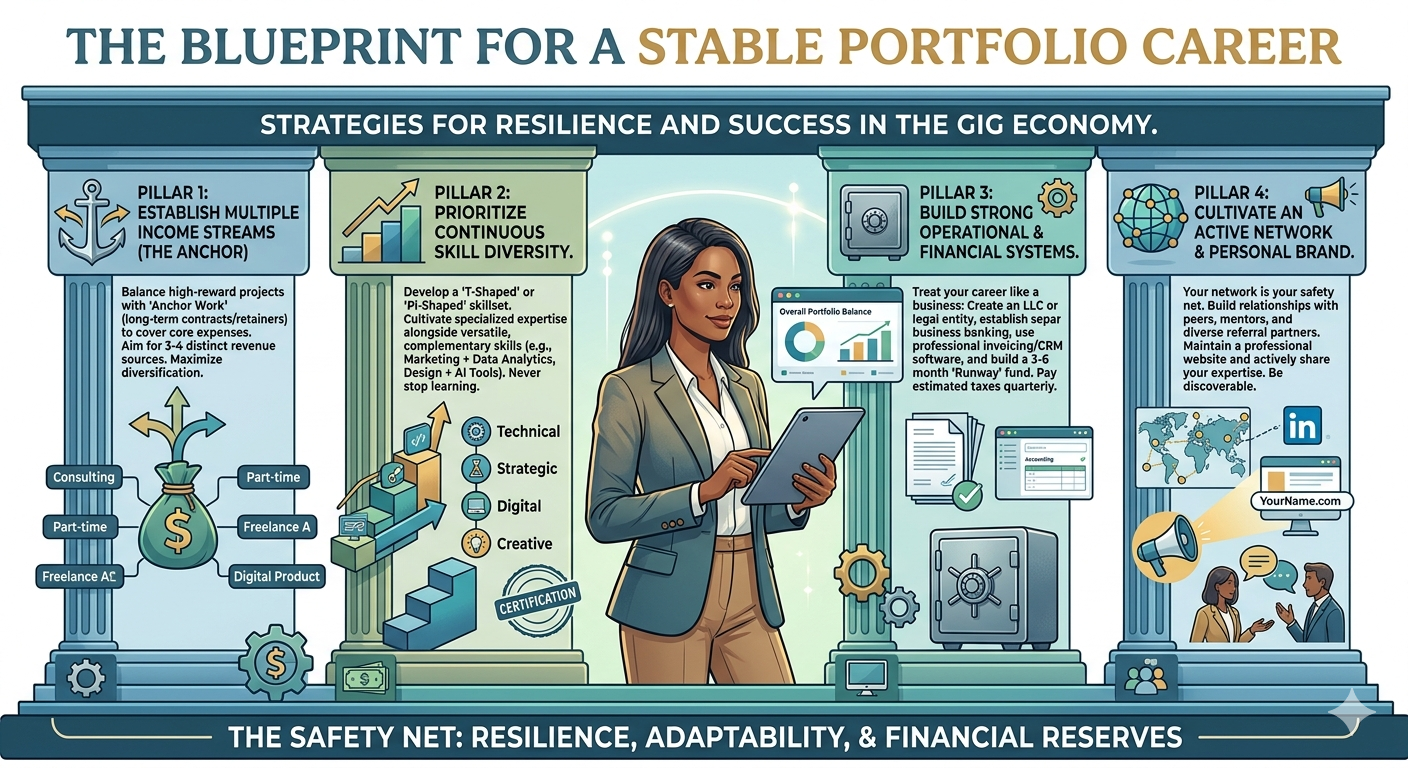
Diversification is one of the strongest stability strategies. Multiple income streams reduce dependency on a single source.
If one stream slows down, others can support you. Therefore, financial risk decreases.
Additionally, diversification increases opportunities. Professionals can explore different industries and roles.
Thus, diversification creates a stable foundation.
Creating consistent income streams
Consistency is key to financial stability. Professionals should aim to create recurring income where possible.
Retainer clients, long-term projects, or subscription-based services can provide steady earnings.
Additionally, combining active and passive income improves reliability.
Moreover, tracking income patterns helps in planning.
Therefore, consistent income streams strengthen stability.
The role of financial planning and savings
Financial planning is essential in a portfolio career. Income fluctuations require careful management.
Building savings provides a safety net. It helps during periods of low income.
Additionally, budgeting ensures expenses remain under control.
Moreover, planning for taxes and investments supports long-term security.
Thus, financial discipline enhances stability.
Building strong client and professional relationships
Relationships play a major role in stability. Repeat clients provide consistent work opportunities.
Therefore, maintaining strong communication is important. Delivering quality work builds trust.
Additionally, networking expands your opportunities. New connections can lead to future projects.
Moreover, referrals often come from satisfied clients.
Thus, relationships create a reliable support system.
Managing time and workload effectively
Time management is critical in a portfolio career. Balancing multiple roles requires structure.
Set clear schedules and priorities. Focus on high-impact tasks.
Additionally, avoid overcommitting. Taking on too much work can reduce quality.
Moreover, allocate time for rest and recovery.
Therefore, effective time management supports both productivity and stability.
The importance of consistency in building stability
Consistency is the foundation of stability. Regular effort leads to predictable outcomes.
Professionals who deliver consistently build strong reputations. This increases demand for their work.
Additionally, consistent communication improves relationships.
Moreover, consistency reduces uncertainty over time.
Thus, stable careers are built on consistent actions.
How to reduce risk in a portfolio career
Risk is part of any portfolio career. However, it can be managed effectively.
Avoid relying on a single client or income source. Diversification reduces vulnerability.
Additionally, maintain emergency savings. This provides financial security.
Moreover, continuously update your skills. This ensures ongoing opportunities.
Therefore, proactive strategies help reduce risk.
The role of continuous learning in long-term stability
Learning is essential for staying relevant. Portfolio professionals must adapt to changing demands.
Invest in new skills and knowledge. This improves competitiveness.
Additionally, learning increases confidence. It prepares professionals for new opportunities.
Moreover, staying updated with trends ensures long-term growth.
Thus, continuous learning supports stability.
How the best job tool supports portfolio professionals
Using the best job tool can enhance stability in a portfolio career. It helps professionals find consistent opportunities.
Additionally, it connects individuals with multiple clients and roles. This supports diversification.
Moreover, advanced filters help identify relevant projects quickly.
Therefore, the best job tool becomes a valuable resource for maintaining stability.
Conclusion
Understanding how to build stability inside a portfolio-style career is essential for long-term success. Stability comes from diversification, consistency, and strategic planning.
By creating multiple income streams, managing finances, and maintaining strong relationships, professionals can reduce uncertainty.
In today’s evolving work environment, portfolio careers offer both flexibility and opportunity. With the right approach and the best job tool, you can build a stable, sustainable, and rewarding career.
Find Your Dream Job Today – Explore Endless Career Opportunities and Secure Your Next Role with Best Job Tool.






Comments
Be the first to leave a comment.