

Introduction: Communicate Upwards With Senior Management
In every organization, communication is one of the most important skills. Employees usually communicate with their teammates, but there is another level of communication that is even more important and often more challenging—communicating upwards with senior management.
Many people find it difficult to talk to managers, directors, or senior leaders. They feel nervous, overthink their words, or try to explain too much. But the truth is, senior management does not expect complicated language or long explanations. They expect clarity, relevance, and confidence.
In this article, we will understand how to communicate effectively with senior management in simple steps. This will help you express your ideas clearly, build trust, and grow in your career.
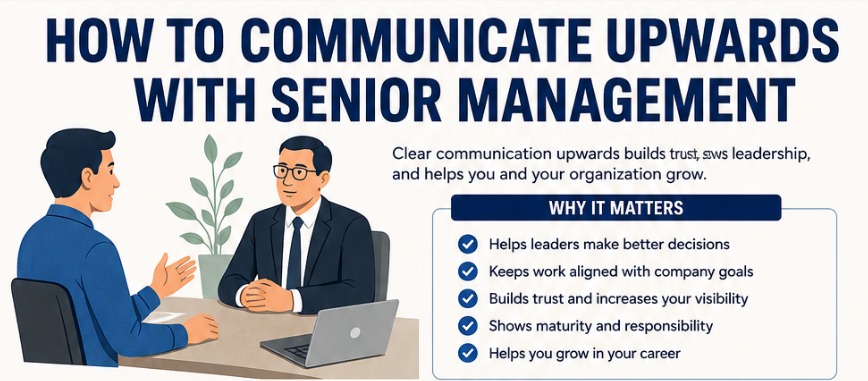
Why Upward Communication Is Important?
Upward communication means sharing information, ideas, problems, or updates with people above you in the organization hierarchy.
It is important because:
- It helps leaders make better decisions
- It keeps projects aligned with company goals
- It builds trust between employees and management
- It increases your visibility in the organization
- It helps you grow faster in your career
If you communicate well with senior leaders, they see you as a responsible and thoughtful employee.
1. Understand What Senior Management Wants
Before you communicate with senior leaders, you must understand their mindset.
Senior management usually focuses on:
- Business results
- Time and efficiency
- Risks and solutions
- Big picture goals
- Return on investment
They do not focus on small details unless required.
For example, if you say:
“I worked on fixing bugs in the system.”
It may not sound important.
But if you say:
“I fixed system bugs that improved performance by 20% and reduced customer complaints.”
Now it sounds valuable because it connects to business impact.
So always think:
“How does this matter to the company?”
2. Be Clear and Simple
One of the biggest mistakes people make is using complicated language or giving too much information.
Senior leaders are busy. They do not have time to listen to long stories.
So always keep your communication:
- Short
- Clear
- Direct
Instead of explaining everything step by step, focus on the main point.
Example:
Bad communication:
“So yesterday I started working on the report and then I checked data from different sources and then I realized there was a mismatch so I corrected it and then I updated the file…”
Better communication:
“I updated the report after fixing data mismatch. The final version is now accurate.”
Simple communication is powerful.
3. Start With the Main Point to Communicate Upwards With Senior Management
When speaking with senior management, never start with background information. Start with the conclusion or key message.
This technique is very effective because it saves time and improves understanding.
Example
Instead of saying:
“I want to talk about the new marketing strategy we discussed last week…”
Say:
“The new marketing strategy is ready and can increase leads by 30%.”
After that, you can explain details if needed.
This method is called “bottom line first” communication.
4. Focus on Impact, Not Effort
Many employees make the mistake of talking about how hard they worked.
But senior management is more interested in results than effort.
Example:
Focus on effort:
“I worked for 10 hours to complete this task.”
Focus on impact:
“The task was completed and it improved customer response time by 15%.”
Effort is important, but impact is more important in communication.
Always answer:
“What changed because of my work?”
5. Use Simple Structure in Communication
A good structure makes communication easy to understand.
You can use this simple format:
1. What is happening
2. Why it matters
3. What action is needed (if any)
Example:
“We have completed the new feature development. It will improve user experience and increase engagement. We need approval to move it to production.”
This structure is simple and effective.
6. Be Confident But Honest to Communicate Upwards With Senior Management
Confidence is very important when communicating with senior management. But confidence does not mean pretending to know everything.
It means:
- Speaking clearly
- Being honest
- Not over-explaining
- Not guessing when unsure
If you don’t know something, it is okay to say:
“I will check and get back to you.”
This shows responsibility and honesty.
Senior leaders respect people who are clear and honest.
7. Be Ready for Questions
Senior management often asks questions to understand things better. You should be prepared for that.
Common questions may include:
- What is the risk?
- What is the cost?
- What are the alternatives?
- What is the timeline?
If you think ahead and prepare answers, your communication becomes stronger.
This also shows that you are well-prepared and thoughtful.
8. Do Not Over-Explain
Many people feel nervous while talking to senior leaders, so they start explaining everything in detail.
But too much information can confuse the message.
Remember:
👉 Simple is powerful
👉 Short is better than long
Only include important points.
If they want more details, they will ask.
9. Use Data When Possible
Data makes your communication stronger and more professional.
Instead of saying:
“Performance has improved.”
Say:
“Performance has improved by 25% in the last two weeks.”
Instead of:
“Customers are happy.”
Say:
“Customer satisfaction score increased from 3.8 to 4.5.”
Data helps senior management trust your message.
But remember, do not overload with numbers. Use only important ones.
10. Suggest Solutions, Not Just Problems
When you communicate problems, always try to suggest solutions.
Bad:
“There is a delay in the project.”
Better:
“There is a delay in the project due to dependency issues. We can fix it by adjusting timelines or adding resources.”
This shows that you are solution-oriented, not just problem-focused.
Senior leaders value people who bring solutions.
11. Choose the Right Time and Medium to Communicate Upwards With Senior Management
Not every message needs a meeting.
- Use email for updates
- Use meetings for decisions
- Use chat for quick questions
Also, choose the right time. If a leader is busy or in another meeting, it is better to wait.
Good timing improves communication quality.
12. End With Clarity
Always end your communication with a clear next step.
For example:
“If approved, we will launch the feature on Friday.”
Or:
“I will wait for your feedback before proceeding.”
This avoids confusion and keeps things clear.
Final Thoughts: Communicate Upwards With Senior Management
Communicating upwards with senior management is not about speaking more. It is about speaking smartly.
If you remember just a few things:
- Be clear and simple
- Start with the main point
- Focus on impact
- Use structure
- Be confident and honest
- Offer solutions, not just problems
Then your communication will become much stronger.
Good upward communication helps you build trust, grow faster in your career, and become someone leaders rely on.
It is a skill that improves with practice. The more you communicate intentionally, the better you become over time.






Comments
Be the first to leave a comment.