

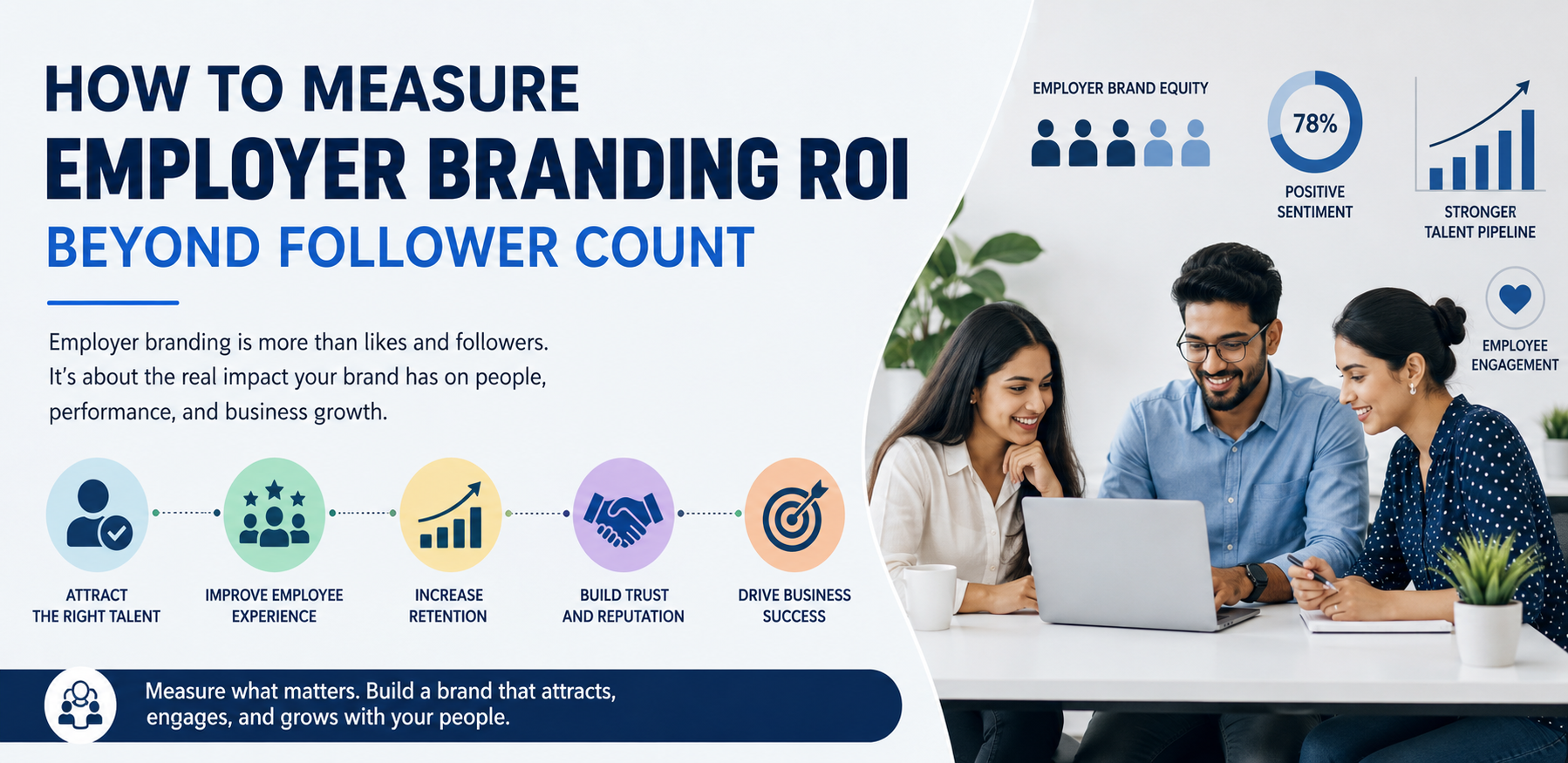
Introduction: Employer Branding ROI
Employer branding has become one of the most important parts of hiring and employee retention. Many companies spend time and money creating content on social media, sharing employee stories, posting company culture videos, and promoting workplace benefits. But one common mistake many businesses make is measuring success only by follower count.
Having thousands of followers may look impressive, but followers alone do not prove that your employer branding strategy is working. A company can have a large audience and still struggle to attract skilled candidates, improve employee retention, or build trust among employees.
Real employer branding ROI is measured by the impact your branding creates on recruitment, employee engagement, retention, and business growth. Companies need to focus on meaningful results instead of vanity metrics.
In this article, we will understand how businesses can measure employer branding ROI beyond follower count and why deeper metrics matter more.
Why Follower Count Is Not Enough?
Follower count is only a surface-level metric. It shows how many people follow your page, but it does not explain whether people trust your company or want to work there.
For example, a company may have 500,000 followers but receive very few quality job applications. Another company may have only 20,000 followers but attract highly skilled candidates and maintain strong employee retention.
This happens because followers do not always represent engagement, trust, or interest in working with the company.
Sometimes people follow pages only for entertainment, industry news, or random content. They may never apply for jobs or interact with the brand seriously.
That is why businesses should look deeper and focus on metrics connected to actual hiring and employee experience outcomes.
How to Measure Employer Branding ROI Beyond Follower Count?
1. Track Quality of Job Applications
One of the best ways to measure employer branding ROI is by tracking the quality of applications received.
A strong employer brand attracts candidates who are more aligned with company culture, values, and job expectations.
Instead of only counting the number of applications, companies should measure:
- How many qualified candidates are applying
- How many candidates match job requirements
- How many candidates pass interview rounds
- How many candidates accept offers
- How long new hires stay in the company
If employer branding is improving, the quality of applicants usually improves as well.
For example, when companies share authentic employee experiences, workplace culture, learning opportunities, and career growth stories, candidates understand the organization better before applying. This reduces mismatched applications and improves hiring efficiency.
2. Measure Employee Referral Rates
Employee referrals are a strong indicator of employer branding success.
When employees are proud of their workplace, they naturally recommend the company to friends, former colleagues, and professional connections.
A high employee referral rate often means:
- Employees trust the company
- Employees feel valued
- Employees believe others will have a positive experience
- Workplace culture is healthy
Referral hires are also usually faster to onboard and more likely to stay longer.
Companies should track:
- Number of referrals received
- Percentage of hires through referrals
- Retention rate of referral hires
- Employee participation in referral programs
If these numbers improve over time, it often shows that employer branding efforts are creating real internal trust.
3. Analyze Candidate Experience Feedback
Candidate experience is another important metric that many companies ignore.
Employer branding is not only about attracting people. It is also about how candidates feel during the hiring process.
Even rejected candidates can become future applicants, customers, or brand supporters if they have a respectful experience.
Companies can collect candidate feedback through:
- Surveys after interviews
- Application feedback forms
- Email responses
- Recruitment review platforms
- Social media comments
Questions may include:
- Was the communication clear?
- Did the interview process feel respectful?
- Did the company culture match the online image?
- Would the candidate apply again in the future?
Positive candidate feedback often shows that employer branding is authentic and consistent.
4. Monitor Employee Retention Rates
A strong employer brand should not only attract employees but also help retain them.
If employees leave quickly despite strong social media marketing, then the employer branding may not reflect the real workplace experience.
Retention rate is one of the most powerful ROI indicators because replacing employees is expensive and time-consuming.
Businesses should monitor:
- Overall retention rate
- First-year employee retention
- Department-wise turnover
- Exit interview feedback
- Employee satisfaction levels
When employer branding accurately represents company culture, employees usually stay longer because expectations match reality.

5. Measure Time to Hire
Time to hire refers to how long it takes to fill open positions.
A trusted employer brand can reduce hiring time because candidates already know and trust the company before applying.
Strong employer branding helps companies:
- Receive faster applications
- Attract active and passive candidates
- Improve recruiter response rates
- Build talent pipelines
If hiring becomes faster after employer branding campaigns, it may indicate positive ROI.
Companies should compare hiring speed before and after branding improvements to identify trends.
6. Track Offer Acceptance Rate
Offer acceptance rate is another useful employer branding metric.
Even if companies attract applicants, branding may still be weak if candidates reject offers frequently.
Candidates today research companies carefully before accepting jobs. They check:
- Employee reviews
- Company culture
- Leadership reputation
- Career growth opportunities
- Workplace flexibility
- Employee testimonials
A strong employer brand increases trust and confidence during the decision-making process.
If more candidates start accepting offers, it usually means the company reputation is improving.
7. Study Employee Engagement Levels to Measure Employer Branding ROI
Employer branding also affects internal employee engagement.
Employees who feel connected to company values and culture are more motivated and productive.
Engaged employees often:
- Participate in company activities
- Share company content online
- Recommend the organization
- Contribute ideas
- Stay committed during challenges
Companies can measure engagement through:
- Employee surveys
- Participation rates
- Internal communication activity
- Feedback sessions
- Recognition program involvement
When engagement improves, employer branding efforts are often creating emotional connection and trust inside the organization.
Conclusion: Employer Branding ROI
Employer branding ROI cannot be measured only through follower count. Followers may increase visibility, but they do not automatically improve hiring quality, employee retention, or workplace trust.
Real employer branding success is measured through meaningful business outcomes such as better candidate quality, stronger employee engagement, higher retention, improved referral rates, faster hiring, and stronger brand reputation.
Companies that focus on authentic employee experiences and long-term trust usually see stronger ROI over time.
Instead of chasing vanity metrics, businesses should build employer branding strategies that create real connection, credibility, and positive workplace experiences. When employees genuinely trust and support the organization, employer branding becomes far more powerful than social media popularity alone.






Comments
Be the first to leave a comment.