

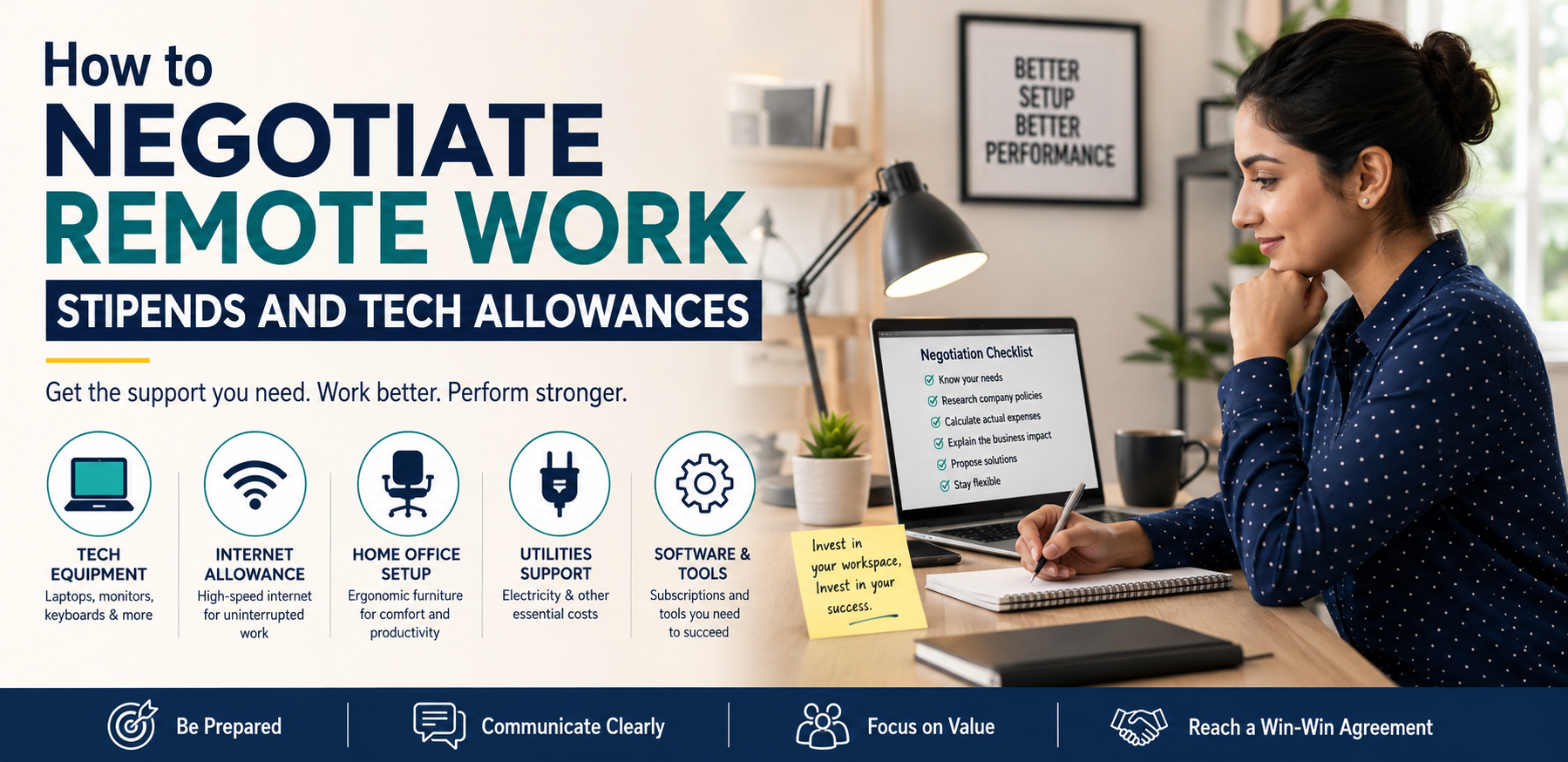
Introduction: Negotiate Remote Work Stipends
Remote work has changed the way people think about employment. Instead of commuting to an office every day, millions of professionals now work from home, coworking spaces, or even while traveling. While remote jobs provide flexibility and better work-life balance, they also shift many workplace expenses to employees.
Internet bills, electricity costs, ergonomic furniture, laptops, monitors, headsets, and other tools often become personal expenses unless employers provide financial support.
This is where remote work stipends and tech allowances become important. Many organizations understand that remote employees need proper equipment and a comfortable workspace to remain productive. As a result, they offer one-time setup budgets or recurring monthly allowances. However, not every employer automatically provides these benefits. Sometimes employees need to negotiate them professionally.
Many professionals hesitate to ask because they fear appearing demanding or ungrateful. In reality, negotiating remote work benefits is no different from discussing salary, vacation days, or health insurance. Employers benefit when employees have the right tools to perform efficiently.
This guide explains what remote work stipends are, why companies provide them, when to negotiate, how to prepare your case, mistakes to avoid, and practical strategies that increase your chances of success.
How to Negotiate Remote Work Stipends and Tech Allowances?
1. Research Before Negotiating
Preparation increases confidence.
Research:
Company Policies
Check:
- Employee handbook
- HR documentation
- Internal benefits portal
You may discover existing benefits you weren’t aware of.
Industry Standards
Many technology companies already offer:
- Home office budgets
- Internet reimbursements
- Ergonomic furniture allowances
Knowing common practices helps you make realistic requests.
Your Actual Expenses
Calculate:
- Monthly internet
- Electricity increase
- Equipment purchases
- Office supplies
Specific numbers strengthen your case.
Example:
Instead of saying:
“Working from home costs me money.”
Say:
“Reliable high-speed internet costs approximately ₹1,800 per month, and I recently purchased an external monitor for ₹18,000 to improve productivity.”
Facts are more persuasive than vague statements.
2. Know Exactly What You Need
Avoid making general requests.
Instead, identify priorities.
Examples:
- One additional monitor
- Ergonomic chair
- Webcam
- Internet reimbursement
- Laptop upgrade
- Standing desk
- Keyboard
- Software license
Specific requests are easier for employers to approve.
3. Build a Business Case
The strongest negotiations focus on business value rather than personal convenience.
Instead of saying:
“I want a better chair.”
Say:
“An ergonomic chair would allow me to work longer comfortably and reduce discomfort during extended client meetings.”
Instead of:
“I need a faster laptop.”
Say:
“Current rendering tasks take twice as long because of hardware limitations. A faster system would reduce turnaround times.”
Employers respond positively when requests improve productivity.
4. Choose the Right Communication Style
Remain professional.
Avoid emotional language.
Instead of:
“I deserve this.”
Try:
“I believe these resources would help me perform my responsibilities more effectively.”
Professional communication encourages productive conversations.
5. Consider Total Compensation
Sometimes employers cannot increase salary but may approve additional benefits.
For example:
Instead of:
- ₹20,000 salary increase
They may approve:
- ₹60,000 yearly technology budget
- Internet reimbursement
- Office furniture
- Learning stipend
Overall value may actually be greater.
6. Be Flexible
Negotiation means discussing options.
If a company cannot provide one benefit, ask about alternatives.
For example:
Instead of:
“I need ₹50,000.”
Consider:
- Company-issued laptop
- Monitor
- Internet reimbursement
- Partial reimbursement
- Annual equipment budget
Flexibility often leads to agreement.
Conclusion: Negotiate Remote Work Stipends
Negotiating remote work stipends and tech allowances is a practical conversation about enabling your best work. As remote and hybrid work continue to grow, employers increasingly recognize that reliable technology and a well-equipped workspace are essential for employee success. The key is to approach the discussion with preparation, professionalism, and a focus on mutual benefit.
Instead of treating the conversation as a request for extra perks, present it as an investment that helps you deliver better results, collaborate more effectively, and remain productive over the long term. By researching company policies, understanding your actual needs, providing clear business reasons, and remaining open to different solutions, you can negotiate confidently and increase the likelihood of a positive outcome.
“Remote work benefits are often negotiable. Learn how to discuss stipends and tech allowances professionally while demonstrating the value you bring with Best Job Tool.”






Comments (3)
[8560]JL16 Login | Register for JL16 Casino App & Slots Bonus,Access your JL16 login to experience the best online casino in the Philippines. Register today for the JL16 casino app to enjoy premium slots, exciting bonuses, and seamless gaming. visit: jl16login
[802]winairlines লগইন ও অ্যাপ ডাউনলোড | বিকাশ ক্যাসিনো ডিপোজিট,winairlines লগইন করুন এবং সহজে winairlines app download করে নিন। বিকাশ দিয়ে ক্যাসিনো ডিপোজিট করে অনলাইন স্লট গেম খেলার নিয়ম জানুন ও শুরু করুন। visit: winairlines
[5981]5777bd লগইন এবং অ্যাপ ডাউনলোড | সেরা অনলাইন স্লট গেম,5777bd login করুন এবং সেরা অনলাইন স্লট গেম উপভোগ করুন। বিকাশ দিয়ে অনলাইন ক্যাসিনো পেমেন্ট সহজ করুন এবং আজই অ্যাপ ডাউনলোড করে খেলা শুরু করুন। visit: 5777bd