

Introduction
In today’s fast-moving world, everyone wants to learn more — new skills, new tools, new ideas. But there’s one problem almost all of us share: limited time.
You might be working full-time, managing family responsibilities, building a freelance career, or trying to grow your writing portfolio. Learning becomes important — but time feels scarce.
So the real question isn’t “What should I learn?”
It’s “How do I prioritize learning when I barely have time?”
Let’s explore this deeply and practically.
How to Prioritize Learning with Limited Time?
1. Accept That You Can’t Learn Everything
The biggest mistake people make is trying to learn everything at once.
- SEO
- Copywriting
- Video editing
- AI tools
- Social media growth
- Personal branding
- Productivity systems
- And 10 more things…
Learning without prioritization creates mental clutter.
Instead of progressing in one direction, you move in ten directions — slowly.
The truth is simple:
Growth doesn’t come from learning more.
It comes from learning what matters most.
2. Define Your Current Goal (Not Your Dream Life)
When time is limited, clarity becomes powerful.
Ask yourself:
- What am I trying to achieve in the next 3–6 months?
- What outcome matters right now?
For example:
- If you want freelance writing clients → learn proposal writing and portfolio building.
- If you want a promotion → learn communication and measurable results reporting.
- If you want to grow on Medium → learn storytelling and headline writing.
Notice something important:
You don’t need 20 skills. You need 2–3 skills aligned with your current goal.
Your long-term dream is important.
But your short-term priority decides your direction.
3. Use the “ROI Learning” Framework
When time is limited, treat learning like an investment.
Ask three questions before starting anything new:
- Will this skill increase my income?
- Will this skill increase my opportunities?
- Will this skill make my current work easier or better?
If the answer is “no” to all three — it’s probably not urgent.
For example:
- Learning advanced design tools may be interesting.
- But if your goal is writing clients, learn writing persuasive email for faster ROI.
Prioritization is about impact, not excitement.
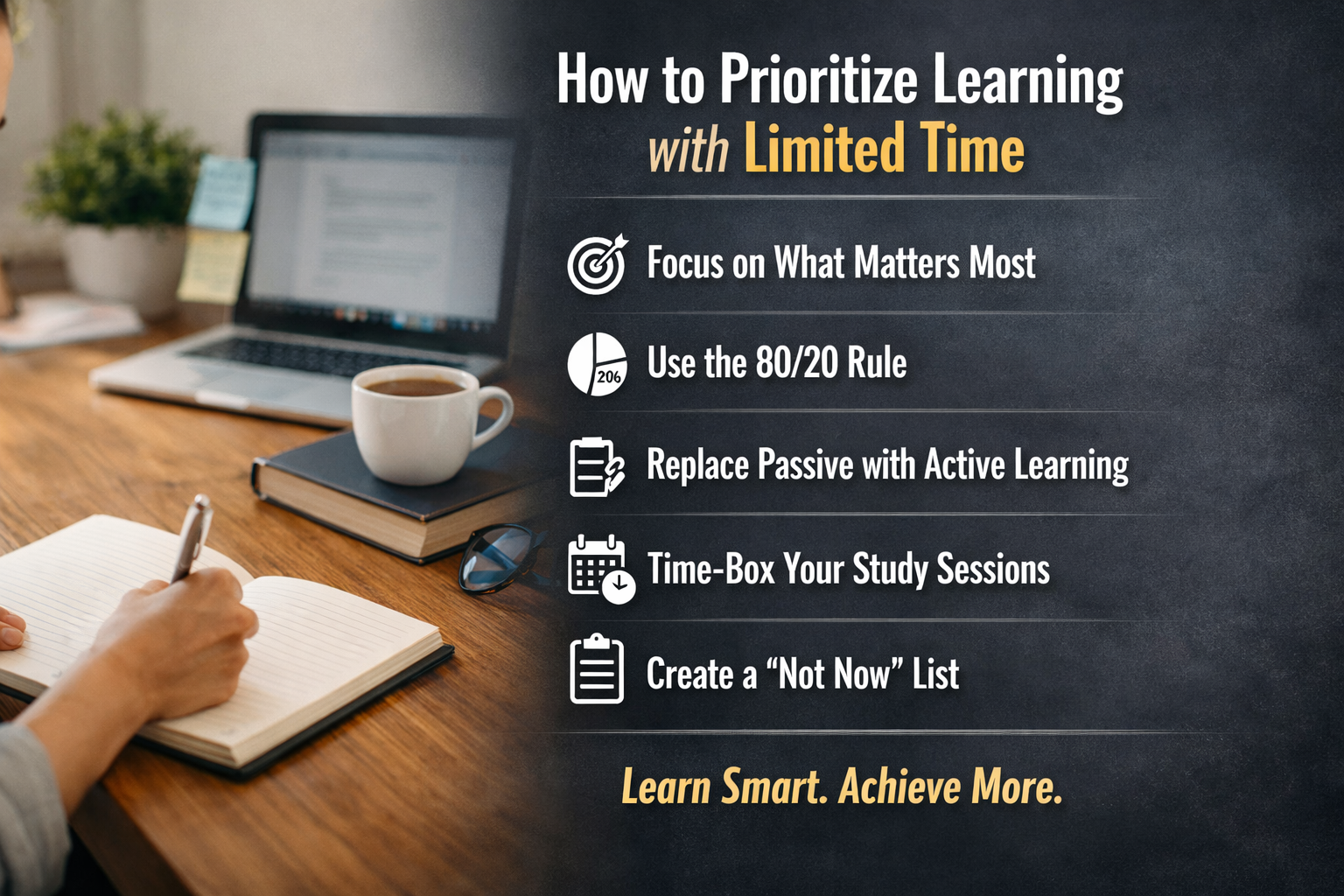
4. Identify the 20% That Creates 80% Results
The 80/20 principle (often associated with Vilfredo Pareto) teaches that a small percentage of actions create most results.
In learning, this means:
- 20% of skills create 80% of career growth.
For content writers, that 20% might include:
- Clear writing
- Strong hooks
- Understanding audience psychology
- Delivering on time
Not:
- Fancy vocabulary
- Complex frameworks
- Trendy jargon
Focus on foundational skills first. Advanced skills can wait.
5. Replace Passive Learning with Active Learning
Many people “feel productive” because they:
- Watch YouTube videos
- Save Instagram posts
- Bookmark articles
- Buy courses
But they rarely apply what they learn.
With limited time, passive learning is dangerous.
Instead:
- Learn something small.
- Apply it immediately.
- Reflect on results.
For example:
If you learn about better headlines, write 5 headlines today.
If you learn about client outreach, send 3 proposals today.
6. Time-Box Your Learning
When time is limited, structure creates discipline.
Instead of:
“I’ll learn when I get free time.”
Try:
- 30 minutes daily
- Or 1 hour every alternate day
- Or 2 focused sessions on weekends
Consistency beats intensity.
Even 30 minutes daily equals:
- 15 hours per month
- 180 hours per year
That’s powerful.
The goal is not marathon study sessions.
It’s sustainable progress.
7. Eliminate “Learning Distractions”
Some learning feels productive but isn’t aligned.
Examples:
- Random podcasts unrelated to your goal
- Trending courses that everyone is buying
- Jumping from one topic to another
Ask yourself:
“Is this directly connected to my priority?”
If not, save it for later.
Learning discipline is as important as learning curiosity.
8. Stack Learning With Daily Work
If you’re already working, turn your job into a learning lab.
For example:
- If you’re writing articles, experiment with storytelling.
- If you’re sending emails, improve clarity and persuasion.
- If you’re freelancing, practice negotiation skills.
Instead of separating “learning time” and “work time,” combine them.
This is powerful because:
- You don’t need extra hours.
- You learn through real experience.
- Results become measurable.
Practical learning beats theoretical learning.
9. Create a “Not Now” List
This is underrated.
Sometimes we don’t prioritize because everything feels important.
Create two lists:
Priority List (Now)
Skills aligned with your current goal.
Not Now List (Later)
Interesting but non-urgent skills.
This reduces anxiety.
You’re not ignoring things — you’re scheduling them for the future.
Mental clarity increases focus.
10. Measure Progress Through Output, Not Input
Most people measure like this:
- 10 videos watched
- 3 books read
- 2 courses completed
But the real question is:
What did you produce?
- Articles written
- Projects completed
- Clients acquired
- Revenue earned
- Skills demonstrated
Output-based measurement keeps learning practical.
Especially if you’re building a writing career — your portfolio matters more than certificates.
11. Learn in Public (When Possible)
Sharing your learning journey creates:
- Accountability
- Feedback
- Visibility
Platforms like LinkedIn or Medium allow you to:
- Publish what you learn
- Share insights
- Document progress
When you teach what you’re learning, understanding deepens.
And opportunities often follow visibility.
12. Avoid Perfection Before Starting
Limited time often creates pressure:
“I need to fully understand this before applying.”
But real learning is messy.
Start before you feel ready.
Your first article won’t be perfect, your first proposal won’t be perfect.
Your first client call won’t be perfect.
But perfection grows from repetition.
Progress > Preparation.
13. Align with Energy, Not Just Time
Sometimes you have time but no energy.
Notice:
- When are you most focused?
- Morning?
- Late night?
- After exercise?
Use high-energy time for difficult learning (strategy, deep work).
Use low-energy time for light tasks (reviewing notes, editing).
Learning is not just about hours — it’s about quality of attention.
14. Revisit and Reprioritize Every 90 Days
Your priorities change.
What was important 6 months ago may not be important now.
Every 90 days, ask:
- What did I learn?
- What helped most?
- What can I drop?
- What should I focus on next?
Learning without reflection becomes accumulation and with reflection becomes growth.
Conclusion
When time is limited, learning must be intentional.
Not reactive, random, and not trend-driven.
Ask yourself:
- What matters right now?
- What creates the highest return?
- What moves me closer to my next milestone?
Prioritizing learning is not about reducing ambition.
It’s about increasing direction.
And direction turns effort into results.
To explore more such blogs, visit the Best Job Tool.






Comments (2)
Appreciate it for sharing the information with us.
Have you ever thought about publishing an e-book or guest authoring on other sites? I have a blog based upon on the same topics you discuss and would love to have you share some stories/information. I know my subscribers would enjoy your work. If you are even remotely interested, feel free to shoot me an email.