

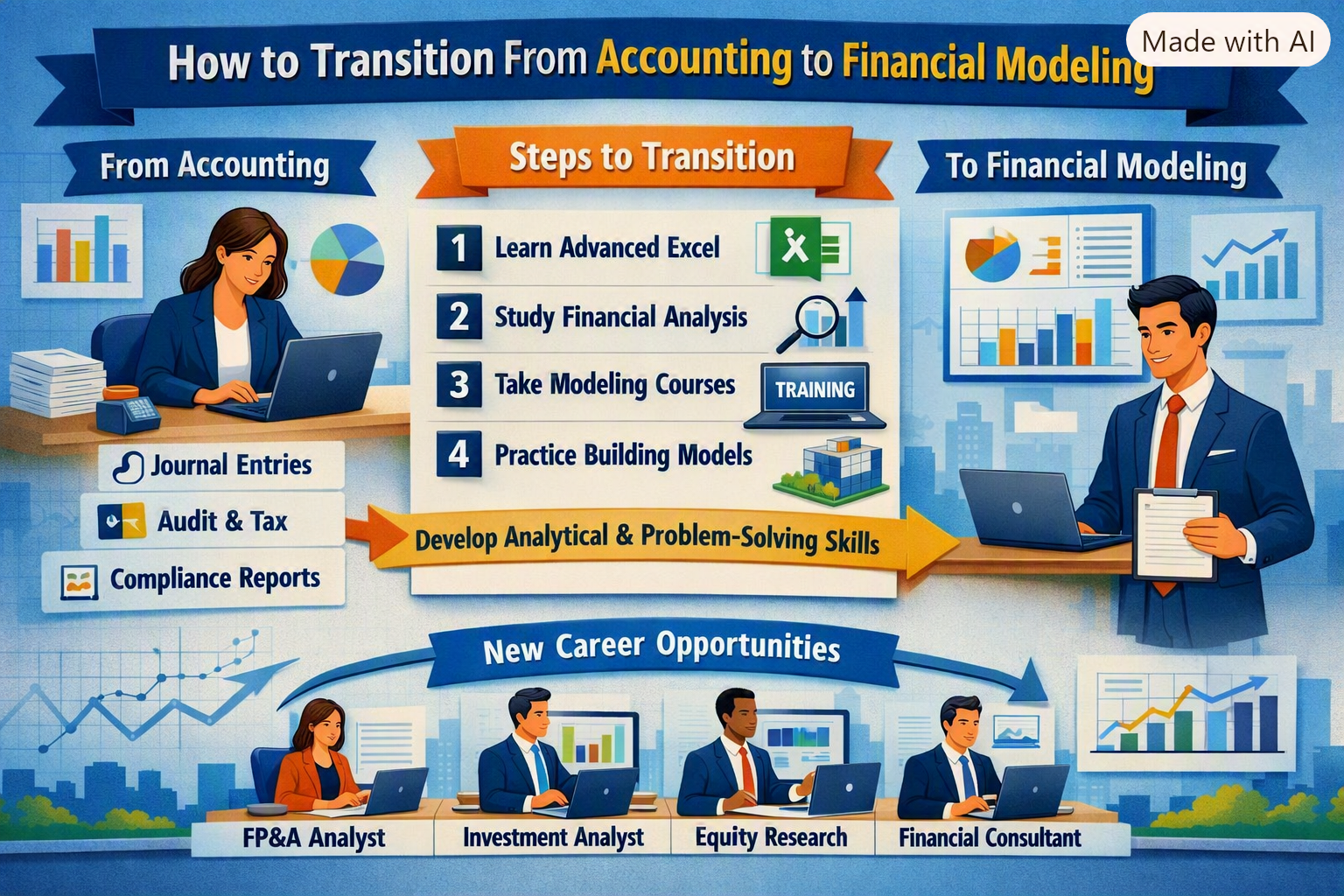
Introduction: Accounting to Financial Modeling
Accounting and financial modeling are two closely related domains that require a slightly different set of skills to succeed. Whereas accounting is about recording and analyzing the financial information of a company, financial modeling is more about forecasting and assumption. As such, one does not necessarily have to acquire a finance degree to transition from accounting to financial modeling.
In fact, many financial analysts and managers cut their teeth in the realm of accounting before branching out into the exciting world of financial modeling. If you are also wondering How to transition from accounting to financial modeling, then you have come to the right place.
How to Transition From Accounting to Financial Modeling?
1. Understand What Financial Modeling Involves
The first thing you need to do is to understand what financial modeling entails. Simply put, it is a process of building a spreadsheet model that forecasts the financial performance of a business. A financial model uses figures and assumptions to estimate revenues, expenses, cash flows, profits, investments, and other metrics.
Accounting provides the inputs needed for financial modeling. An accountant analyzes the revenue and expenses of a company for a particular period. On the other hand, a financial modeler uses the information provided by an accountant to make assumptions about the future of the business.
For instance, while an accountant may deal with the income statement of a company, a financial modeler uses the income statement to forecast revenues and profits for the next five years.
2. Strengthen Your Excel Skills
There is no doubt that Microsoft Excel is one of the most popular applications for financial modeling. As an accountant, you are probably quite proficient with Excel. However, financial modeling requires a deeper understanding of the program than most entry-level accounting jobs.
You should start by brushing up on your knowledge of formulas such as SUM, IF, SUMIFS, COUNTIFS, XLOOKUP, INDEX, and MATCH. It is also good to have a working knowledge of financial functions and how to construct spreadsheets. The next logical step is to start building models.
The key is to learn how to link different parts of a financial model. For instance, you should be able to construct a working model by linking an income statement with a balance sheet and a cash flow statement. After that, you can proceed to forecast and scenario modeling.
The aim is not to memorize all the Excel functions. Instead, you should understand what each Excel function does and how it affects a financial model. If you have the requisite accounting and finance knowledge, you will likely find it easy to grasp the concepts of financial modeling.
3. Learn Financial Statements Properly
Your accounting expertise is a great launching pad for delving into financial modeling. However, you need a firm grasp of financial statements to be a successful financial modeler. As much as a financial modeler works with financial assumptions, he or she must understand the implications of changes in revenues, expenses, assets, liabilities, working capital, and other items on the income statement, balance sheet, and cash flow statement.
For instance, an accountant or a financial manager may understand how revenues and expenses affect an income statement. However, a financial modeler needs to comprehend the effects of increased credit sales on working capital and cash flow.
If you are an accountant, it is crucial to take the time to understand the interconnections between items on financial statements. The more time you invest in this area, the better financial modeler you will become.
4. Learn Forecasting and Assumptions
Another important skill for a financial modeler is the ability to forecast future values. Financial modeling often involves projecting revenues, costs, working capital, and other figures based on certain assumptions.
You should understand the drivers of revenues, costs, and expenses. For instance, a company’s revenues typically depend on the number of customers and the amount of money each customer spends.
When building a financial model, it is not enough to simply make projections. You need to make assumptions about the expected growth rate of revenues, costs, and expenses, working capital requirements, capital expenditures, and debt.
Assumptions should be realistic and based on the historical performance of the business, as well as industry-specific trends. Good financial modelers know how to make accurate assumptions and provide documentation for each assumption.
5. Build Your Own Financial Models
Some of the best ways to learn financial modeling are by doing it yourself. If possible, get access to the financial statements of a company and try to build a financial model. Pick a company you are familiar with and download its annual reports.
You can start by building a three-year historical model and then project the figures for the next three or five years. You can also include assumptions about revenues, margins, working capital, capital expenditures, and other items. Another option is to try different types of financial models, such as a financial forecast or a company valuation model.
You could also try building a budget model, a forecast model for a start-up company, or any other model that interests you. The more you practice, the better you will become at financial modeling.
Conclusion: Accounting to Financial Modeling
Transitioning from accounting to financial modeling can be a natural career move because accounting already provides a strong foundation in financial statements, numbers, and business performance. By developing skills in Excel, forecasting, valuation, financial analysis, and scenario modeling, accounting professionals can expand their career opportunities. The key is to combine existing accounting knowledge with practical modeling experience and demonstrate these skills through real-world projects.
Ready to transition from accounting to financial modeling? Build the right skills, strengthen your financial modeling expertise, and explore relevant opportunities with Best Job Tool to take the next step in your finance career.






Comments
Be the first to leave a comment.