

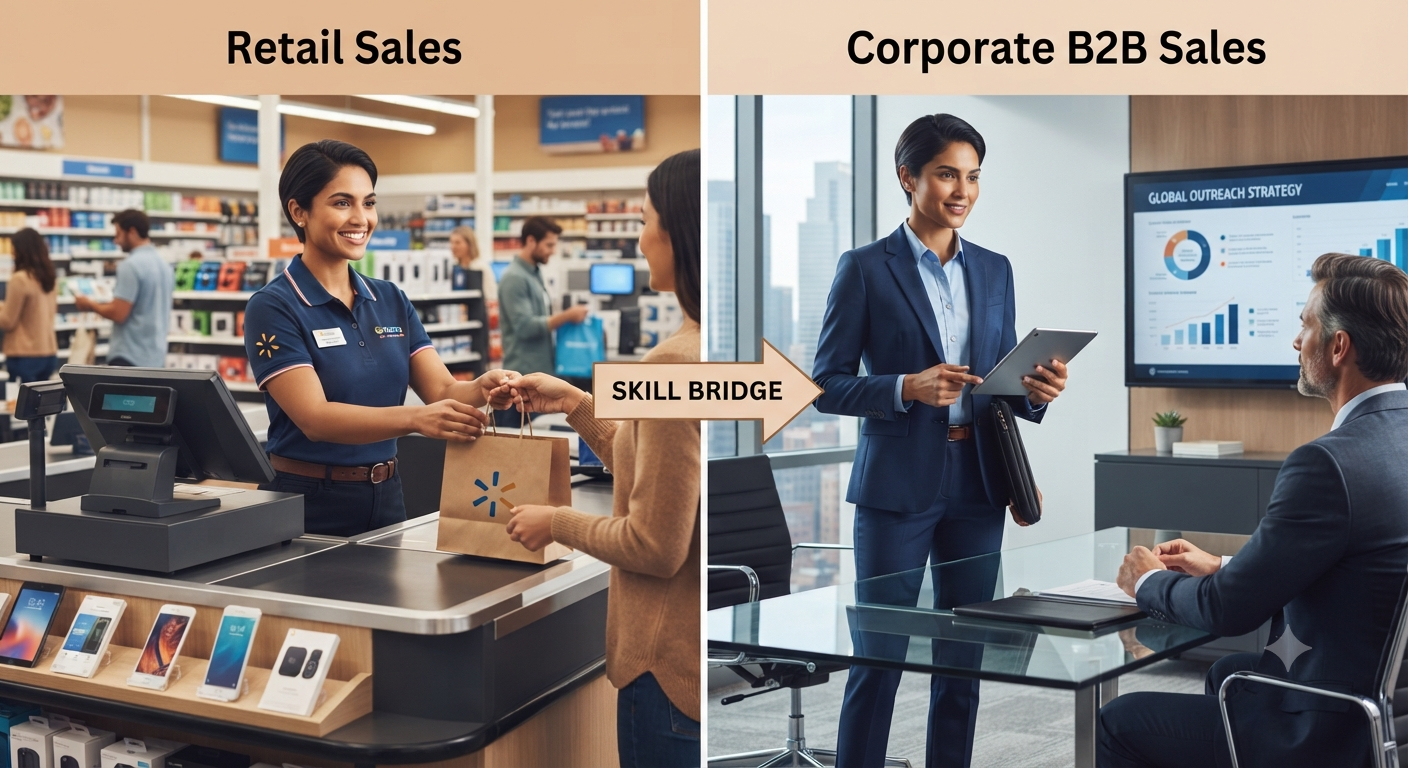
Moving from retail sales to a corporate B2B sales role can be a practical career transition for professionals who already have experience communicating with customers, understanding buying behavior, handling objections, and working toward sales targets. However, B2B sales operates differently from retail because the sales cycle is often longer, multiple stakeholders may be involved, and decisions are frequently based on business needs rather than individual preferences. B2B Roles
The transition does not require starting your career from zero. Instead, the goal is to translate your retail experience into skills that corporate employers recognize. With the right positioning, targeted learning, and consistent job searching, retail sales professionals can move into business development, inside sales, account management, and other B2B positions.
Understand the Difference Between Retail and B2B Sales
The first step is understanding how your current experience differs from corporate B2B selling.
Retail sales often involve direct interactions with individual consumers. The buying decision can happen within minutes or during a single visit. B2B sales, however, may involve organizations purchasing products or services for operational, financial, technical, or strategic reasons.
A B2B sales cycle can involve:
- Prospect identification
- Business research
- Cold outreach
- Discovery calls
- Needs analysis
- Product demonstrations
- Proposals
- Negotiations
- Multiple decision-makers
- Contracts
- Account management
For example, a retail salesperson might help a customer choose a laptop based on personal requirements. A B2B salesperson selling technology may work with an organization’s IT, finance, procurement, and leadership teams before a purchase is approved.
Therefore, focus on developing the ability to understand business problems rather than only product features.
Turn Retail Experience Into B2B Skills
One of the biggest mistakes during a career transition is assuming retail experience has little value in corporate sales. In reality, many retail skills are transferable.
Retail professionals regularly handle customer questions, identify needs, recommend products, manage objections, and work toward targets. These activities are relevant to B2B sales as well.
Translate your experience into business-oriented language.
For example:
- “Helped customers choose products” → “Identified customer requirements and recommended solutions based on individual needs.”
- “Achieved monthly sales targets” → “Consistently worked against revenue and sales performance targets.”
- “Handled customer complaints” → “Resolved customer concerns while maintaining service quality and customer relationships.”
- “Promoted products” → “Used consultative selling techniques to communicate product value and increase conversions.”
Whenever possible, include measurable results such as B2B Roles sales growth, conversion rates, average transaction value, repeat customers, or target achievement.
Your resume should make it clear that you already understand the fundamentals of selling.
Learn Corporate B2B Sales Fundamentals
After identifying your transferable skills, develop knowledge of the B2B sales process.
Start with the concepts that frequently appear in corporate sales roles:
- Lead generation
- Prospecting
- Cold calling
- Email outreach
- Lead qualification
- Discovery calls
- Sales pipelines
- CRM management
- Account management
- Proposal creation
- Negotiation
- Closing
Learn how sales teams use CRM systems to track prospects and opportunities. Platforms such as Salesforce, HubSpot, and other CRM systems are commonly used to organize customer information and sales activity.
You do not need to become an advanced CRM administrator. However, you should understand concepts such as leads, contacts, opportunities, activities, pipeline stages, and follow-ups.
You should also learn how B2B buyers evaluate solutions. Price is only one consideration. Buyers may also consider implementation requirements, return on investment, security, operational efficiency, vendor reputation, and long-term value.
Target the Right Entry-Level Corporate Roles
You may not need to move directly from retail sales into a senior corporate Account Executive position. A more realistic pathway is to target roles that allow you to build B2B experience.
Consider positions such as:
- Sales Development Representative
- Business Development Representative
- Inside Sales Representative
- Business Development Associate
- Junior Account Executive
- Sales Consultant
- Account Coordinator
- Customer Success Associate
- Account Management Associate
SDR and BDR roles can be particularly useful because they provide structured exposure to prospecting, qualification, CRM management, and business communication.
Customer success and account coordination can also provide a pathway toward B2B account management or sales.
When applying, prioritize roles where employers value communication and commercial ability rather than requiring several years of direct enterprise sales experience.
A global job platform such as best job tool can help you B2B Roles explore corporate sales opportunities across different companies, industries, and locations.
Improve Your Business Communication
Retail conversations are often immediate and conversational. Corporate B2B communication usually requires greater structure.
You may communicate with:
- Business owners
- Department heads
- Procurement teams
- Finance professionals
- IT managers
- Operations leaders
- Senior executives
Practice explaining ideas in terms of business outcomes.
Instead of focusing only on what a product does, explain why it matters.
For example:
“This software provides automated reporting.”
can become:
“The software reduces manual reporting work and gives management faster access to operational information.”
The second explanation connects the product to a potential business outcome.
Also practice professional email writing, presentation skills, meeting etiquette, active listening, and concise explanations.
These skills become particularly important when communicating with decision-makers.
Build Experience Before You Leave Retail
You do not necessarily need to resign from your retail position before developing B2B skills.
Look for opportunities to gain relevant experience while working in your current role.
You could:
- Volunteer to handle business customers.
- Help with corporate orders.
- Support local business accounts.
- Participate in vendor meetings.
- Track sales data.
- Learn CRM software.
- Assist with promotional campaigns.
- Practice structured sales presentations.
- Take online B2B sales courses.
If your employer sells to businesses as well as consumers, ask whether you can support the corporate-sales team.
Even limited exposure can provide useful examples during B2B Roles interviews.
You can also create mock B2B sales projects. Choose a company and prepare a fictional prospecting email, discovery-call plan, account profile, and sales presentation.
This gives you practical material to discuss when an interviewer asks how you would approach a B2B prospect.
Prepare for Remote and Hybrid B2B Sales
Many corporate B2B sales teams operate remotely or through hybrid models. This creates opportunities for professionals who want to move beyond traditional retail environments.
Remote sales requires strong organization because you may manage prospecting, virtual meetings, follow-ups, CRM updates, and proposals from the same workspace.
A productive routine can include:
- Reviewing your pipeline at the beginning of the day.
- Blocking dedicated prospecting time.
- Preparing before every customer meeting.
- Updating CRM records immediately.
- Scheduling follow-ups instead of relying on memory.
- Reviewing priorities at the end of the day.
Technology preparation is equally important. Before an important virtual meeting, check your internet connection, microphone, camera, presentation, CRM access, and meeting software.
If the role includes business travel, ask about expected travel frequency during the interview process. Some B2B positions are primarily remote, while others require regular client visits, conferences, or onsite meetings.
For professionals working while traveling, test connectivity and access to essential sales systems before important customer calls.
Plan Your Finances During the Career Transition
Moving from retail sales to corporate B2B sales can change your compensation structure. Some corporate roles offer a fixed salary, while others combine base pay with commissions or bonuses.
Before accepting an offer, review the complete compensation package.
Pay attention to:
- Base salary
- Commission structure
- Sales targets
- Bonus eligibility
- Commission payment schedule
- Probation or ramp-up period
- Travel reimbursement
- Working hours
- Remote-work arrangements
- Career progression
Do not build your monthly budget around the highest possible commission figure. Instead, use guaranteed B2B Roles income for essential expenses and treat variable compensation as additional income until you understand your earning pattern.
If possible, maintain an emergency fund during the transition. This can provide financial flexibility while you adapt to a new industry, sales process, or compensation model.
Build a Long-Term B2B Sales Career
Once you enter corporate B2B sales, your career can develop in several directions.
A common progression can look like:
SDR/BDR → Account Executive → Senior Account Executive → Enterprise Account Executive → Sales Manager
Other paths can include:
SDR/BDR → Account Management → Strategic Account Manager → Sales Leadership
Some professionals eventually specialize in industries such as technology, healthcare, financial services, manufacturing, logistics, or professional services.
Choose an industry where you are willing to develop deeper expertise.
Track your performance throughout your career. Maintain records of:
- Revenue generated
- Quota attainment
- New accounts acquired
- Customer retention
- Deal size
- Conversion rates
- Sales-cycle improvements
These metrics can make future career moves easier because they demonstrate measurable commercial performance.
Conclusion
Transitioning from retail sales to corporate B2B roles does not require abandoning the experience you have already built. The key is to reposition your existing customer-facing skills and add the business knowledge required for corporate selling.
Start by understanding how B2B sales differs from retail. Then strengthen your knowledge of prospecting, CRM systems, discovery calls, pipeline management, negotiation, and business communication.
Target entry-level corporate roles such as SDR, BDR, inside sales, account coordination, and junior account executive positions. At the same time, look for opportunities to gain B2B exposure while continuing your current job.
Remote and hybrid sales models can provide additional opportunities, although some positions may involve client travel. Therefore, evaluate working arrangements, travel requirements, and compensation structures before making the transition.
Finally, approach the move as a long-term career development process. Build measurable results, develop industry expertise, and continue improving your sales skills. A global job platform such as best job tool can also help you identify relevant B2B opportunities across different companies and markets.






Comments
Be the first to leave a comment.