

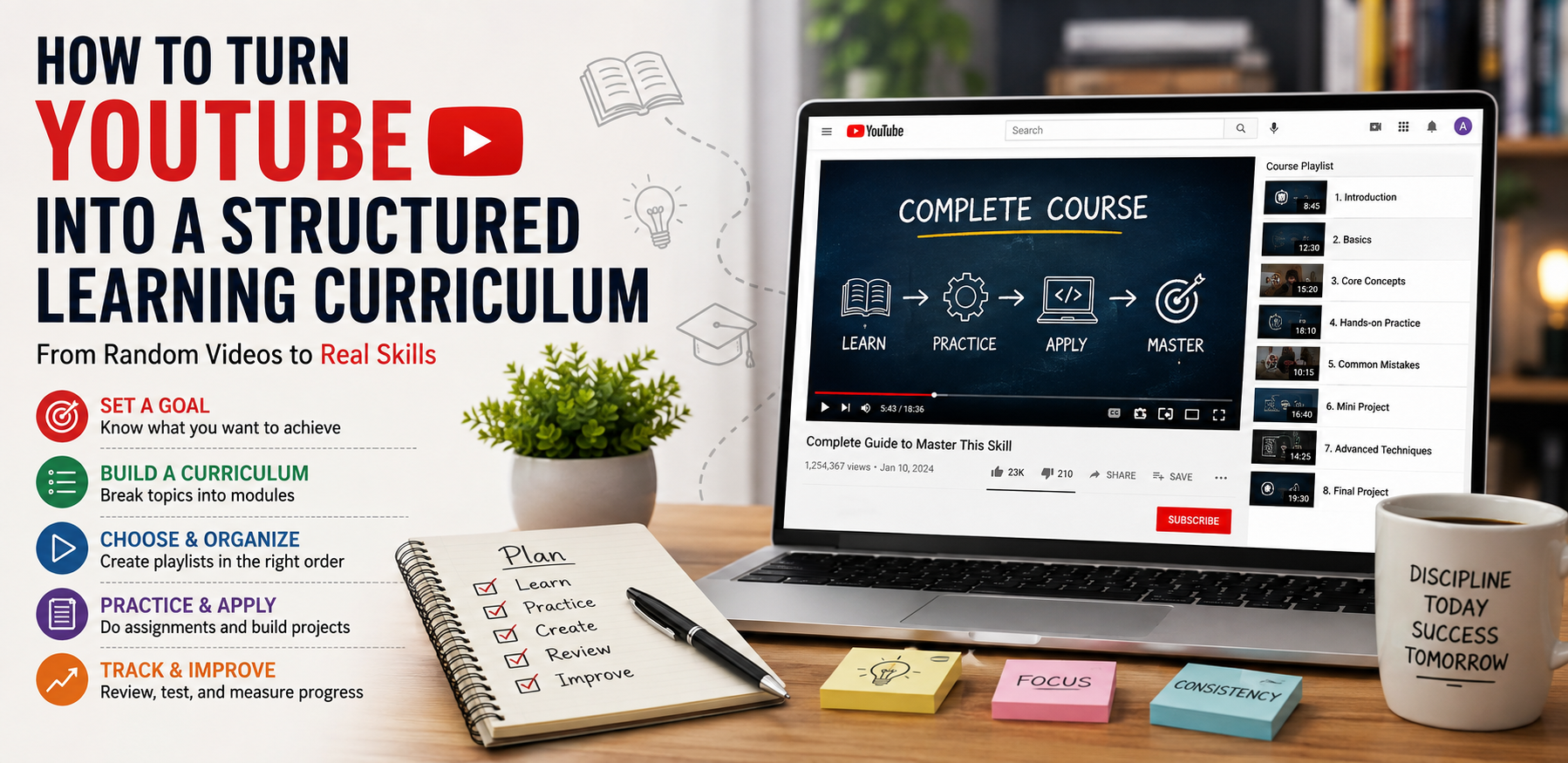
Introduction: YouTube Into a Structured Learning Curriculum
YouTube is one of the largest free learning platforms in the world. Millions of people use it every day to learn coding, graphic design, writing, marketing, photography, languages, finance, cooking, fitness, and almost every skill imaginable. However, despite having unlimited access to educational content, many learners struggle to make real progress.
The biggest reason is not the lack of information—it is the lack of structure.
Many people open YouTube with the intention of learning one topic but end up watching unrelated videos. They save dozens of playlists but never complete them. They consume hours of content without practicing what they have learned. This creates the illusion of learning while producing very little improvement.
The good news is that YouTube can become an excellent learning platform if you treat it like a structured course instead of an entertainment app.
In this guide, you will learn how to transform YouTube into a complete learning curriculum that helps you build real skills, stay organized, and achieve measurable progress.
How to Turn YouTube Into a Structured Learning Curriculum?
Step 1: Define One Clear Learning Goal
Every curriculum starts with a destination.
Avoid vague goals like:
- Learn coding
- Become better at writing
- Improve marketing
Instead, create specific outcomes.
For example:
- Build my first WordPress website
- Learn Python basics in 30 days
- Write SEO blog posts professionally
- Design social media graphics in Canva
- Speak conversational English confidently
A clear destination helps you ignore unnecessary content.
Step 2: Break the Goal into Small Modules
Universities divide courses into subjects.
Online courses divide lessons into modules.
You should do the same.
For example, if you want to learn Content Writing, your curriculum might look like this:
Module 1
Introduction to Content Writing
Module 2
Grammar Basics
Module 3
Research Skills
Module 4
SEO Fundamentals
Module 5
Headline Writing
Module 6
Blog Structure
Module 7
Editing Techniques
Module 8
Portfolio Building
Module 9
Freelancing
Module 10
Client Communication
Now every YouTube video has a place inside your curriculum.
Step 3: Find One Primary Teacher
One major problem with YouTube is information overload.
Different creators explain the same topic differently.
Watching too many teachers at once often creates confusion.
Instead:
Choose one creator as your primary instructor.
Use other creators only when:
- You need another explanation.
- A topic is outdated.
- You want advanced knowledge.
- You need additional examples.
This creates consistency in your learning.
Step 4: Build a Playlist in the Right Order
Instead of relying on YouTube recommendations, create your own playlist.
Arrange videos logically.
For example:
Lesson 1
Introduction
Lesson 2
Basic Concepts
Lesson 3
Tools
Lesson 4
Practical Exercise
Lesson 5
Common Mistakes
Lesson 6
Mini Project
Lesson 7
Advanced Techniques
Lesson 8
Final Project
A customized playlist works like an online course.
Step 5: Create a Weekly Learning Schedule
Consistency beats intensity.
Instead of studying for six hours once a week, study for one hour every day.
Example schedule:
Monday
Watch Lesson 1
Take notes
Tuesday
Watch Lesson 2
Practice
Wednesday
Complete exercises
Thursday
Watch Lesson 3
Friday
Practice again
Saturday
Mini project
Sunday
Review everything
This approach improves long-term retention.
Step 6: Take Active Notes
Watching videos passively rarely leads to mastery.
Instead, create notes while learning.
Your notes should include:
- Key concepts
- Definitions
- Examples
- Important formulas
- Mistakes to avoid
- Personal observations
- Useful resources
Write everything in your own words.
This improves understanding and memory.
Conclusion: YouTube Into a Structured Learning Curriculum
YouTube is not just a platform for entertainment—it can be one of the most valuable learning resources available if you use it with purpose and discipline. The difference between endless scrolling and meaningful education lies in having a clear goal, a structured plan, regular practice, and consistent review.
Instead of relying on YouTube’s algorithm to decide what you learn next, create your own curriculum. Set learning objectives, organize videos into logical modules, complete assignments, build projects, and track your progress. By doing so, you transform free videos into a personalized education system that develops real-world skills.
“YouTube can be more than entertainment—it can become your personal classroom. Learn with purpose, stay consistent, and build valuable skills with Best Job Tool.”






Comments
Be the first to leave a comment.