

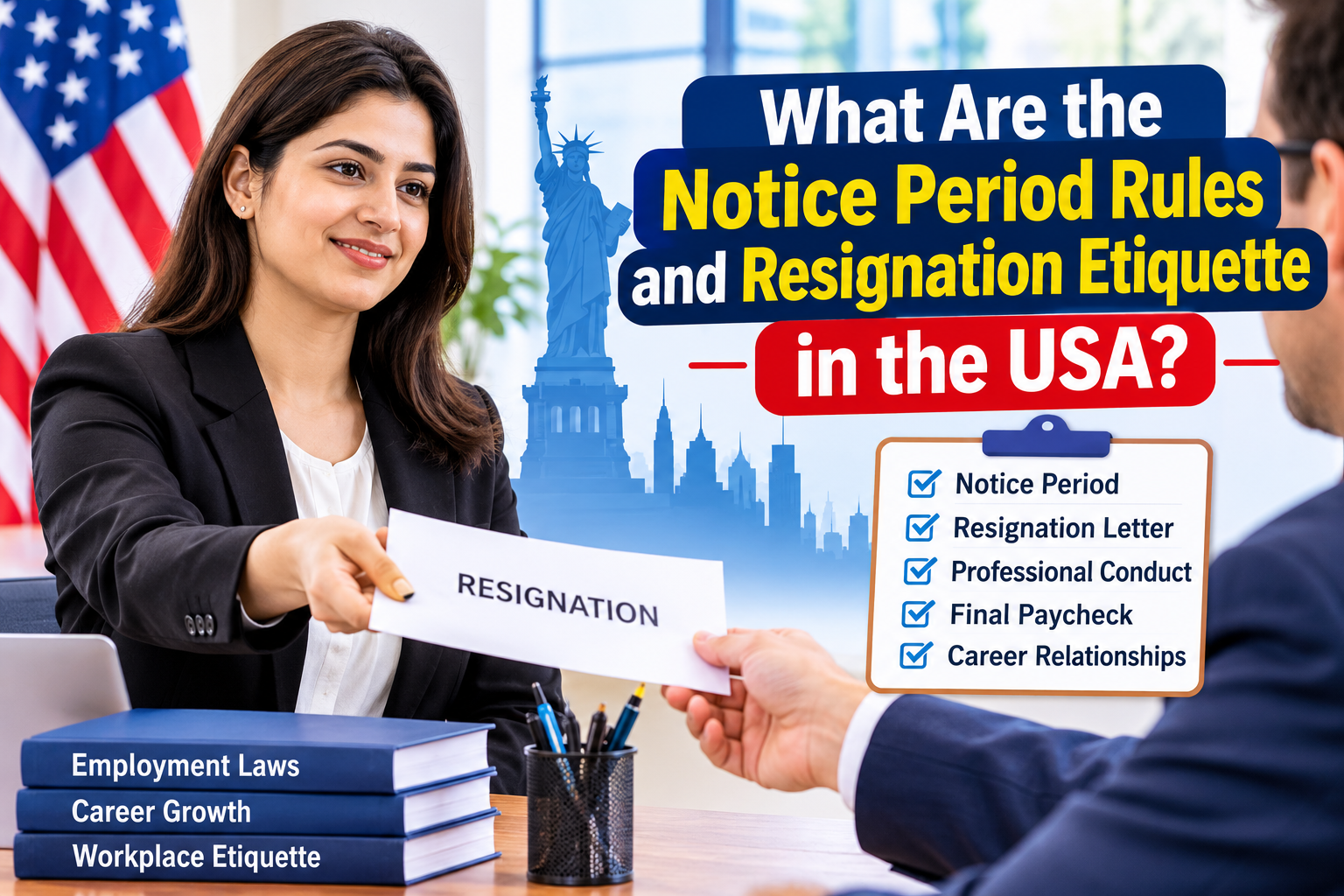
Introduction: Notice Period Rules and Resignation Etiquette
People will often resign from their jobs for a number of reasons including for a better role, to allow them to change career or to relocate and/or continue learning. It is therefore important to know the correct procedure for resigning. The method of handling resignations is typically dictated by an employment contract, company policy and state laws. Awareness of Notice Period and Resignation guidance can help individuals to effectively manage their resignation. Although it is commonly expected within the professional world that people will give a two week notice period, this is not generally a legal requirement for most people in the USA.
What Are the Notice Period Rules and Resignation Etiquette?
1. Employment At Will – USA
Most states operate using the ‘employment at will’ system meaning that both employers and employees can terminate employment at any time (with or without notice), as long as this is not illegal or in breach of a contract. Montana however, has differing employment guidance particularly around post probation periods.
Whilst people can usually resign without giving a reason and without adhering to a notice period, there may be particular notice requirements detailed within an employment contract, collective bargaining agreement and/or company policy. Therefore it is advisable that people assess these so that they are fully aware of what is expected of them. Awareness of Notice Period and Resignation guidance is therefore key.
2. Is Two Weeks Notice a Legal Requirement?
Although it is widely recognised within the professional world that people should ideally give a two week notice period when resigning, federal law does not usually make this a legal requirement. Typically, those in at-will employment can therefore end their employment with no prior notification.
Giving a two week notice period enables employers to plan for an individual’s resignation, re-allocate work and source a new member of staff. Employers may also specify in a contract or company policy that people must give a particular notice period. Again, it is advisable to investigate this so that individuals can appropriately asses when they wish to resign. Observing Notice Period and Resignation guidance will enable people to professionally resign and continue to effectively manage their working relationships.
3. Assess Employment Contract Information
Prior to resigning, people should analyse the details of their employment contract and employee handbook. These may detail how to resign, what notice period is expected, confidentiality requirements and post-employment commitments amongst other areas. Some higher level roles may specify different notice periods to the typical two weeks.
Likewise, employees should assess their contracts to find out if they contain provisions regarding remuneration (such as commission and bonuses), relocation and/or training. If there are any sections of a contract that are not wholly clear then it may be wise for people to speak to an employment solicitor in order to minimise the risk of issues arising. Analysis of contracts is key in observing Notice Period and Resignation guidance.
4. Writing a Professional Resignation Letter
People should write a letter to their line manager and/or human resources department to formally notify an employer that they are resigning. Ideally, people should first discuss their resignation with their line manager. Within the letter, individuals should convey that they are resigning, state their current role and advise of their last working day.
It is also appropriate to show gratitude. Although people are not required to elaborate on the personal reasons for their resignation, it is important for people to retain a courteous and professional manner. Further, a letter provides evidence of when someone resigns and ensures both parties adhere to a defined process.
5. Advise Manager Prior to Colleagues
Typically, people should advise their line manager of their resignation prior to informing others in their workplace. This enables them to then meet with their manager in a confidential setting and professionally convey their resignation. People should stay composed and succinctly convey why they are resigning. They should also refrain from complaining about the business and/or its management.
Should their manager wish to know further details about why they are resigning, employees can truthfully and briefly respond to this. Moreover, individuals should advise their manager of their last working day and endeavour to support their employer throughout their transition phase. Good Notice Period and Resignation guidance can therefore be observed, and positive working relationships can be sustained in this way.
6. Undertake a Transition Process
Effectively managing a transition supports employers to continue operating smoothly in an individual’s absence. Within the notice period people should systematically collate work, update pertinent information and advise others of the status of work. Staff can devise guidance for others, share relevant information and highlight areas requiring further action.
People should also return items belonging to a company such as laptops, key-cards and paperwork in line with company protocols. Successfully carrying out a transition process is highly professional. Furthermore, good Notice Period and Resignation guidance can contribute to individuals receiving favourable references.
7. Determine Payment and Outstanding Leave Entitlements
It is important that people are aware of their entitlements in relation to payment. Generally, federal law does not oblige employers to promptly pay someone their last salary upon them resigning. However, employers must abide by wage regulations. Moreover, some states enforce quicker payment of final salaries. With regard to leave, again, federal law does not usually require employers to offer or to pay for accrued leave.
Whether or not employers must compensate people for outstanding leave upon the conclusion of their employment will depend on state laws and company policy. People should therefore consult their human resources and/or payroll department to ascertained their final pay, commission and benefit entitlements together with their remaining leave entitlement. Again, this is a key area to be aware of in accordance with Notice Period and Resignation guidance.
8. Continue to Sustain Working Relationships
Whilst people cease working for a business they should still endeavour to sustain good working relationships with previous colleagues and managers. This can open up networking and recommendation prospects and facilitate continued career progression. Those leaving should express their gratitude to both their managers and co-workers for their support. People should furthermore avoid disclosing confidential business information.
Links can then easily be formed with former colleagues via professional networking sites such as LinkedIn. Even if someone resigns due to issues with a business, it remains advantageous to continue to behave respectfully. Good working relationships are perceived favourably and can in turn promote long-term career progression.
Conclusion: Notice Period Rules and Resignation Etiquette
Whilst notifying a business of one’s resignation is a key element in leaving a role, people should also analyse their employment contract, effectively communicate and successfully perform a transition process. In addition, they should ascertain their payment entitlements. Even though it is widely accepted within the professional sphere that a two week notice period should generally be given, federal law does not typically require at-will employees to do so. Good adherence to Notice Period and Resignation guidance can therefore enable people to professionally resign and to continue to effectively manage their future working relationships.
Planning your next career move? Explore new opportunities with Best Job Tool to discover suitable vacancies, connect with potential employers, and take the next step towards achieving your professional goals.






Comments
Be the first to leave a comment.