

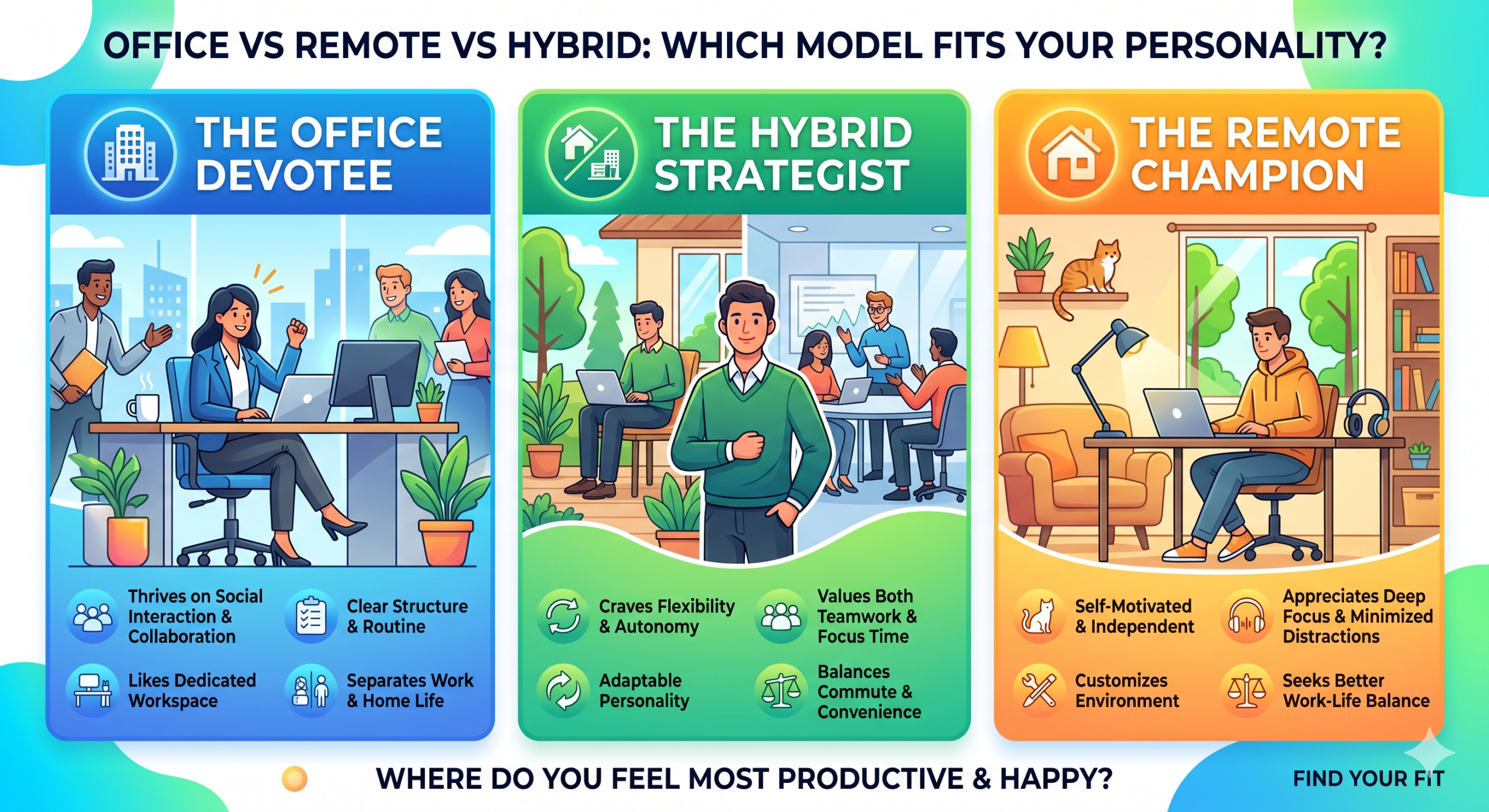
The modern workplace has changed dramatically over the last few years. Professionals now have more flexibility than ever before in choosing how they work. Some companies operate fully remotely, Personality others continue traditional office culture, while many businesses have adopted hybrid systems that combine both models.
While flexibility sounds attractive, choosing the right work environment is not always simple. A work model that helps one person thrive can completely drain another. Productivity, motivation, communication style, focus levels, and even mental well-being are heavily influenced by the environment in which you work.
Many professionals make career decisions based only on salary or flexibility without considering whether the work structure actually matches their personality. This often leads to burnout, low engagement, and declining performance over time.
Understanding how office, remote, and hybrid work models align with your personality can help you build a more sustainable and satisfying career.
Why Work Environment Impacts Performance More Than People Realize
Work environments shape daily routines, communication patterns, energy levels, and focus. Some people naturally perform better with structure and social interaction, while others need independence and quiet environments to produce their best work.
The wrong environment creates hidden stress. For example:
- A highly independent person may feel overwhelmed in busy offices
- A social and collaborative employee may feel isolated while working remotely
- Someone who dislikes constant routine changes may struggle in hybrid systems
Your work model directly affects:
- Productivity
- Motivation
- Mental energy
- Collaboration quality
- Career satisfaction
- Work-life balance
This is why choosing the right environment matters as much as choosing the right role.
Office Work: Best for Structured and Social Personalities
Traditional office environments continue to work extremely well for many professionals despite the rise of remote work. Offices provide structure, direct communication, and easier team collaboration.
People who usually thrive in office settings include:
- Extroverted personalities
- Professionals who enjoy teamwork
- Employees who prefer fixed routines
- Individuals who focus better outside the home
- People who learn through direct interaction
Office environments create natural accountability. Daily schedules, face-to-face meetings, and physical workspaces help many people stay disciplined and productive.
For early-career professionals, office settings can also accelerate growth through:
- Mentorship opportunities
- Faster relationship-building
- Spontaneous learning moments
- Easier networking visibility
Some professionals simply feel more mentally “in work mode” when they physically enter an office environment.
However, office work also comes with challenges such as commuting, distractions, limited flexibility, and difficulty balancing personal responsibilities.
Remote Work: Ideal for Independent and Self-Managed Professionals
Remote work has become one of the biggest shifts in modern employment. Many professionals discovered they work far more effectively when given flexibility and control over their environment.
Remote work often fits people who:
- Prefer independent work
- Need uninterrupted focus time
- Enjoy flexible schedules
- Work well without supervision
- Communicate effectively in writing
Highly self-disciplined individuals often experience major productivity improvements remotely because they can structure their day around personal energy patterns instead of office schedules.
Remote work also supports:
- Better location flexibility
- Reduced commuting stress
- More personal schedule control
- Potential cost savings
- Improved work-life integration
For professionals interested in travel or digital nomad lifestyles, remote work creates opportunities impossible in traditional office structures.
However, remote work is not automatically easier. It requires strong discipline, communication skills, and personal boundaries.
Common remote work challenges include:
- Isolation and loneliness
- Difficulty disconnecting from work
- Communication misunderstandings
- Reduced team visibility
- Home distractions
Without systems and routines, remote work can slowly reduce both productivity and mental balance.
Hybrid Work: A Balance Between Flexibility and Collaboration
Hybrid work attempts to combine the best parts of office and remote environments. Employees divide time between home and office, depending on company policies or personal preference.
Hybrid models often fit professionals who:
- Want flexibility without full isolation
- Enjoy both teamwork and independent work
- Need occasional structure
- Like variety in routines
- Adapt easily to changing environments
Many employees prefer using remote days for deep focus work and office days for collaboration, meetings, and brainstorming sessions.
Hybrid work can improve balance because it provides:
- More flexibility than traditional offices
- More social interaction than remote work
- Reduced commuting frequency
- Better separation between work styles
However, hybrid systems can also create complications.
Some professionals struggle with:
- Constant schedule adjustments
- Managing two work environments
- Communication inconsistencies
- Coordination challenges
Hybrid work requires adaptability and strong organizational skills.
Personality Traits That Influence Work Style Preferences
Personality plays a major role in determining which work environment feels natural.
Extroverts Often Prefer Offices or Hybrid Models
Extroverted professionals usually gain energy from interaction, collaboration, and group environments. They may feel mentally drained or disconnected during fully remote work.
They often enjoy:
- Team discussions
- In-person collaboration
- Fast-paced communication
- Networking opportunities
For extroverts, office or hybrid environments usually provide better energy balance.
Introverts Often Thrive in Remote Work
Introverted professionals frequently perform better in quieter environments where they can focus deeply without constant interruptions.
Remote work often benefits introverts because it allows:
- Greater concentration
- Reduced social fatigue
- More control over interaction levels
- Independent workflow management
However, many introverts still value occasional in-person interaction, making hybrid work attractive as well.
Highly Structured Individuals Prefer Predictable Systems
Some people simply perform best with clear routines and stable environments.
They often prefer:
- Fixed schedules
- Consistent routines
- Physical workspaces
- Defined separation between work and personal life
Traditional office environments usually support these preferences effectively.
Communication Style Matters in Every Work Model
Each work environment rewards different communication habits.
Office Communication
Office environments depend heavily on:
- Verbal discussions
- Quick problem-solving conversations
- Real-time collaboration
Remote Communication
Remote work requires:
- Clear written communication
- Documentation skills
- Async collaboration habits
Hybrid Communication
Hybrid environments require both communication styles and strong adaptability.
Professionals who struggle with written clarity may find remote work more difficult. Similarly, people uncomfortable with constant meetings may prefer remote-focused roles.
Using a Best Job Tool can help professionals identify work environments that better align with communication strengths and personality traits.
Productivity Looks Different for Different People
One of the biggest misconceptions is assuming everyone is productive in the same environment.
Some people:
- Need quiet environments for focus
- Perform better under supervision
- Require collaboration for motivation
- Need flexibility to maintain energy
Productivity depends heavily on:
- Noise tolerance
- Self-discipline
- Attention span
- Energy management
- Task type
For example, deep-focus analytical work may benefit from remote environments, while highly collaborative creative tasks may improve in office settings.
Work-Life Balance Depends on Boundaries
Many people assume remote work automatically creates balance, but this is not always true.
Remote workers often struggle with:
- Overworking
- Difficulty disconnecting
- Blurred personal boundaries
Office workers, however, may struggle with:
- Long commuting times
- Reduced flexibility
- Less personal time
Hybrid work offers flexibility but can also create scheduling complexity.
Healthy work-life balance depends more on personal boundaries than location alone.
Important habits include:
- Fixed working hours
- Dedicated workspaces
- Scheduled breaks
- Time away from screens
- Realistic workload management
Career Growth and Visibility Are Different in Every Model
Career growth patterns also vary depending on work structure.
Office employees often gain:
- Higher visibility with leadership
- Easier relationship-building
- Faster informal networking
Remote professionals often develop:
- Stronger independence
- Better async communication skills
- Higher self-management abilities
Hybrid employees usually build adaptability across both systems.
No model guarantees success automatically. Growth depends on how effectively you operate within the environment.
Financial and Lifestyle Considerations
Work models affect finances and lifestyle choices significantly.
Remote Work May Reduce:
- Commuting expenses
- Relocation costs
- Daily transportation spending
Office Work May Provide:
- Better access to workplace resources
- Easier equipment support
- Clearer routine structures
Hybrid Work Often Balances Both
Lifestyle goals matter too. Someone interested in travel flexibility may prefer remote work, while someone who values separation between work and home may prefer office environments.
Conclusion
Office, remote, and hybrid work models all offer unique advantages and challenges. The best choice depends less on trends and more on personality, communication style, productivity habits, and lifestyle goals.
Some professionals thrive in structured office environments with direct collaboration and routine. Others perform better remotely where flexibility and independence improve focus and energy. Hybrid work appeals to those who want a balance between autonomy and social interaction.
Instead of choosing based only on what appears attractive online, professionals should evaluate how they naturally work best. Long-term career success depends heavily on selecting environments that support both productivity and mental sustainability.
With careful self-awareness, structured planning, and tools like a Best Job Tool to evaluate opportunities strategically, professionals can build careers that align with both their personality and long-term professional goals.





Comments
Be the first to leave a comment.