

Introduction
If you receive job offers and the salary is exactly what you expected, it doesn’t mean you should immediately say yes. You should ignore any advice that says “just accept the offer if the salary is right,” because this can ruin your entire career growth. A job offer is not just about salary—there are many other important factors to consider.
Whenever you get a job offer, you need to research it properly: the company, its work environment, and the job itself. Not every job offer is the same—each one is different, and these differences can completely affect your career path, lifestyle, and long-term outcomes.
In this article, we are going to talk about why not all job offers are equal.
Why Not All Job Offers are Equal?
1. Salary vs Total Compensation
A person works a job mainly to earn a salary and maintain a stable living. But a job is not just about salary—salary is only one part of a job offer. Along with salary, a company provides many other benefits, such as bonuses, incentives, health insurance, paid leave, and retirement benefits.
If you only focus on salary, it may seem advantageous in the short term, but over time, you may not feel satisfied, because the other benefits are also very valuable for an employee.
That’s why, if you receive two job offers—one with a higher salary but fewer benefits, and another with a slightly lower salary but full benefits—you should choose the second one. A slightly lower salary with full benefits is more valuable in the long term than just a high salary.
2. Job Offers with Growth Opportunities
The second reason why not all job offers are equal is growth opportunities.
Getting a job doesn’t mean your life will become easy and you don’t have to do anything else—you can’t just do the work and leave it at that. Jobs keep changing—lifestyles change, expectations change, and because of this, we cannot stay stuck in the same place. We need growth so that we can increase our earnings and improve our lifestyle.
Growth happens when we get opportunities. Opportunities come when we are in a job where we can learn new things, where promotions are available, and where our skills can improve.
But some jobs are not like this. Some jobs have limited work, so we don’t learn anything and cannot grow.
That’s why, before accepting a job offer, you need to ask yourself:
- Will I learn new skills in this job?
- Is there a promotion path?
- Will this job improve my future opportunities?
By asking these questions, you can choose a better job for yourself.
3. Job Offers with Work Culture
If the question is what is more important: work culture or high salary, most people will choose high salary.
But a person who values good work culture beyond salary stays happy in the long term.
Many people don’t give work culture as much importance as salary, but it is a very important part of our work and growth. When the environment around us is good, teammates are supportive, and leadership is strong, we learn, grow, and don’t feel stressed.
However, if you work in an environment where the salary is high but nobody respects you, teammates are not supportive, your stress will increase, burnout will rise, motivation will drop, and your growth will be limited.

4. Work-Life Balance
Another reason why not all job offers are equal is work-life balance.
Many companies don’t value their employees’ personal time. They only focus on getting work done, whether the employee works during personal time or regular work hours—they just need results. Because of this, employees often have to work long hours, which means they don’t get time for themselves or their loved ones. Even if the salary is high, they remain stressed and unhappy.
That’s why, if you want your work and personal life to stay balanced, always consider working hours, weekend work, and flexibility when choosing a job offer.
5. Job Role and Responsibilities
The most important thing when choosing a job offer is not to apply just based on the job title. You need to read the job role carefully.
Many companies use misleading job titles—the title may sound good, but the actual role is different. For example, two companies may offer the same title, but one may give meaningful work, while the other may give repetitive or low-value tasks.
That’s why you should always understand what you will actually be doing daily before accepting a job offer.
6. Personal Goals and Interests
If you do any work without interest, or if your personal goals don’t match the job role, you will not be able to grow.
That’s why, if you want to see yourself grow, always match your goals and interests with the job offer. Focus on whatever you value the most—whether it is learning, stability, passion, or money—and accept the job offer accordingly.
Conclusion
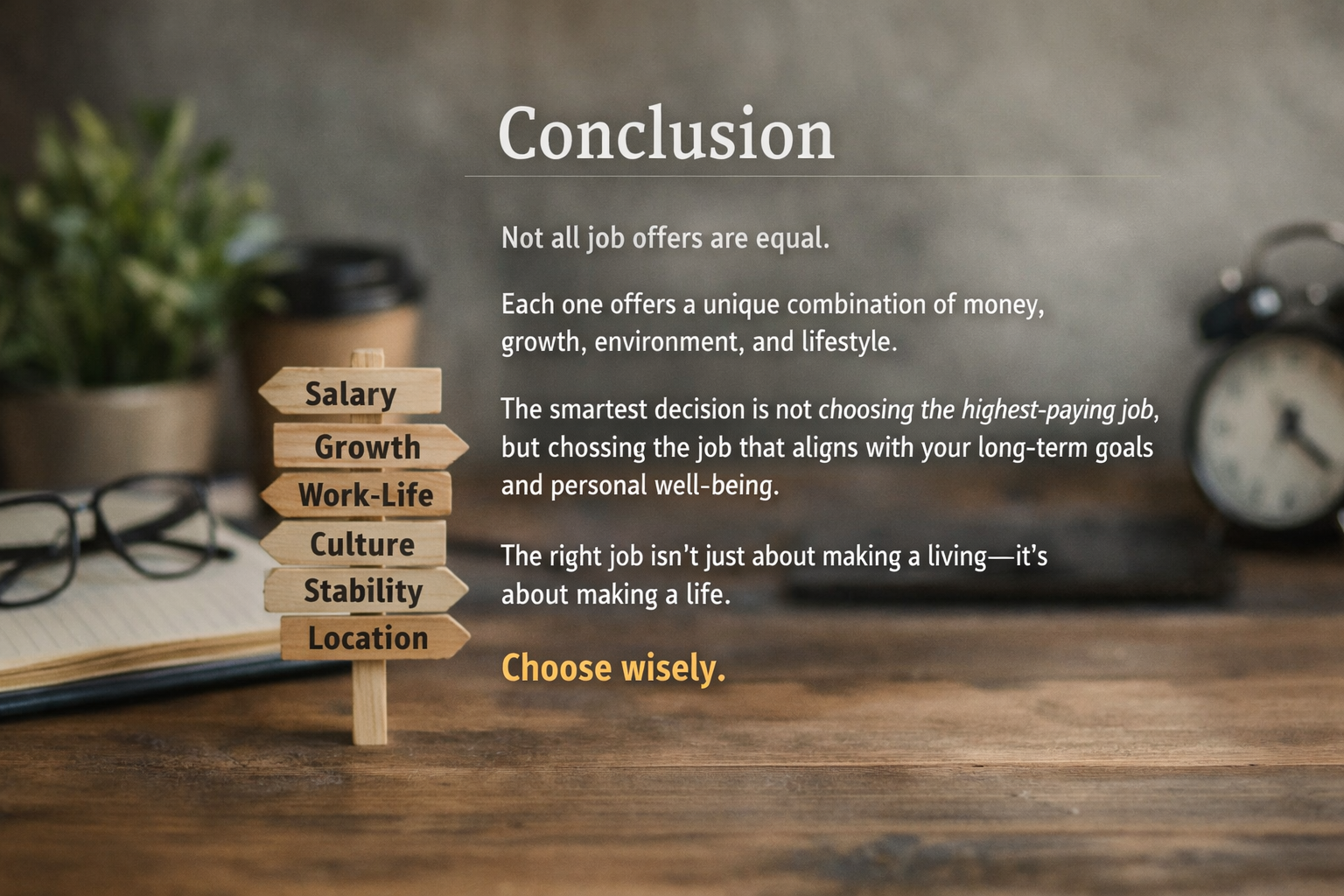
Not all job offers are created equal because a job is more than just money. Each offer comes with its own mix of salary, benefits, growth opportunities, work culture, responsibilities, and alignment with your personal goals.
Choosing the right job means looking beyond the paycheck and evaluating how it impacts your career, learning, lifestyle, and long-term happiness. The best offer is not always the highest-paying one—it’s the one that supports your growth, well-being, and future aspirations.






Comments
Be the first to leave a comment.