

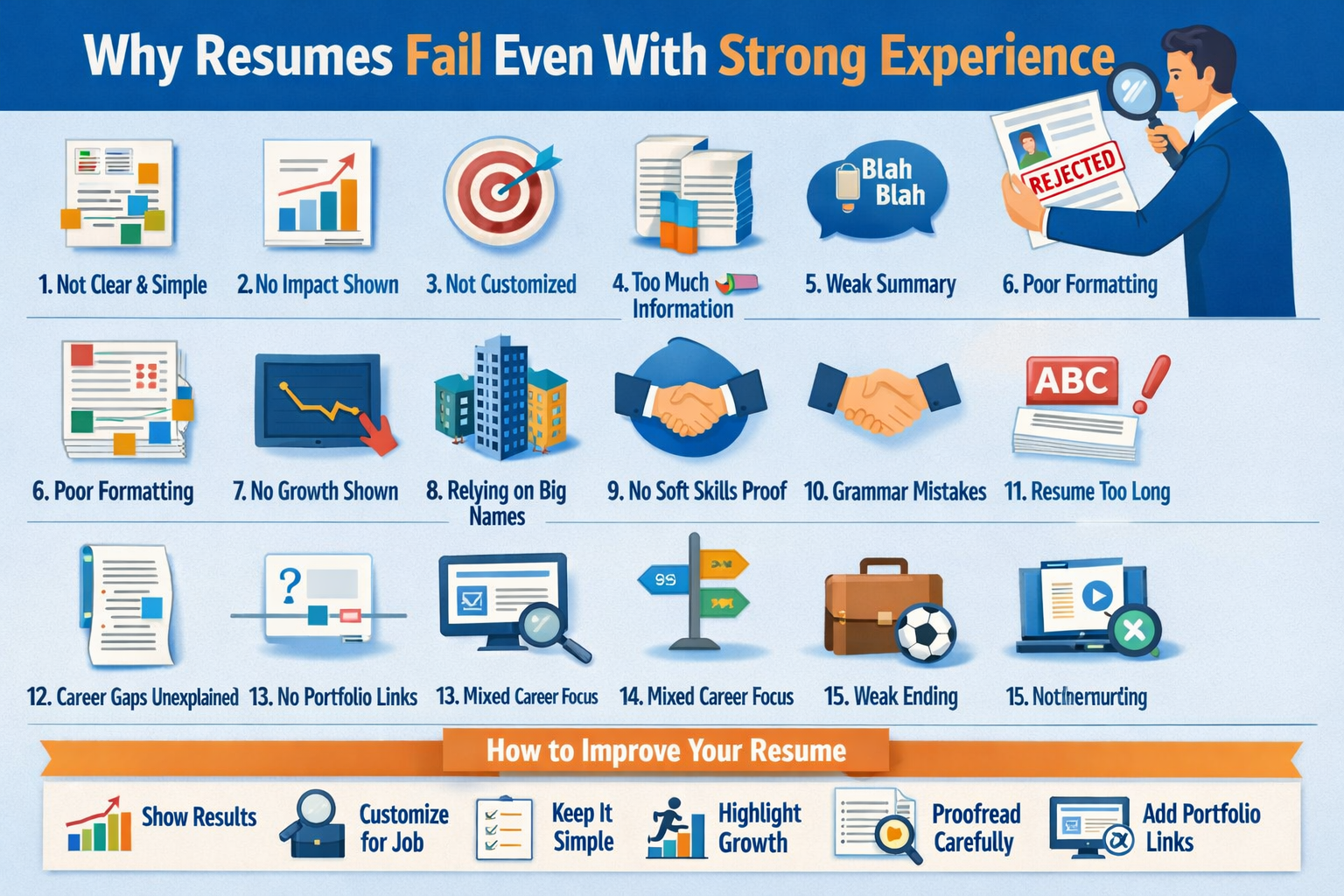
Introduction: Why Resumes Fail Even With Strong Experience
Many professionals believe that strong experience is enough to get interview calls. They think that if they have worked for many years, handled big projects, or worked in famous companies, their resume will automatically get selected. But in reality, many resumes get rejected even when the candidate has strong experience.
This can feel confusing and unfair. You may think, “I have done so much work. Why am I not getting interviews?”
The truth is simple: experience alone is not enough. The way you present your experience matters a lot.
In this article, we will understand why resumes fail even with strong experience and how you can improve your resume to get better results.
Why Resumes Fail Even With Strong Experience?
1. Resumes Are Not Clear and Simple
One big reason resumes fail is lack of clarity.
Many people write long paragraphs. They try to explain everything they have done. But recruiters do not have time to read long stories.
Recruiters usually spend only 6–10 seconds on one resume in the first screening.
If your resume is:
- Too long
- Full of big paragraphs
- Hard to scan
- Poorly formatted
Then even strong experience will not help.
What You Should Do:
- Use bullet points
- Keep sentences short
- Highlight key achievements
- Make layout clean and simple
Clarity makes your experience visible.
2. Experience Is Listed, But Impact Is Missing
Many candidates write their job responsibilities instead of achievements.
For example:
❌ “Responsible for managing social media accounts.”
❌ “Handled a team of 5 people.”
These statements do not show impact.
Recruiters want to see results.
For example:
✅ “Increased Instagram engagement by 45% in 6 months.”
✅ “Led a team of 5 and delivered project 2 weeks before deadline.”
Strong experience without measurable results looks average.
Why This Fails:
Because everyone can write responsibilities. Very few show impact.
Your resume must answer:
- What did you improve?
- What problem did you solve?
- What changed because of you?
3. Resumes Are Not Customized for the Job
Another common reason is using the same resume for every job.
Even if you have strong experience, if it does not match the job description, your resume may get rejected.
For example:
If a company is looking for:
- SEO skills
- Content strategy
- Analytics knowledge
But your resume only talks about:
- Writing blogs
- Posting on social media
Then the recruiter may feel you are not a strong match.
Why Customization Matters:
Today, many companies use Applicant Tracking Systems (ATS). These systems scan resumes for keywords.
If your resume does not include the right keywords from the job description, it may never reach a human recruiter.
Strong experience is useless if it is not aligned with the job role.
4. Too Much Information Creates Confusion
Some people think adding more information makes the resume stronger.
So they add:
- Every small internship
- Every short course
- Every workshop
- Every school achievement
This makes the resume crowded.
When there is too much information:
- Important achievements get hidden
- Recruiters feel overwhelmed
- Your main strengths are not visible
A resume is not your life story. It is a marketing document.
You must show only relevant information.
5. Weak Resume Summary
The resume summary is the first thing many recruiters read.
If your summary is generic like:
“Hardworking and dedicated professional looking for growth opportunities.”
This does not say anything specific.
Even with strong experience, a weak summary creates a weak first impression.
A Better Example:
“Content writer with 3 years of experience in SEO-driven blogs, increasing organic traffic by 60% for lifestyle brands.”
This is clear and strong.
Your summary should quickly explain:
- Who you are
- What you specialize in
- What results you bring
6. Poor Formatting and Design
Strong experience can get ignored if your resume looks unprofessional.
Common formatting mistakes:
- Different font styles
- Very small or very large font size
- Too many colors
- No proper spacing
- Misaligned sections
If your resume looks messy, the recruiter may assume your work style is also messy.
Simple and clean design builds trust.
You do not need fancy graphics. A clean, structured layout is enough.
7. No Proof of Growth
Recruiters look for progress.
If your resume shows:
- Same responsibilities for 5 years
- No promotions
- No new skills added
Then even strong experience may look stagnant.
Growth can be shown in many ways:
- Promotion
- Bigger responsibilities
- Leading teams
- Learning new tools
- Handling larger budgets
If your resume does not show growth, it may feel flat.
8. Overconfidence in Big Company Names
Some candidates believe working in a famous company is enough.
They think the company name will impress the recruiter.
But recruiters care about:
- What YOU did
- Not just where you worked
If your resume only mentions the company but not your contribution, it loses strength.
For example:
❌ “Worked at XYZ Company for 4 years.”
This does not show your value.
Even if you worked at a big brand, explain your impact.
9. Lack of Soft Skills Evidence
Many resumes list soft skills like:
- Leadership
- Communication
- Teamwork
- Problem-solving
But they do not give proof.
Just writing the word is not enough.
Instead of writing:
“Strong leadership skills”
You can show it like:
“Led cross-functional team of 8 members to launch new product.”
Show, do not just tell.
10. Grammar and Language Mistakes
Even small grammar mistakes can create a negative impression.
If your resume has:
- Spelling errors
- Wrong tenses
- Inconsistent formatting
Recruiters may think you lack attention to detail.
This is especially important in roles like:
- Content writing
- Marketing
- Communication
- Administration
Always proofread your resume.
You can:
- Read it aloud
- Use grammar tools
- Ask someone to review
Strong experience can lose power because of small language mistakes.
11. Resumes Are Too Long
Many experienced professionals create 3–4 page resumes.
But in most industries, 1–2 pages are enough.
Long resumes fail because:
- Recruiters lose interest
- Important details get buried
- It looks unfocused
Be selective.
Quality is more important than quantity.
12. Career Gaps Not Explained Properly
If there is a career gap and it is not explained, recruiters may hesitate.
They may think:
- Why was this person not working?
- Is there a performance issue?
If you had a gap for:
- Studies
- Family reasons
- Freelancing
- Skill development
You can briefly mention it.
Clarity reduces doubt.
13. No Portfolio or Supporting Links
In many modern roles, proof matters.
If you are:
- A content writer
- A designer
- A developer
- A marketer
And you do not include:
- Portfolio link
- LinkedIn profile
- Work samples
Then recruiters cannot verify your skills.
Strong experience without proof feels incomplete.
14. Resumes Do Not Match Career Goal
Sometimes the resume shows confusion.
For example:
- First page talks about marketing
- Second page talks about HR
- Third page talks about sales
This creates a mixed message.
Recruiters may feel:
“This candidate is not clear about their direction.”
Your resume must show a focused career path.
Even if you changed fields, explain the transition clearly.
15. Weak Ending Impression
The last part of your resume also matters.
If the resume ends with:
- Unnecessary personal details
- Outdated information
- Random hobbies
It reduces professionalism.
Keep it relevant and strong till the end.
Conclusion: Why Resumes Fail Even With Strong Experience
Strong experience is powerful.
But experience alone does not guarantee interviews.
Your resume is like a bridge between you and the recruiter. If that bridge is weak, the recruiter will not cross it.
A resume fails not because the candidate is weak, but because the presentation is weak.
Think of your resume as a marketing document. It must:
- Be clear
- Show impact
- Match the job
- Be easy to read
When you combine strong experience with strong presentation, your chances of getting interviews increase a lot.
Remember, recruiters do not reject people. They reject resumes.
Make sure your resume truly represents your value.






Comments
Be the first to leave a comment.