

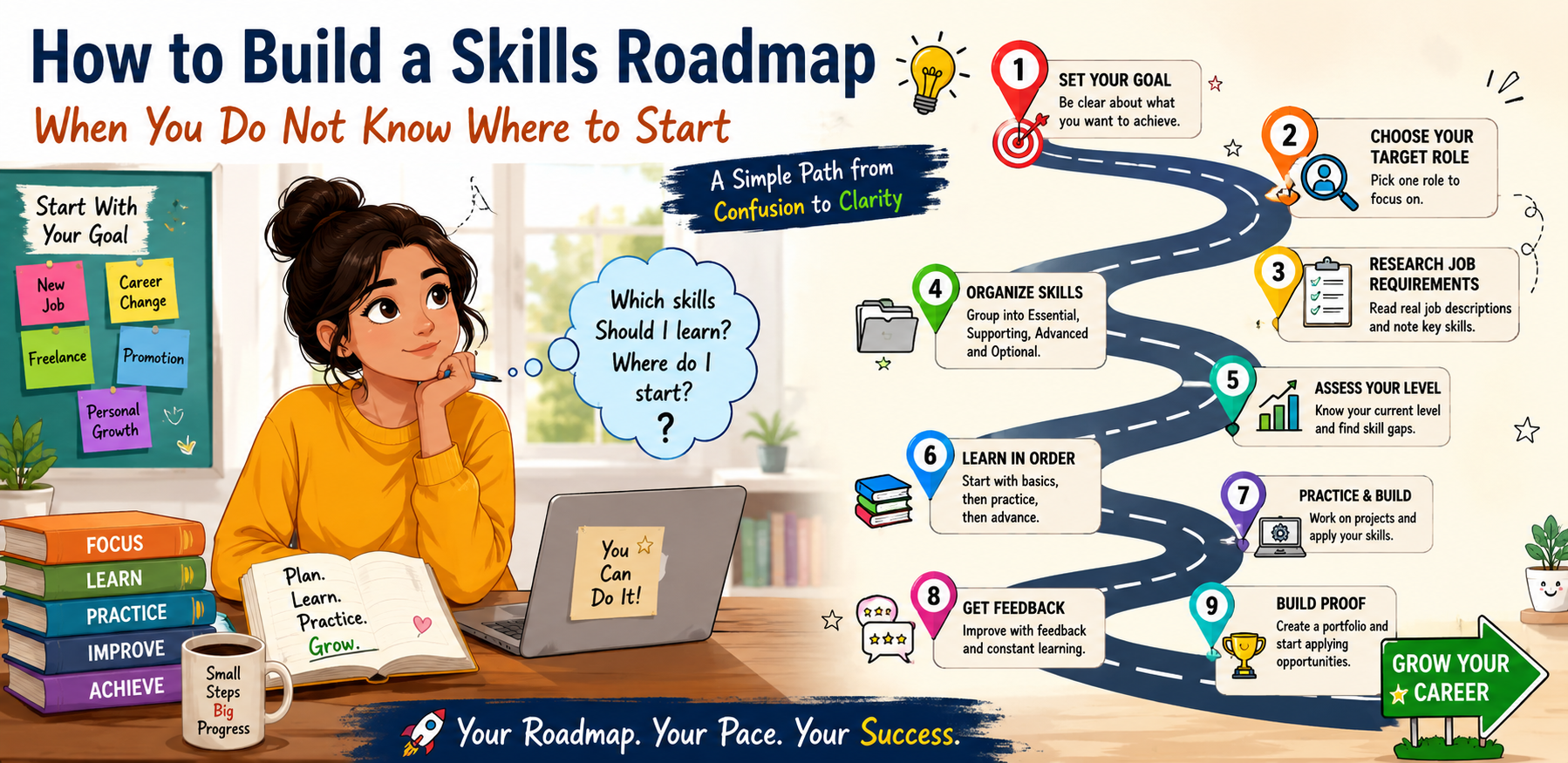
Introduction: Skills Roadmap
Many people want to improve their skills but do not know where to begin.
You may see job descriptions asking for many different skills. You may watch videos about new technologies, read articles about successful professionals, or see people learning several skills at the same time. This can make you feel confused.
You may ask yourself:
- Which skill should I learn first?
- Do I need a degree or certification?
- Should I learn technical skills or soft skills?
- How do I know which skills will help my career?
- What if I choose the wrong skill?
The good news is that you do not need to know everything before you start. You only need a clear direction and a simple plan.
A skills roadmap can help you understand what to learn, why you need to learn it, and when you should learn it. It can also help you avoid wasting time on random courses and information.
Here is how you can build a skills roadmap even when you do not know where to start.
How to Build a Skills Roadmap When You Do Not Know Where to Start?
1. Start With Your Goal
The first step is to decide what you want your skills to help you achieve.
Do not start by asking, “What skills should I learn?”
Instead, ask, “What do I want to do?”
Your answer could be:
- Get my first job
- Change my career
- Get a promotion
- Start freelancing
- Become better at my current job
- Start a business
- Work remotely
- Prepare for a specific job role
Your goal does not have to be perfect. It can change later.
For example, if you want to become a content writer, your goal can be:
“I want to become a professional content writer within the next six months.”
This goal gives you a direction.
Without a goal, you may spend months learning unrelated skills. With a goal, you can focus on skills that support your desired result.
2. Choose One Target Role
Once you know your general goal, choose one role to focus on.
For example, “I want to work in technology” is too broad.
You could choose:
- Web developer
- Data analyst
- UX designer
- Digital marketer
- Cybersecurity analyst
- Product manager
If you are interested in writing, you could choose:
- Content writer
- Copywriter
- Technical writer
- SEO writer
- Social media writer
Choosing one role does not mean you must stay with it forever. It simply gives you a starting point.
You can explore other roles later.
When you are confused, choosing one direction for the next three to six months is often better than trying to prepare for ten different careers at once.
3. Read Real Job Descriptions
One of the easiest ways to understand which skills you need is to look at real job descriptions.
Search for jobs related to your target role on job platforms and company career pages.
Read at least 10 to 20 job descriptions.
Write down the skills that appear repeatedly.
For example, if you are researching content writing jobs, you may notice skills such as:
- Blog writing
- Research
- SEO
- Editing
- Grammar
- Content management systems
- Social media
- Communication
Do not panic when you see a long list.
You are not expected to learn everything immediately.
Your purpose at this stage is to identify patterns.
If a skill appears in many job descriptions, it may deserve a higher place on your roadmap.
4. Separate Skills Into Categories
After collecting skills, organize them into categories.
A simple system is:
Essential Skills
These are skills you need to perform the basic work.
For example, a content writer may need writing, research, editing, and basic SEO knowledge.
Supporting Skills
These skills can make you more effective.
For example, communication, project management, time management, and presentation skills.
Advanced Skills
These skills can help you grow later.
For example, content strategy, leadership, analytics, automation, or advanced technical knowledge.
Optional Skills
These skills may be useful but are not necessary at the beginning.
This classification can reduce confusion.
Instead of thinking, “I need to learn 15 skills,” you can think, “I need to learn four essential skills first.”
That feels much more manageable.
5. Find Your Current Skill Level
Before creating a learning plan, understand where you are today.
Make a simple table with three columns:
Skill | Current Level | Evidence
For example:
| Skill | Current Level | Evidence |
|---|---|---|
| Writing | Beginner | Written a few articles |
| SEO | Beginner | Understand basic keywords |
| Research | Intermediate | Can research topics independently |
| Editing | Beginner | Can correct basic grammar |
| Social media | Beginner | Have created a few posts |
Be honest with yourself.
You do not need to call yourself an expert to feel confident.
The purpose of this exercise is to identify your starting point.
If you already have some knowledge, you do not need to start from zero.
6. Identify Your Skill Gaps
A skill gap is the difference between what you can do now and what you need to do for your target role.
For example, suppose you want to become a social media manager.
You may already know how to use social media personally. However, professional social media management may require additional skills such as:
- Content planning
- Social media analytics
- Copywriting
- Audience research
- Content calendars
- Basic design
- Performance reporting
The gap between your current ability and the requirements of the job is your learning area.
Write down your skill gaps.
Then rank them.
Ask yourself:
- Is this skill required for my target role?
- How often does it appear in job descriptions?
- Will learning it help me create real work?
- Can I learn the basics within a reasonable time?
The answers will help you decide what to learn first.
Conclusion: Skills Roadmap
Building a skills roadmap can feel difficult when you do not know where to start. You may have many interests and very little clarity.
You do not need to figure out your entire career today.
Start with one goal.
Choose one target role.
Research what that role requires.
Identify your current skills.
Find the gaps.
Choose the most important skill.
Learn it.
Practice it.
Build a project.
Get feedback.
Then move to the next skill.
Your roadmap will become clearer as you move forward.
Remember that a skills roadmap is not a fixed plan for your entire life. It is a guide for your next step.
You do not need to see the entire road before you begin walking.
You only need to know where you are going next.






Comments
Be the first to leave a comment.