

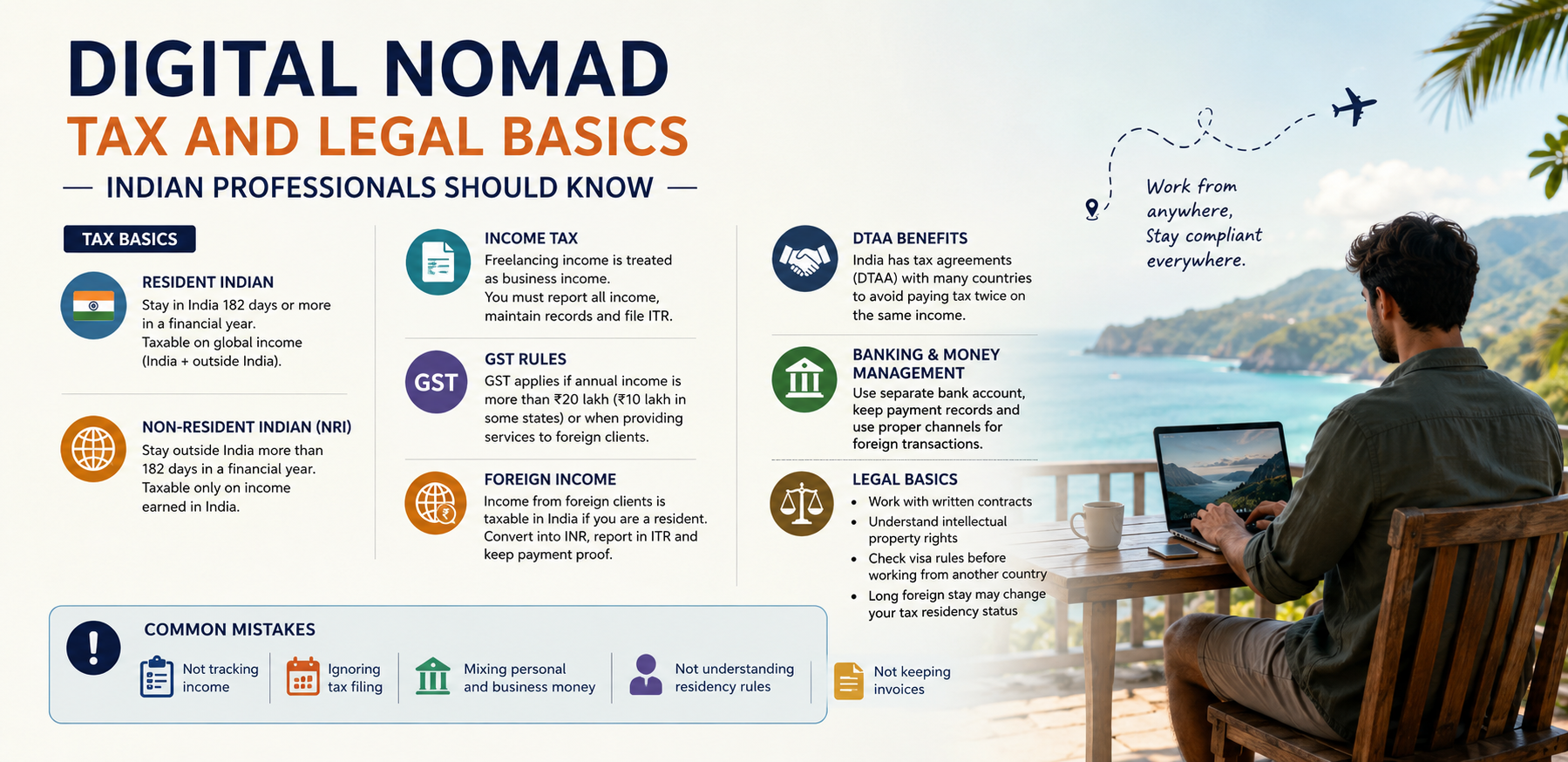
Introduction: Digital Nomad Tax and Legal Basics
Today, more Indian professionals are choosing a digital nomad lifestyle. This means they work online while traveling or living in different places instead of staying in one office or city. Freelancers, content writers, designers, developers, marketers, and consultants are all becoming digital nomads.
This lifestyle gives freedom, but it also brings responsibility. One of the biggest responsibilities is understanding taxes and legal rules. Many people ignore this part in the beginning and later face problems like penalties, double taxation, or legal confusion.
In this article, we will explain digital nomad tax and legal basics in very simple English so Indian professionals can understand and plan better.
What is a Digital Nomad?
A digital nomad is a person who works online and is not fixed to one location. They can work from:
- Home
- Cafes
- Co-working spaces
- Different cities or countries
For example, an Indian content writer can work from Delhi today and Goa next month. As long as they have a laptop and internet, they can work from anywhere.
But even if work is flexible, taxes and legal rules still apply based on your income and country of residence.
Understanding Tax Basics for Indian Digital Nomads
If you are an Indian citizen, your tax situation depends mainly on your residential status.
1. Resident Indian
You are a resident if:
- You stay in India for 182 days or more in a financial year
If you are a resident:
- You must pay tax on global income (income from India + outside India)
2. Non-Resident Indian (NRI)
You are an NRI if:
- You stay outside India for more than 182 days in a financial year
If you are an NRI:
- You pay tax only on income earned in India
Why this is important?
If you travel a lot as a digital nomad, your tax status may change every year. This affects how much tax you pay and where you pay it.
Digital Nomad Tax Indian Professionals Should Know
1. Income Tax for Freelancers and Remote Workers
Most digital nomads are freelancers or self-employed professionals.
In India, freelancing income is treated as business income.
You must:
- Report all income earned
- Maintain basic records of earnings
- File Income Tax Return (ITR)
Allowed expenses
You can reduce taxable income by claiming business expenses like:
- Laptop and gadgets
- Internet bills
- Co-working space fees
- Software subscriptions
- Travel for work (if related to business)
For example:
If you earn ₹10,00,000 in a year and spend ₹2,00,000 on work expenses, tax is calculated on ₹8,00,000.
2. GST Rules for Digital Nomads
GST (Goods and Services Tax) is important for freelancers in India.
When GST applies:
- If your annual income is more than ₹20 lakh (₹10 lakh in some states)
- If you provide services to foreign clients (in some cases, it is treated as export of services)
Export of services
If you work with foreign clients, it is often considered an export of service. In many cases:
- GST rate = 0%
- But you must still register or file paperwork in some situations
This is why many freelancers get confused. Even if tax is zero, compliance is still required.
3. Foreign Income and Digital Nomads
Many digital nomads earn money from clients outside India (USA, UK, Europe, etc.).
This income is still taxable in India if you are a resident.
You must:
- Convert foreign income into INR
- Report it in your tax return
- Keep invoices and payment proof
Banks may also ask for:
- Foreign Inward Remittance Certificate (FIRC)
This proves that money came from abroad legally.
4. Double Taxation Avoidance Agreement (DTAA)
India has agreements with many countries called DTAA (Double Taxation Avoidance Agreement).
This means:
- You do not pay tax twice on the same income in two countries
For example:
If you earn money in the USA and already pay tax there, India may give you credit for that tax.
This helps digital nomads avoid double tax burden.
But rules depend on:
- Type of income
- Country agreement
- Residential status
It is always good to check DTAA rules or consult a tax expert.
5. Banking and Money Management
Digital nomads must manage money carefully.
Important points:
- Use a separate bank account for freelancing income
- Keep records of all payments
- Use PayPal, Wise, or international transfer services for foreign clients
- Track currency conversion rates
This helps during tax filing and avoids confusion later.
Legal Basics for Indian Digital Nomads
Now let’s understand legal rules that matter for remote workers.
1. Work Contracts
Always use a written contract with clients. A contract should include:
- Work details
- Payment terms
- Deadline
- Revision policy
- Cancellation rules
This protects you from payment issues.
2. Intellectual Property Rights
If you create content, designs, or software:
- Clearly mention who owns the final work
- Some clients take full rights
- Some allow you to keep credit
Without clarity, disputes can happen.
3. Foreign Work Rules
If you work from another country (as a digital nomad abroad), you may need:
- Tourist visa (sometimes not allowed for work)
- Digital nomad visa (offered by some countries)
Working on tourist visa can be illegal in some countries, so always check visa rules before traveling.
4. India’s Rules on Foreign Stay
If you stay outside India for long periods:
- Your residency status may change
- Your tax rules may change
This affects:
- Income reporting
- Banking
- Investments in India
So long-term travel needs planning.
Conclusion: Digital Nomad Tax and Legal Basics
Being a digital nomad is exciting. It gives freedom to work from anywhere and explore life differently. But for Indian professionals, understanding tax and legal basics is very important.
You must know:
- Your residential tax status
- Income tax rules
- GST basics
- Foreign income reporting
- DTAA benefits
- Legal contract safety
- Visa and travel rules
If you manage these properly, your digital nomad journey will be smooth, legal, and stress-free.
Freedom in work is powerful, but only when it is supported by proper knowledge and responsibility.






Comments
Be the first to leave a comment.