

Introduction
Many professionals work hard every day yet feel overlooked. They stay busy, meet deadlines, and put in long hours. Still, recognition and growth seem limited. This happens because effort and results are not the same thing. Understanding how managers differentiate effort from results can completely change how your work is evaluated.
Managers appreciate effort, but they reward outcomes. They focus on what changed because of your work, not how busy you looked. When professionals confuse effort with impact, expectations break down. Learning this distinction helps you align better with leadership thinking.
What effort looks like from a manager’s perspective
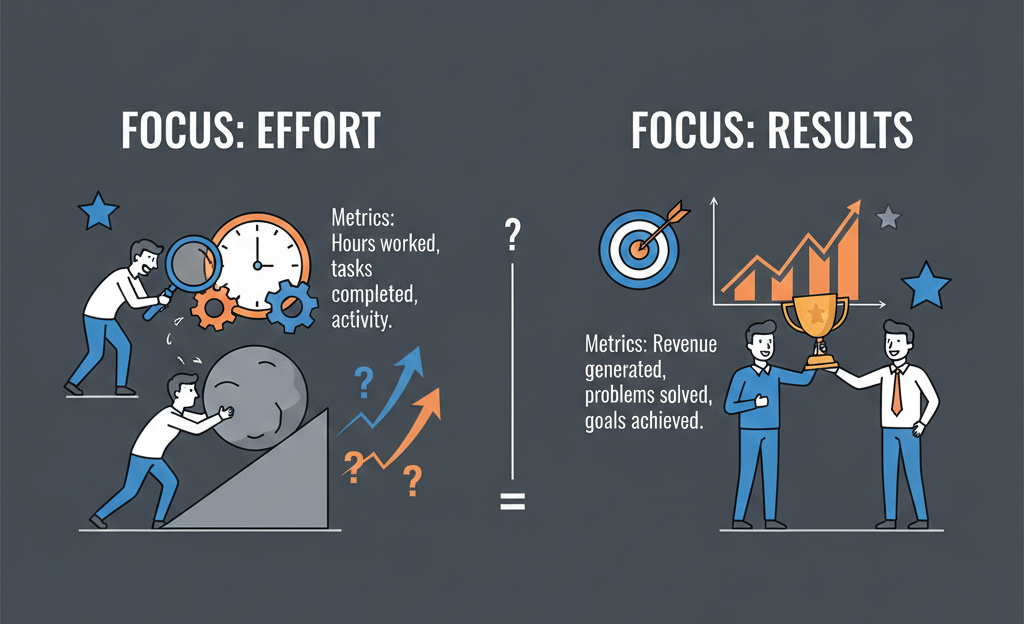
Effort is visible activity. It includes time spent, responsiveness, and task completion. Managers notice when someone is available, reliable, and hardworking.
However, effort alone does not guarantee value. Long hours do not always mean meaningful progress. From a manager’s view, effort is an input, not an outcome.
Effort matters, but it is only the starting point. Managers assume baseline effort from every professional role.
What results mean in management terms
Results focus on outcomes. Managers look at what improved, changed, or moved forward because of your work.
Results may include revenue growth, cost reduction, process improvement, or risk avoidance. Sometimes results are qualitative, such as better collaboration or clearer decision-making.
What matters is impact. Managers connect results to business goals, not personal sacrifice.
This distinction explains how managers differentiate effort from results so clearly.
Why effort alone rarely drives promotions
Promotions are future-focused decisions. Managers ask whether you can deliver at the next level.
Effort shows dedication, but results show capability. Leaders promote people who consistently create outcomes, not just activity.
Someone who works hard but needs direction may stay stable. Someone who produces results with clarity signals readiness.
That difference shapes growth opportunities.
How managers observe results over time
Managers rarely judge results from one task. They observe patterns.
They notice whether your work reduces their involvement or increases it. They see if problems get resolved or repeated.
Results show up through consistency. Over time, patterns outweigh isolated effort.
This is why visible outcomes matter more than occasional intensity.
The role of ownership in result evaluation
Ownership bridges effort and results. Managers value professionals who take responsibility for outcomes.
Ownership means thinking beyond tasks. It involves anticipating issues and following through.
When ownership is strong, results usually follow. When ownership is weak, effort feels scattered.
Managers associate ownership with maturity and trustworthiness.
Why busy behavior can hide weak results
Busy behavior often creates a false sense of productivity. Constant updates and activity feel reassuring.
However, managers eventually ask whether progress exists. If activity does not move metrics or decisions, concern grows.
Over time, busy behavior without results damages credibility. It signals inefficiency, not dedication.
Understanding this protects you from misalignment.
How communication influences result perception
Results must be visible to matter. Poor communication hides impact.
Managers cannot credit what they cannot see or understand. Clear updates that link work to outcomes change perception.
When you explain what changed because of your work, results become tangible. This shifts how managers evaluate you.
Communication turns results into recognized value.
Measuring effort versus measuring impact
Effort is easy to measure. Time, attendance, and responsiveness are obvious.
Impact requires interpretation. Managers assess whether goals were met or improved.
Because impact drives business success, it carries more weight. Effort supports impact, but does not replace it.
This measurement difference explains evaluation gaps many professionals feel.
Why managers still care about effort
Effort still matters. Low effort limits results. Managers expect professionalism and consistency.
However, once effort meets expectations, it stops being a differentiator. Results become the deciding factor.
Think of effort as entry-level currency. Results create advancement.
Balancing both is key.
How professionals can shift focus toward results
Start by understanding what success looks like for your role. Ask what outcomes matter most.
Align tasks with those outcomes. Track progress and highlight impact regularly.
Shift conversations from what you did to what changed. This reframes your contribution naturally.
This shift aligns you with how managers think.
Common mistakes professionals make
One mistake is overemphasizing struggle. Managers value solutions more than sacrifice.
Another mistake is assuming effort speaks for itself. It rarely does.
Some professionals also confuse urgency with importance. Fast work without direction weakens results.
Avoiding these mistakes improves alignment quickly.
How result-focused professionals stand out
Result-focused professionals simplify leadership work. They reduce noise and increase clarity.
Managers trust them with bigger responsibilities. Decisions move faster around them.
Over time, these professionals gain influence without asking for it. Their impact speaks clearly.
That is the advantage of understanding how managers differentiate effort from results.
Conclusion
Effort shows commitment, but results show value. Managers rely on outcomes to make decisions about trust, growth, and promotion. That is how managers differentiate effort from results in real workplace settings.
When you align your work with impact and communicate outcomes clearly, evaluation becomes fairer and growth accelerates.
Use the best job tool to find roles and teams that value results, clarity, and meaningful contribution.
Find Your Dream Job Today – Explore Endless Career Opportunities and Secure Your Next Role with Best Job Tool.






Comments
Be the first to leave a comment.