

Introduction
Don’t know, how to answer ambiguous interview questions?
An interview is one of the most important steps in our career journey. Everyone wants their interview to go well and leave a positive impression on the recruiter so that they can get selected easily.
However, the difficulty starts when the recruiter asks questions that confuse the candidate. Many times, recruiters ask ambiguous questions, and candidates get confused about how to answer them.
But now you don’t have to worry, because this article is going to help you a lot.
In this article, we will understand how to answer ambiguous interview questions easily.
What Are Ambiguous Interview Questions?
Before learning how to answer ambiguous interview questions, we first need to understand what ambiguous interview questions are and what types of questions come under this category.
Ambiguous interview questions are questions that can be answered in many different ways. There is no single correct answer. Recruiters ask these questions to understand a candidate’s thinking process, response style, and communication skills.
These types of questions are open-ended, have multiple valid responses, and usually do not ask for very specific details.
Some examples of ambiguous interview questions are:
- Tell me about yourself
- How do you handle challenges?
- What would you do if things didn’t go as planned?
- Describe a difficult situation you faced
Recruiters intentionally ask these questions so that they can understand the candidate better.
How to Answer Ambiguous Interview Questions?
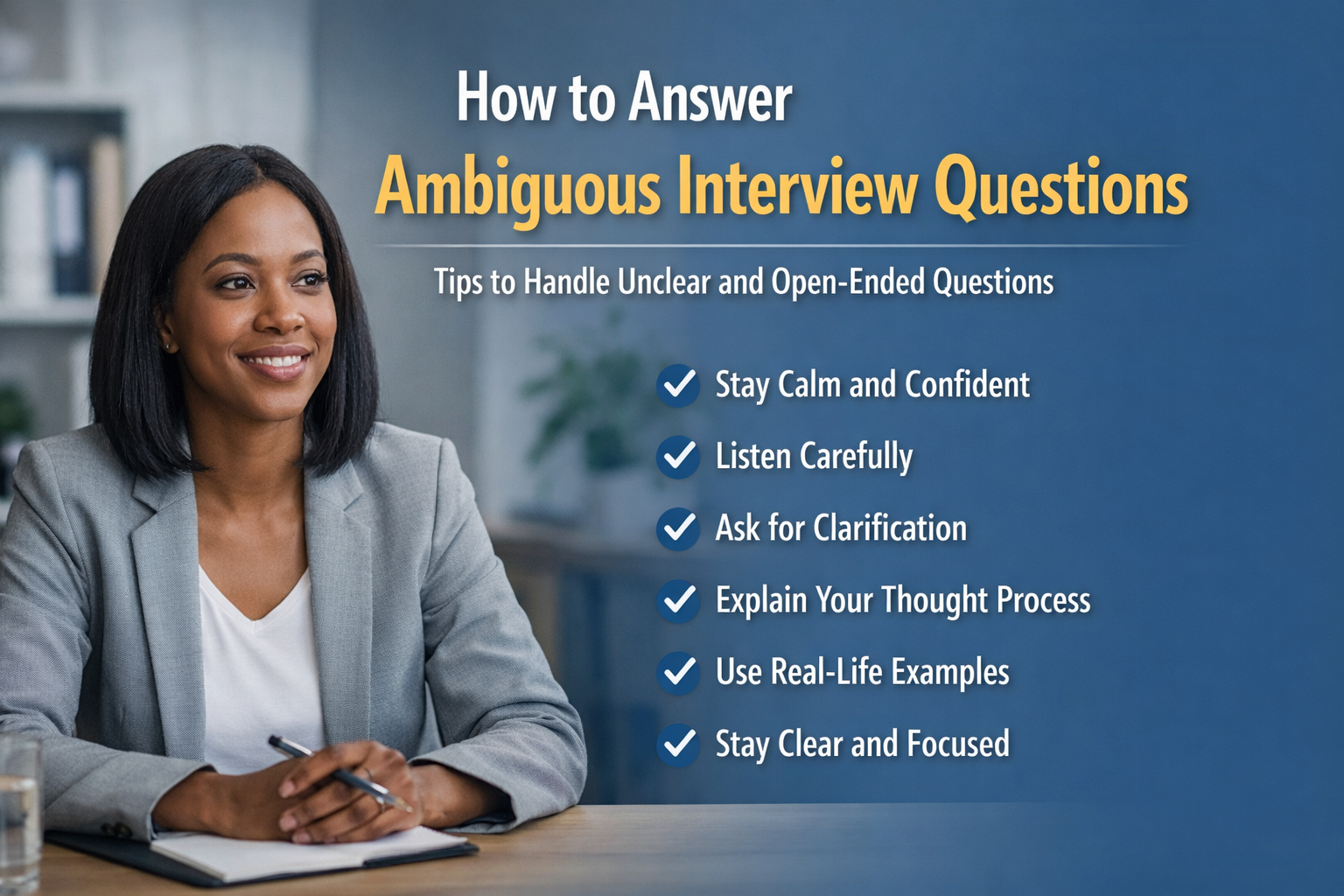
1. Stay calm and don’t panic
The most effective way to handle such questions is this: whenever a recruiter asks you a question that confuses you or makes you unsure about how or what to answer, do not panic. First, calm yourself and relax your mind. Take a moment to think about the best possible answer, and then start speaking.
If you panic and fail to stay calm, you may answer without thinking. This can lead to irrelevant or completely off-topic responses. In moments of confusion, it becomes difficult to understand what to say and what not to say, and because of panic, we often speak in a hurry.
Therefore, stay calm and do not panic while answering ambiguous interview questions.
2. Listen to the ambiguous interview questions carefully
Whenever you hear an ambiguous interview question, do not rush to answer it immediately. First, listen to the question carefully and understand what the recruiter is actually asking. Do not misunderstand the question in a hurry, because careful listening is very important for giving a good answer.
By listening attentively, you can identify the main focus of the question. Based on that, you can frame and present your answer clearly. This will impress the recruiter and increase your chances of getting hired.
3. Take a moment to think
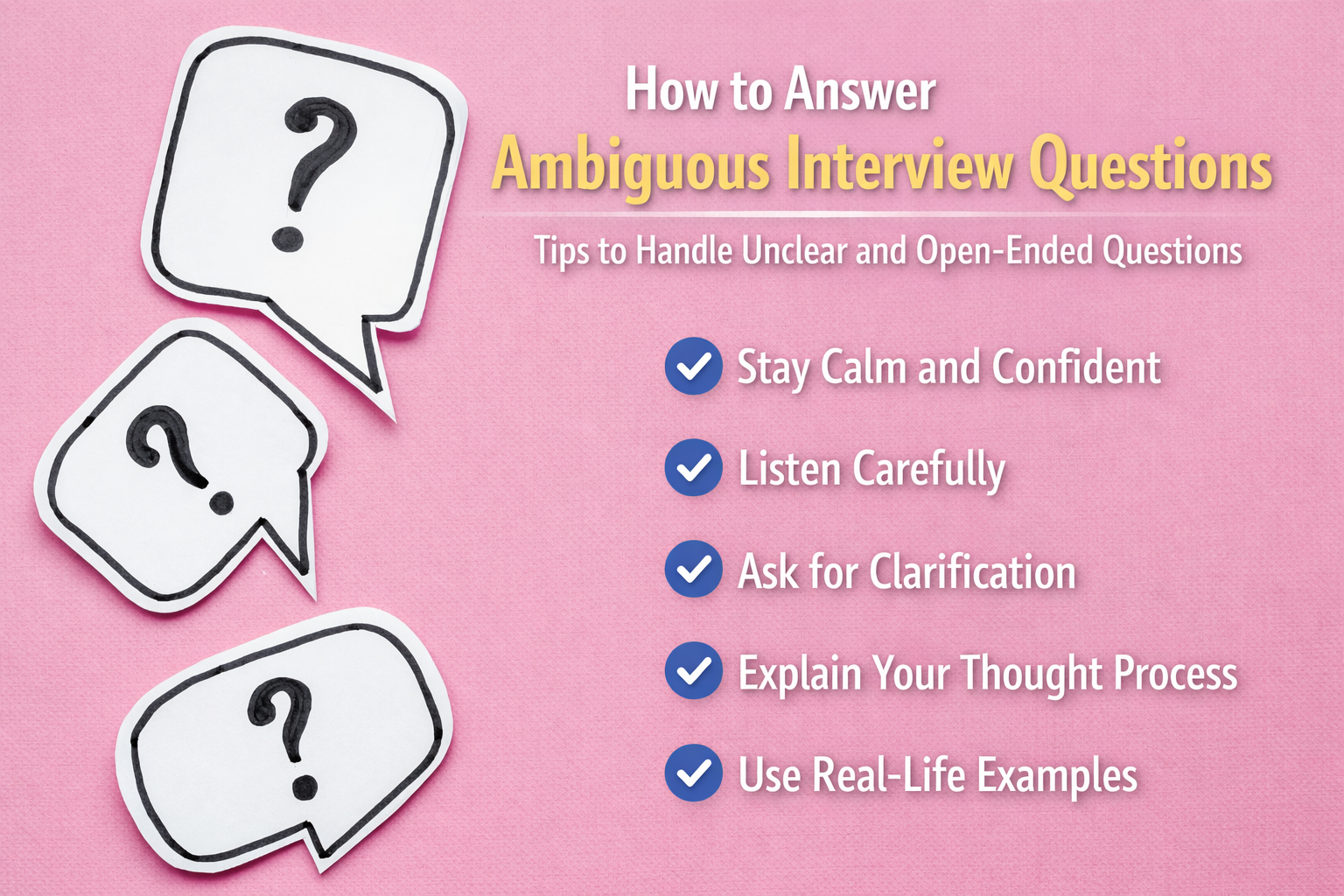
Do not rush to answer as soon as you hear the question. If you answer immediately without thinking, your response may be incorrect or irrelevant. That is why, after hearing the question, you should take a little time to understand it and frame your answer. Then, present your response clearly to the recruiter.
This gives you two major benefits. First, when you understand the question properly before answering, your response will be more relevant and strong. Second, when you take time to think before answering, the recruiter sees you as a candidate who understands problems first and then finds the best solution, instead of making quick and wrong decisions. This increases your value, impresses the recruiter, and improves your chances of getting hired.
4. Ask for clarification if needed
Many candidates answer a question even when they do not fully understand it. They do this because they think that asking the recruiter for clarification will create a negative impression and may even lead to rejection.
But this thinking is completely wrong. If you answer without understanding the question and without clarification, it automatically creates a negative impression on the recruiter. The recruiter may feel that you are more interested in giving memorized answers than actually understanding the question.
So, if you do not understand a question, always ask the recruiter for clarification. Only answer after you clearly understand the question.
When you ask for clarification, it actually impresses the recruiter. It shows that you want to understand the question properly, you value the interview, and you take your answers seriously. This also increases your chances of getting hired.
5. Explain your thought process
Another effective way to answer ambiguous interview questions is to explain your thought process.
Explaining your thought process means sharing how you are thinking, not just what your final answer is. When you explain your thought process step by step, you show the recruiter how you analyze a problem, consider different options, and make decisions.
You can also read “Techniques to Answer Unexpected Interview Questions”.
Conclusion
Ambiguous interview questions may seem tricky at first, but they are actually an opportunity to showcase your thinking, problem-solving, and communication skills. By staying calm, listening carefully, asking for clarification, structuring your answer, and explaining your thought process, you can handle these questions confidently.
Remember, interviewers are not looking for a perfect answer—they are looking for clarity, logic, and confidence. Approaching ambiguous questions thoughtfully can leave a strong impression and set you apart from other candidates.
Want to explore more such blogs? Read here.






Comments
Be the first to leave a comment.