

Introduction
When you apply for a job, you see your resume as your effort, your struggle, your growth, and your dreams.
But a recruiter does not see your emotions. A recruiter sees a document for 6–10 seconds and decides whether to continue reading or move to the next candidate.
This is why learning how to audit your resume like a recruiter is very important. When you review your resume from a recruiter’s point of view, you stop thinking like a job seeker and start thinking like a decision-maker.
In this article, we will understand how recruiters actually read resumes and how you can check your own resume step by step with a practical auditing method.
How to Audit Your Resume Like a Recruiter?
1. Understand How Recruiters Actually Read a Resume
Before auditing your resume, you must understand the recruiter’s reality.
Recruiters:
- Read hundreds of resumes for one role
- Spend only a few seconds on the first scan
- Look for relevance, not effort
- Focus on clarity, not decoration
Many companies like Google and Amazon receive thousands of applications for a single position. Recruiters simply cannot deeply read every resume.
So what do they do?
They scan for:
- Job title match
- Skills match
- Relevant experience
- Clear results
- Clean formatting
If your resume does not quickly show these things, it may get rejected — even if you are talented.
When auditing your resume, your first question should be:
“If I were busy and tired, would I understand this resume in 10 seconds?”
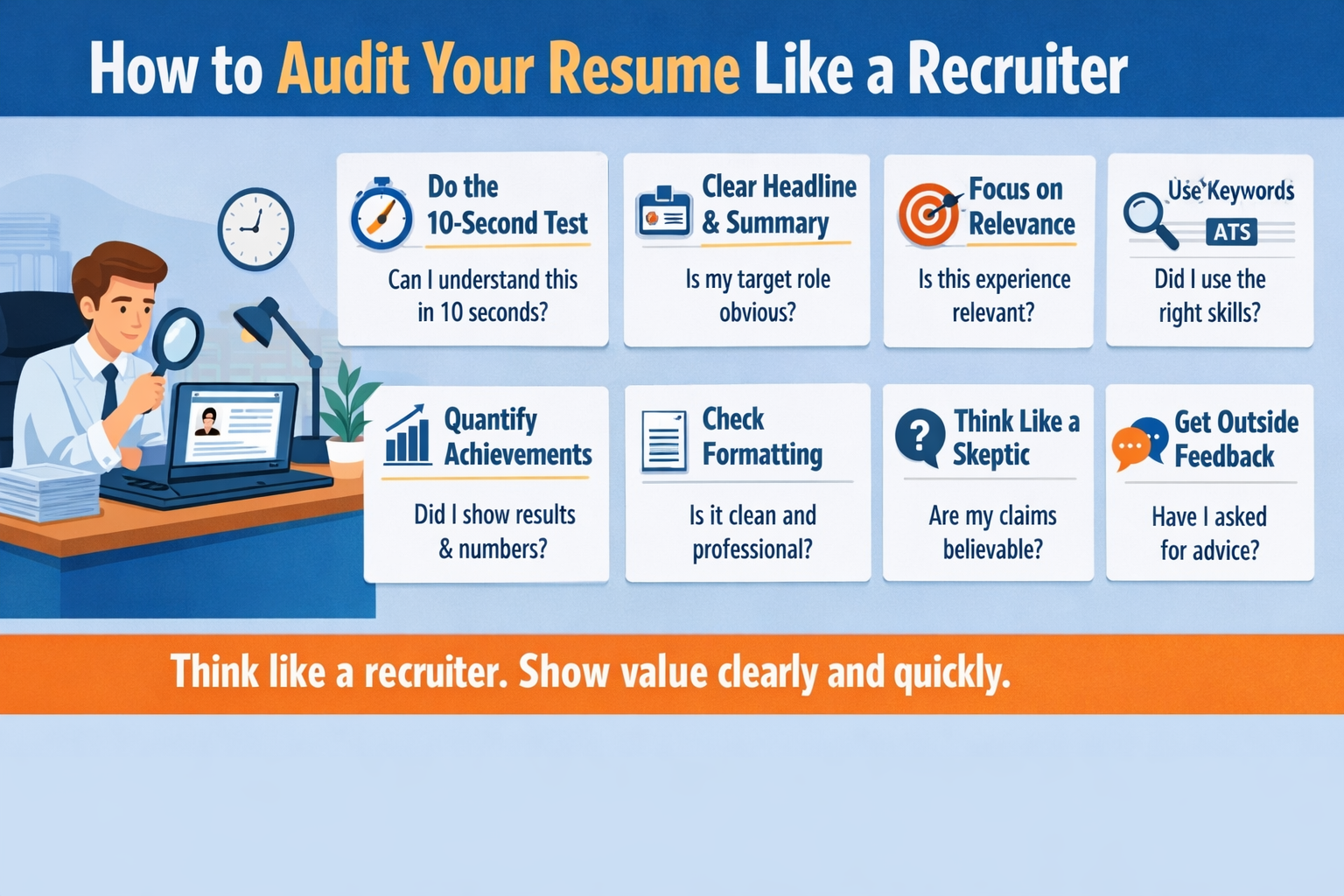
2. Start With the 10-Second Test
Print your resume or open it on screen. Set a timer for 10 seconds.
Now quickly look at it.
After 10 seconds, ask yourself:
- What job role is this person targeting?
- What is their main strength?
- How many years of experience do they have?
- What industry are they from?
If you cannot answer these questions clearly, your resume is not strong enough.
Recruiters do not search for hidden talent. They search for visible value.
If your target role is “Content Writer,” but your resume headline says “Looking for Opportunities” — that is unclear.
Instead of:
Seeking a challenging position in a growth-oriented organization
Write:
Content Writer with 2 years of experience in blog writing and SEO content
Clarity wins.
3. Check Your Resume Headline and Summary
Recruiters first look at the top section.
Audit this section carefully.
Ask:
- Does my headline clearly mention my target role?
- Does my summary focus on value or only on myself?
- Is it short and direct?
Bad summary example:
Hardworking, passionate individual seeking opportunity to learn and grow.
Recruiter reaction: Everyone writes this.
Strong summary example:
SEO-focused Content Writer with 2+ years of experience creating blog articles that increased organic traffic by 35%.
Recruiter reaction: Specific. Measurable. Relevant.
Your summary should answer:
“What problem can this person solve for us?”
If it does not answer this, rewrite it.
4. Audit for Relevance, Not Length
Many people believe longer resumes look more impressive.
Recruiters think differently.
They ask:
“Is this relevant to the job?”
For example, if you are applying for a marketing job, your part-time cashier job from 5 years ago may not need detailed bullet points.
Audit every section and ask:
- Does this experience support my target job?
- If not, can I shorten or remove it?
Your resume is not your biography.
It is your marketing document.
Remove:
- Unnecessary school achievements (if you have work experience)
- Irrelevant hobbies
- Outdated skills
- Very old internships (unless important)
Focus on what supports your career direction.
5. Check for Keyword Alignment
Many companies use Applicant Tracking Systems (ATS). These systems scan resumes before a human sees them.
If your resume does not contain relevant keywords, it may get rejected automatically.
For example, if the job description says:
- SEO
- Content strategy
- Keyword research
- Google Analytics
And your resume says:
- Online writing
- Internet tools
- Content planning
You may not pass the system.
Audit step:
- Open the job description.
- Highlight important skills and tools.
- Check if those exact words appear naturally in your resume.
Do not copy blindly.
But align your language.
Recruiters search for matches.
Help them find it.
6. Examine Your Bullet Points Carefully
This is where most resumes become weak.
Recruiters do not want to read job duties.
They want to see impact.
Weak bullet:
Responsible for writing blog posts.
Strong bullet:
Wrote 15+ SEO-optimized blog posts per month, increasing website traffic by 25% in 6 months.
Audit every bullet point and ask:
- Does this show results?
- Does this show growth?
- Does this show numbers?
Use this formula:
Action + Task + Result
Example:
- Created email marketing campaigns that improved open rates by 18%.
- Designed social media strategy that increased engagement by 40%.
- Reduced customer complaints by 15% by improving response process.
Numbers build trust.
If you don’t have exact numbers, estimate responsibly.
7. Check Formatting in Resume Like a Recruiter
Recruiters prefer clean and simple formatting.
Audit these elements:
Font
- Is it easy to read?
- Is size between 10–12?
Spacing
- Is there enough white space?
- Is it crowded?
Alignment
- Are dates aligned?
- Are headings consistent?
Avoid:
- Too many colors
- Unnecessary graphics
- Fancy fonts
Unless you are applying for a design role, simple is better.
Your resume should look professional, not decorative.
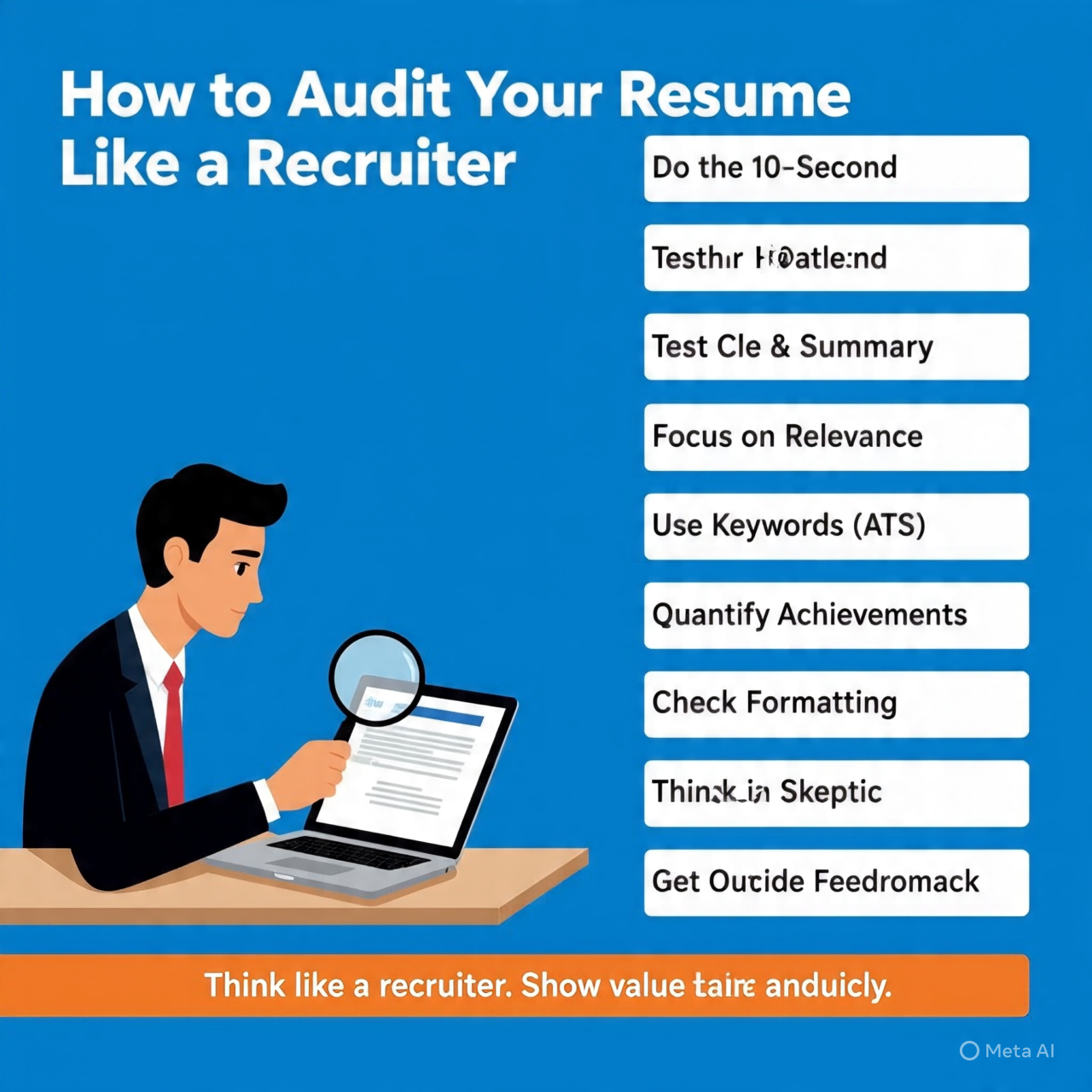
8. Look at Your Resume From a Skeptical View
Now imagine you are a recruiter who doubts everything.
Ask:
- Are these achievements believable?
- Are these claims specific?
- Does this person look stable or job-hopping?
If you changed jobs frequently, show progression.
If you had gaps, consider explaining briefly (if necessary).
Recruiters look for patterns:
- Growth
- Consistency
- Stability
- Learning
Your resume should tell a story of development.
9. Remove Weak Language from Resume
Certain words make resumes weak:
- Hardworking
- Passionate
- Dedicated
- Responsible for
- Team player
These words are common and empty.
Replace them with proof.
Instead of:
Dedicated team player
Write:
Collaborated with 5-member team to launch product campaign that generated 500 leads.
Show. Don’t claim.
10. Check for Grammar and Tone
Small grammar mistakes can create a bad impression.
Audit carefully:
- Spelling errors
- Inconsistent verb tense
- Extra spaces
- Punctuation mistakes
Use consistent tense:
- Past tense for previous jobs
- Present tense for current job
Read your resume aloud.
You will notice awkward sentences.
Also check tone.
Is it confident but not arrogant?
Is it professional but human?
11. Evaluate the Skills Section
Many people list 20–30 skills.
Recruiters think:
“Does this person really know all this?”
Audit your skills section:
- Remove basic skills like MS Word (unless required).
- Prioritize role-related skills.
- Group similar skills together.
Example:
Technical Skills:
- SEO
- Keyword research
- Google Analytics
- WordPress
Soft Skills:
- Communication
- Time management
- Client coordination
Keep it relevant and honest.
12. Ask: Would I Interview This Person?
This is the final audit question.
Read your resume as if you are hiring.
Ask:
- Does this resume show problem-solving ability?
- Does it show results?
- Does it show clarity?
- Does it show growth?
If you were choosing between two resumes, would yours stand out?
If not, improve clarity, numbers, and relevance.
13. Compare With Strong Samples
Study resumes of professionals in your field.
Look at profiles on platforms like LinkedIn.
Notice:
- How they describe achievements
- How they structure experience
- How they write headlines
Do not copy.
But observe patterns.
You will see that strong profiles focus on impact, not effort.
14. Customize for Every Application
One common mistake is sending the same resume everywhere.
Recruiters can sense generic resumes.
Audit step before every application:
- Adjust headline for the specific role
- Rearrange bullet points to match job needs
- Highlight the most relevant achievements
Small changes can increase your chances significantly.
15. Get External Feedback
Even after auditing yourself, you may miss things.
Ask:
- A mentor
- A friend in HR
- A professional resume reviewer
Tell them:
“Review this like a recruiter. Be honest.”
Feedback helps you see blind spots.
16. Use the Reverse Audit Method
Here is a powerful technique:
Step 1: Imagine you got rejected.
2: Ask — why might they reject this?
3: Fix those possible reasons.
Common rejection reasons:
- Too generic
- No numbers
- Too long
- Not aligned with job
- Poor formatting
When you think like this, your resume becomes stronger.
17. Check Emotional Attachment
Many people keep certain lines because they are emotionally attached.
For example:
- First internship
- School leadership role
- Volunteer event
Ask:
“Does this help me get the job now?”
If not, remove it.
Your resume is not memory storage.
It is a strategy document.
18. Keep Updating Resume Regularly
Resume audit should not happen only when you need a job.
Update:
- After every major achievement
- After new certification
- After finishing important projects
When you update regularly, you don’t forget achievements.
Conclusion
Auditing your resume like a recruiter changes everything.
You stop thinking:
“I worked very hard.”
And start thinking:
“Can they see my value clearly?”
A strong resume is:
- Clear
- Relevant
- Results-focused
- Well-structured
- Customized
Remember this simple truth:
Recruiters are not rejecting you.
They are rejecting unclear information.
When your resume communicates value quickly and confidently, your chances increase naturally.
So open your resume today.
Read it with strict eyes.
Cut unnecessary parts.
Add measurable impact.
Align with the job.
Simplify formatting.
Think like a recruiter.
Because when you learn to evaluate yourself honestly, your resume stops being just a document — and starts becoming an opportunity.
You can read more such blogs with the Best Job Tool.






Comments
Be the first to leave a comment.