

Introduction
In today’s fast-moving world, we see many opportunities every day. But not every opportunity is a good opportunity. Some are just noise. Some are distractions. And some are truly powerful.
The real skill is not saying “yes” to everything. The real skill is recognizing high-signal opportunities.
High-signal opportunities are those chances that bring real growth, real learning, and real long-term benefit. They may not always look glamorous. They may not be trending on social media. But they have depth and direction.
In this article, we will understand what high-signal opportunities are, how they are different from low-signal opportunities, and how you can recognize them in your career and life.
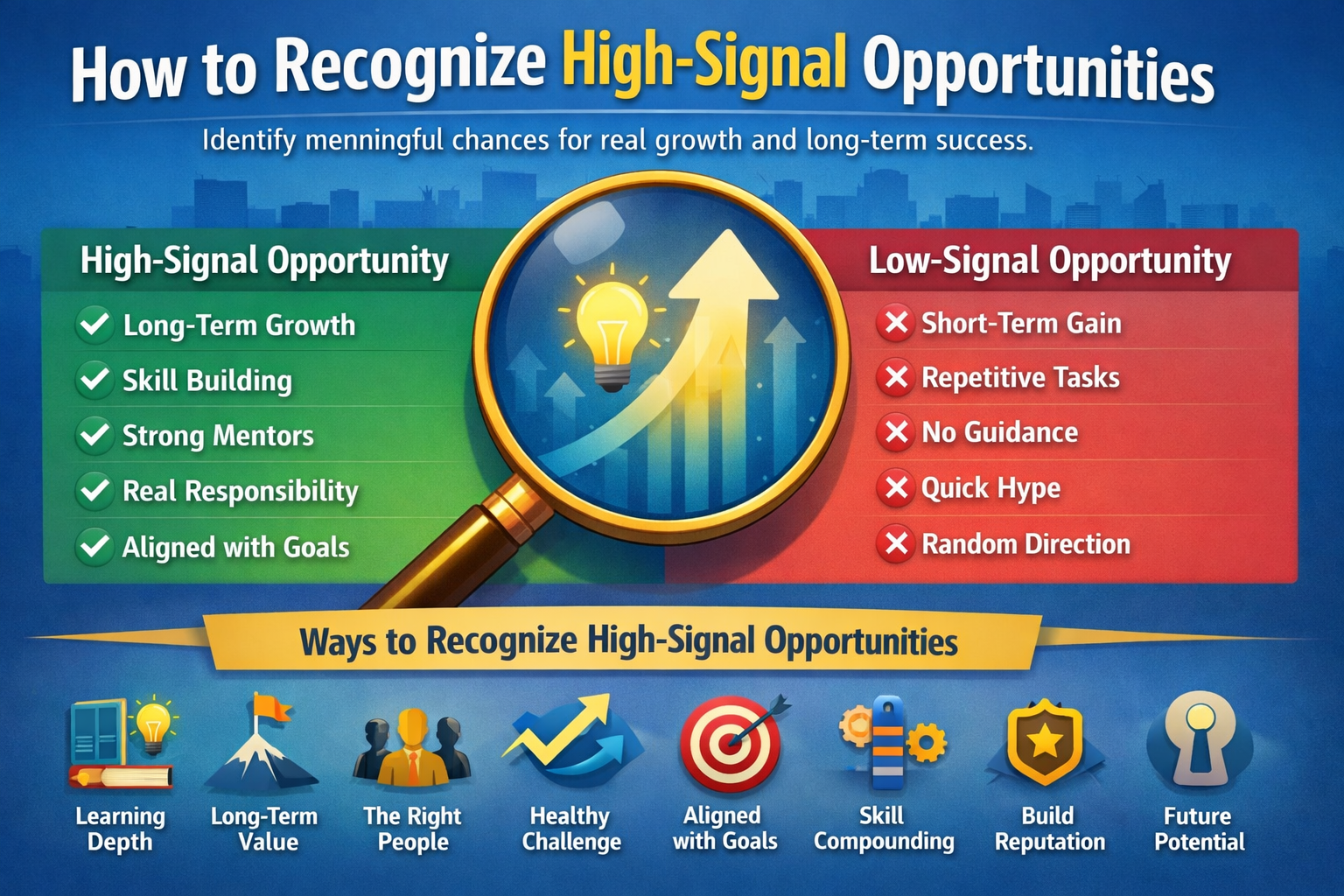
What Is a High-Signal Opportunity?
A high-signal opportunity is a chance that:
- Helps you grow important skills
- Connects you with the right people
- Builds your credibility
- Increases your long-term value
- Moves you closer to your real goals
It gives strong return over time.
On the other hand, a low-signal opportunity may give quick excitement, small money, or temporary attention, but it does not help your long-term growth.
For example:
- A job that pays slightly less but teaches you strong problem-solving skills can be high-signal.
- A job that pays a little more but gives no learning may be low-signal.
High-signal opportunities are not always comfortable. Sometimes they challenge you. But they shape you.
Why Many People Miss High-Signal Opportunities?
Many people miss powerful opportunities because:
- They focus only on short-term rewards.
- They compare themselves too much with others.
- They chase trends instead of purpose.
- They fear discomfort.
- They confuse popularity with quality.
High-signal opportunities often require patience. They do not always give immediate results. But they build strong foundations.
How to Recognize High-Signal Opportunities?
1. Check the Learning Depth to Recognize High-Signal Opportunities
The first way to recognize a high-signal opportunity is to ask:
“What will I learn here?”
Not surface-level learning. Real learning.
For example:
- Will you learn how to think critically?
- Will you learn how to handle responsibility?
- Will you learn communication, leadership, or strategy?
If an opportunity teaches you skills that are transferable and useful in many areas, it is usually high-signal.
Learning depth matters more than job title.
2. Look at Long-Term Value
Ask yourself:
“Will this still matter after 3–5 years?”
Some opportunities give quick money but no long-term benefit. Others build experience that becomes very valuable later.
For example:
- Working on a challenging project may not give instant reward, but it builds your portfolio.
- Taking a course that improves your core skill may not feel exciting now, but it increases your confidence later.
High-signal opportunities grow in value over time.
3. Evaluate the People Around It
Opportunities are not just about tasks. They are about people.
Ask:
- Who will I work with?
- Can I learn from them?
- Are they serious, skilled, and ethical?
If you are surrounded by thoughtful, experienced, and ambitious people, the opportunity becomes stronger.
Environment shapes growth.
Even an average role can become high-signal if you are working with the right mentors and team.
4. Does It Stretch you?
A high-signal opportunity usually stretches you.
It may:
- Make you slightly uncomfortable
- Push you to learn faster
- Require new thinking
- Increase responsibility
If something feels too easy and repetitive, it may not add much value.
Growth comes from stretching, not from staying comfortable.
But stretching does not mean burnout. It means healthy challenge.
5. Does It Align With Your Direction?
Not every good opportunity is good for you.
For example:
- If you want to build a writing career, a project that improves writing skill is high-signal.
- But a random unrelated side task may not help your long-term goal.
You must know your direction first.
Without direction, every opportunity looks confusing.
High-signal opportunities are aligned with your bigger goals.
6. Look Beyond Immediate Money to Recognize High-Signal Opportunities
Money is important. But it should not be the only factor.
Sometimes:
- A lower-paying internship can give powerful experience.
- A volunteer project can build your network.
- A small freelance project can open bigger doors.
Ask:
“What doors can this open later?”
If it increases your credibility, confidence, or skills, it may be high-signal even if the money is small.
7. Notice the Signal-to-Noise Ratio
In today’s world, there is a lot of noise:
- Trending topics
- Viral content
- Quick hacks
- Easy money schemes
Noise is loud. Signal is quiet.
High-signal opportunities are often not flashy. They require effort and consistency.
If something looks too easy, too fast, or too perfect, think carefully.
Real growth takes time.
8. Check for Skill Compounding to Recognize High-Signal Opportunities
Skill compounding means one skill increases the power of another skill.
For example:
- Writing + marketing
- Communication + leadership
- Technology + creativity
If an opportunity allows you to combine skills, it is usually high-signal.
Compounding creates rare value.
When your skills work together, your career becomes stronger.
9. Is There Real Responsibility?
High-signal opportunities give responsibility.
Responsibility builds maturity.
If you are always doing small, low-impact tasks, you may not grow much.
But if you are given ownership of something meaningful, that is powerful.
10. Feedback and Growth System
Ask:
- Will I receive honest feedback?
- Is there a system for improvement?
- Can I track my progress?
High-signal environments give feedback.
Without feedback, growth becomes slow.
An opportunity that helps you see your weaknesses and improve them is valuable.
11. Does It Build Your Reputation?
Reputation is long-term capital.
Some opportunities:
- Add strong projects to your portfolio
- Connect you to respected professionals
- Improve your public presence
If something increases your credibility, it is high-signal.
For example:
- Publishing thoughtful articles
- Working on quality projects
- Collaborating with skilled people
These build trust.
Trust creates future opportunities.
12. Is It Scarce or Common?
High-signal opportunities are often rare.
Not everyone gets them easily.
If an opportunity:
- Requires skill
- Requires effort
- Requires selection
It may have higher value.
Common opportunities are easy to access but may not give deep growth.
Scarcity often increases signal.
13. Does It Improve Your Thinking?
Some roles only require following instructions.
Other roles require thinking.
High-signal opportunities improve:
- Decision-making
- Problem-solving
- Analysis
- Creativity
Thinking skills are powerful.
Knowledge can change. Tools can change. But strong thinking ability stays valuable.
14. Are You Building Assets?
High-signal opportunities often help you build assets such as:
- Portfolio
- Network
- Skills
- Personal brand
- Experience
Assets stay with you.
Low-signal opportunities may only give temporary income without building assets.
Always ask:
“What asset am I building here?”
15. Listen to Your Inner Growth Instinct to Recognize High-Signal Opportunities
Sometimes you feel something is meaningful even if it is difficult.
You feel:
- This will challenge me.
- This will make me better.
- This aligns with who I want to become.
That feeling is important.
Fear and growth often feel similar. But fear stops you. Growth pulls you forward.
If something scares you but also excites you in a positive way, it may be high-signal.
Conclusion
Recognizing high-signal opportunities is a powerful career skill.
It requires:
- Clarity about your direction
- Patience for long-term growth
- Courage to accept challenge
- Wisdom to ignore noise
Not every opportunity deserves your time.
Your time, energy, and focus are limited.
When you choose high-signal opportunities, you build strong skills, strong reputation, and strong confidence.
Over time, small high-signal decisions create big results.
The goal is not to do more.
The goal is to do what matters.
When you learn to recognize signal in a noisy world, your growth becomes intentional, steady, and powerful.
You can read more such blogs with the Best Job Tool.






Comments
Be the first to leave a comment.