

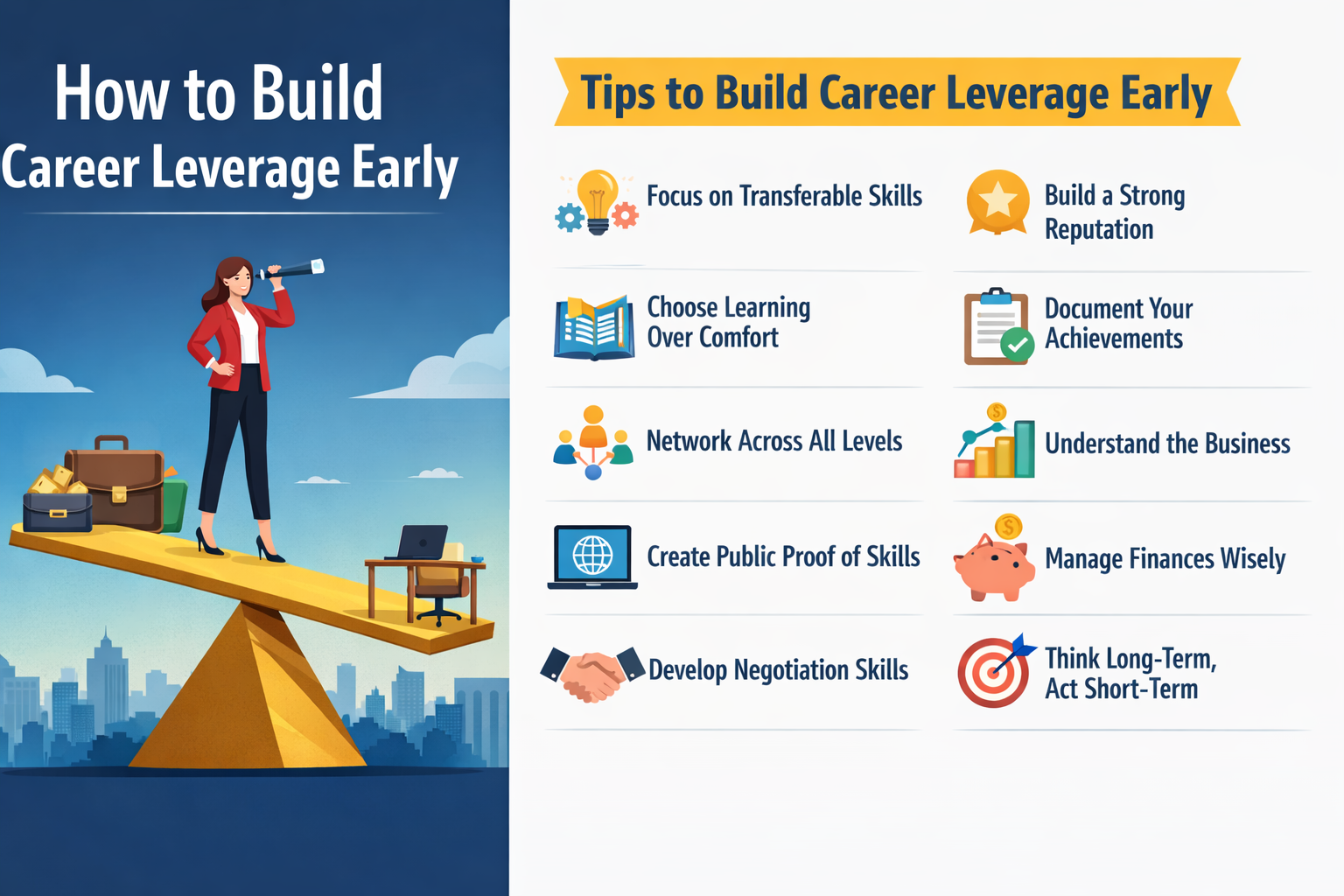
Introduction
In the early stage of your career, most people focus only on getting a job. They think salary is everything. They think experience alone will secure the future. But there is something more powerful than just experience or salary.
That thing is career leverage.
Career leverage means building advantages early that give you more control, better opportunities, and stronger bargaining power later.
If you build leverage early, your career becomes easier over time. If you ignore it, you may work hard for years but still feel replaceable.
In this article, we will deeply understand how to build career leverage early in a practical and human way.
What Is Career Leverage?
Career leverage is the ability to:
- Choose better opportunities
- Negotiate better salary
- Move between roles easily
- Say “no” when needed
- Build long-term growth
Leverage gives you power without arrogance. It gives you confidence without ego.
For example:
Two employees work equally hard.
- One only follows instructions.
- The other builds skills, relationships, visibility, and reputation.
After three years, the second employee has more options. That is leverage.
Leverage is not luck. It is built intentionally.
How to Build Career Leverage Early?
1. Focus on Skills That Multiply, Not Just Skills That Maintain
In the beginning, many people learn only what is required for their job. They become dependent on their company to grow.
But if you want leverage, focus on transferable skills.
These include:
- Communication
- Writing
- Problem-solving
- Critical thinking
- Adaptability
- Digital literacy
- Negotiation
- Decision-making
These skills are valuable in every industry.
For example, strong communication skills can help you in:
- Corporate jobs
- Freelancing
- Entrepreneurship
- Leadership roles
Skills that multiply your opportunities build leverage.
Do not just ask:
“What does my job require?”
Ask:
“What skills will make me valuable everywhere?”
2. Build a Reputation, Not Just a Resume
A resume shows what you did.
A reputation shows who you are.
Early in your career, your reputation matters more than you think.
People notice:
- Do you take responsibility?
- Do you solve problems?
- Are you reliable?
- Do you communicate clearly?
- Do you adapt to change?
Your reputation travels faster than your CV.
In the age of platforms like LinkedIn, reputation can be visible beyond your workplace. Sharing insights, writing posts, or engaging thoughtfully can create early visibility.
Leverage grows when people start saying:
“Let’s call her. She handles things well.”
3. Choose Learning Over Comfort
Comfort is dangerous in the early career stage.
When you stay comfortable:
- You repeat the same tasks.
- You avoid difficult projects.
- You avoid feedback.
- You avoid growth.
But leverage is built in discomfort.
Volunteer for:
- Complex assignments
- Cross-team projects
- Presentations
- New tools or systems
Even if you feel underprepared.
Growth gives you capability. Capability builds leverage.
4. Document Your Work and Results
Many people work hard but forget to track results.
If you want leverage, track:
- Projects completed
- Revenue impact
- Cost saved
- Systems improved
- Processes simplified
Instead of saying:
“I worked on marketing campaigns.”
Say:
“I improved campaign conversion by 20% in 3 months.”
Results give you negotiation power.
When appraisal time comes, documentation becomes leverage.
5. Build Relationships Across Levels to Build Career Leverage
Your manager is important. But not only your manager.
Build professional relationships with:
- Colleagues
- Seniors
- Mentors
- Other departments
- Industry professionals
Relationships create hidden opportunities.
Sometimes, growth does not come from job portals. It comes from referrals.
Networking is not manipulation. It is relationship-building with respect.
If you build genuine connections early, your career safety increases.
6. Understand Business, Not Just Your Role
Many early professionals think:
“I only need to do my job.”
But leverage increases when you understand:
- How the company makes money
- Who the customers are
- What problems the company solves
- What competitors are doing
When you understand the bigger picture, you become more strategic.
Strategic employees are harder to replace.
When you speak in business language, leadership starts noticing you.
7. Create Public Proof of Skills to Build Career Leverage
Today, leverage is not only internal. It is external.
You can create proof of skills by:
- Writing articles
- Publishing blogs
- Sharing case studies
- Building a portfolio
- Posting insights
For example, platforms like Medium allow professionals to publish articles and show expertise publicly.
Public proof creates opportunities beyond your current employer.
It reduces dependency.
When you have visibility outside, you feel more confident inside.
8. Avoid Early Career Debt Traps to Build Career Leverage
Leverage is also financial.
If your expenses grow faster than your income, you lose leverage.
If you depend completely on one salary with no savings, you cannot:
- Take risks
- Switch jobs freely
- Upskill peacefully
Try to:
- Save early
- Avoid unnecessary lifestyle upgrades
- Build emergency funds
Financial freedom increases career freedom.
Even small savings create mental peace.
9. Say Yes Strategically, Not Emotionally
In early career stages, people either say yes to everything or no to everything.
Both are risky.
Say yes when:
- It gives new exposure
- It builds important skills
- It increases visibility
- It expands network
Say no when:
- It wastes time
- It adds no learning
- It damages work-life balance
- It distracts from growth goals
Strategic decisions create long-term leverage.
10. Develop Communication Clarity to Build Career Leverage
Communication is one of the biggest leverage tools.
If you can:
- Explain ideas clearly
- Present confidently
- Write professionally
- Ask intelligent questions
You automatically stand out.
Many talented people remain unnoticed because they cannot express clearly.
Clear communication makes your work visible.
Visibility builds leverage.
11. Learn How to Negotiate Early to Build Career Leverage
Negotiation is not only about salary.
It includes:
- Project responsibilities
- Role clarity
- Deadlines
- Work flexibility
- Promotion expectations
If you never negotiate, people assume you are comfortable.
Early negotiation builds confidence.
Confidence builds leverage.
12. Avoid Skill Overload, Build Depth
Learning many skills randomly creates confusion.
Instead:
- Choose 1–2 core strengths.
- Build depth.
- Then add complementary skills.
For example:
If you are a content writer:
- Core: Writing
- Add: SEO, storytelling, research
Depth makes you valuable.
Value creates leverage.
13. Take Feedback Seriously
Feedback feels uncomfortable.
But feedback builds self-awareness.
Self-aware professionals grow faster.
Ask:
- “What can I improve?”
- “Where did I fall short?”
- “How can I perform better?”
People who improve consistently build strong long-term leverage.
14. Build Adaptability Early
Industries change fast.
Technology changes fast.
Companies change fast.
If you resist change, you lose leverage.
If you adapt quickly, you become reliable during uncertainty.
Adaptability is one of the strongest long-term advantages.
It makes you future-ready.
15. Think Long-Term, Act Short-Term
Many early professionals think only about:
- This month’s salary
- This year’s promotion
- Immediate recognition
Instead, ask:
- “Will this skill matter in 5 years?”
- “Will this project build future value?”
- “Will this connection help long-term?”
Short-term thinking gives short-term satisfaction.
Long-term thinking builds leverage.
16. Protect Your Energy and Health
Burnout reduces leverage.
If you are always exhausted:
- You cannot learn properly.
- You cannot think clearly.
- You cannot perform consistently.
Protect:
- Sleep
- Mental health
- Physical health
Career is a marathon, not a sprint.
Sustainable growth builds stronger leverage than temporary hustle.
17. Create Optionality to Build Career Leverage
Optionality means having multiple paths.
For example:
- Job + Freelance skill
- Corporate role + Personal brand
- Technical skill + Communication skill
When you have options, fear reduces.
When fear reduces, confidence increases.
Confidence increases leverage.
Conclusion
Career leverage is not built in one day.
It is built through:
- Smart decisions
- Continuous learning
- Strategic relationships
- Financial discipline
- Consistent improvement
In the beginning, leverage may not look powerful. But after 3–5 years, the difference becomes clear.
One person feels stuck.
The other has choices.
Early career years are not only about earning. They are about building power for the future.
If you build leverage early, you do not chase opportunities.
Opportunities start chasing you.
And that is when your career truly becomes yours.
You can read more such blogs with the Best Job Tool.






Comments
Be the first to leave a comment.