

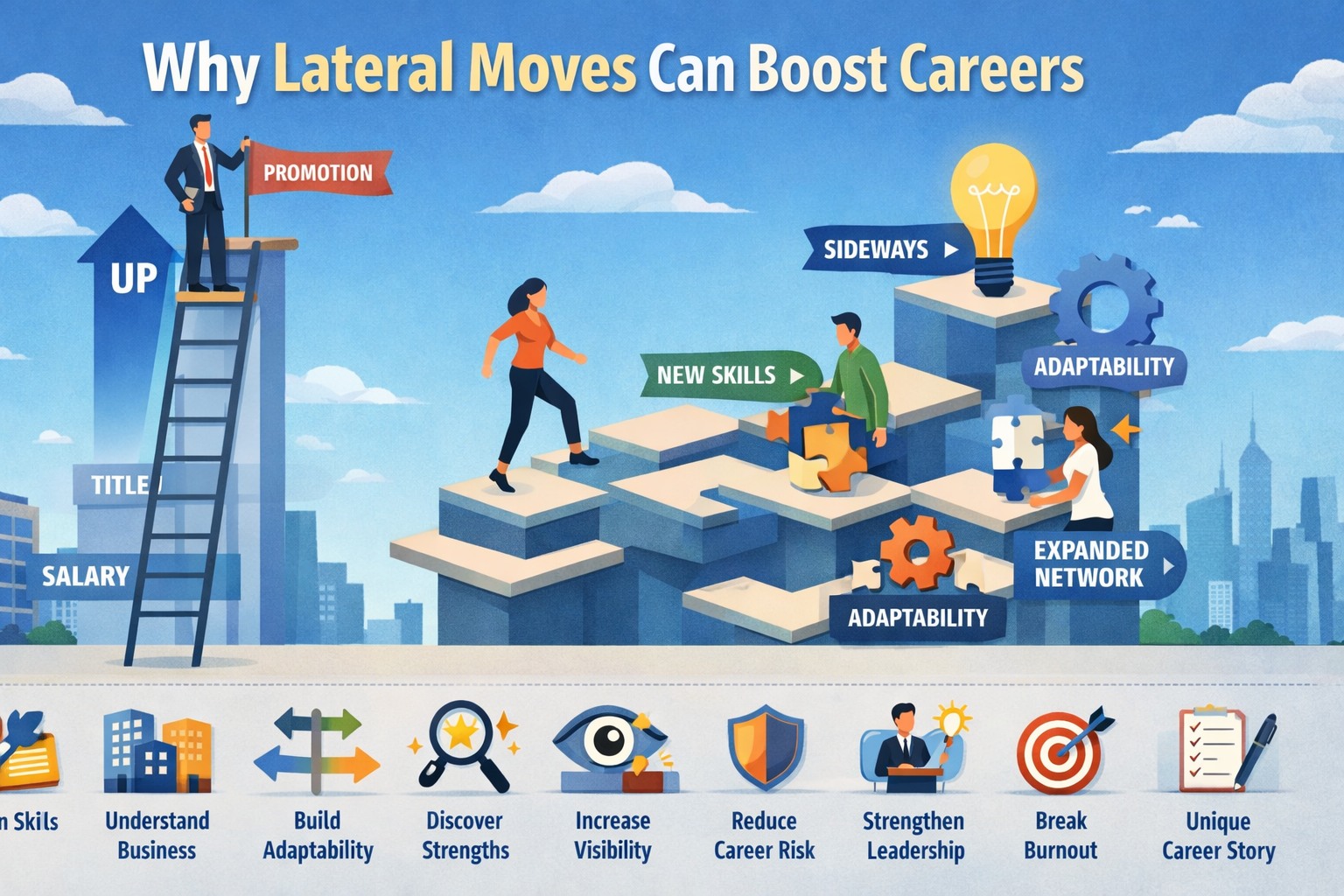
Introduction
When people think about career growth, they usually imagine moving upward. A promotion. A bigger title. A higher salary. More responsibility. In many workplaces, success is measured by how fast you climb the ladder.
But what if growth is not always about climbing up?
Sometimes, the smartest move in your career is not upward. It is sideways.
A lateral move means shifting to a different role at the same level. The title may stay similar. The salary may not change much. From the outside, it may not look impressive. But from the inside, it can completely transform your career.
In this article, we will understand why lateral moves can boost careers, how they build long-term strength, and when they make sense.
What Is a Lateral Move?
A lateral move is when you change roles without getting a promotion in title or rank.
For example:
- A marketing executive moves into product management.
- A content writer shifts into brand strategy.
- A sales professional moves into customer success.
- A software developer joins the operations team.
The level is similar. The pay may be similar. But the function changes.
It is not about status. It is about exposure.
And exposure builds power.
Why Lateral Moves Can Boost Careers?
1. Lateral Moves Expand Your Skill Set
When you stay in one role for too long, your skills become narrow. You become very good at one thing, but you may not understand the bigger picture.
A lateral move forces you to learn new systems, tools, and ways of thinking.
For example:
- Moving from writing to editing improves your decision-making.
- Moving from execution to coordination improves leadership.
- Moving from technical work to client-facing work improves communication.
You become more versatile.
In today’s world, companies value people who can handle multiple responsibilities. Specialists are important. But versatile professionals often grow faster in the long run.
A lateral move builds that versatility.
2. You Understand the Business Better
Many professionals only understand their department. They do their tasks well but do not see how everything connects.
When you move laterally, you see the organization from a new angle.
If you move from sales to operations, you understand:
- What promises are realistic.
- What challenges exist behind the scenes.
- How decisions impact delivery.
If you move from content to analytics, you understand:
- What actually drives performance.
- How audience behavior affects strategy.
- How data influences creative decisions.
This cross-functional understanding makes you more strategic.
Later, when leadership roles open, people who understand multiple departments are often preferred.
3. Lateral Moves Build Adaptability
Adaptability is one of the most powerful career skills.
In a fast-changing world, industries evolve. Technology changes. Market demands shift. Roles transform.
When you make a lateral move, you train yourself to:
- Learn quickly.
- Adjust to new environments.
- Work with new teams.
- Handle uncertainty.
You become comfortable with change.
That confidence reduces fear.
People who stay in one fixed role for years may struggle when forced to change. But people who have moved across functions are mentally stronger. They know they can survive new situations.
And that confidence reflects in interviews, leadership, and decision-making.
4. You Discover Hidden Strengths
Sometimes, we think we know what we are good at. But we only know based on limited experience.
A lateral move can reveal talents you did not know you had.
Maybe:
- You discover you enjoy strategy more than execution.
- You realize you are good at mentoring.
- You find you love working with data.
- You perform better in collaborative roles than solo roles.
Without movement, these discoveries never happen.
Many people feel stuck in careers because they never explored sideways. They only chased promotions. And later, they realize they climbed the wrong ladder.
Lateral moves help you explore before committing long-term.
5. Lateral Moves Increase Internal Visibility
When you work in only one department, only that department knows you.
But when you move laterally:
- New managers see your work.
- New teams experience your collaboration.
- Leadership observes your flexibility.
Your network inside the company grows.
This internal visibility can help in future promotions.
When decision-makers discuss leadership candidates, they often prefer someone who has:
- Worked across teams.
- Built relationships in different functions.
- Understood multiple business areas.
A lateral move increases your internal reputation.
6. Lateral Moves Reduce Career Risk
Depending on one narrow skill can be risky.
If the market changes and your skill becomes less valuable, you may struggle.
But if you have experience in multiple areas, your career becomes more secure.
For example:
- A writer who understands SEO, analytics, and branding has more options.
- A developer who understands business operations has more flexibility.
- A marketer who understands product and customer support can move into different roles.
Lateral moves create backup pathways.
They make you less replaceable.
In uncertain times, this matters a lot.
7. Lateral Moves Strengthen Leadership Potential
Strong leaders usually have broad experience.
They understand:
- How teams operate.
- How decisions affect different departments.
- Where friction happens.
Many successful leaders moved laterally before moving upward.
For example, executives at companies like Google and Microsoft often rotate across teams before taking higher leadership roles. This helps them understand the organization deeply.
Leadership is not only about authority. It is about perspective.
And perspective comes from exposure.
8. Lateral Moves Break Monotony and Burnout
Doing the same work for years can create boredom. Boredom can slowly turn into disengagement. And disengagement can turn into burnout.
Sometimes, you do not need a promotion. You need stimulation.
A lateral move refreshes your mind.
Learning something new increases motivation.
Instead of quitting your job or changing companies, a lateral shift inside the same organization can bring energy back into your career.
9. Lateral Moves Prepare You for Future Promotions
Ironically, lateral moves can make promotions easier later.
Why?
Because you become more complete.
Imagine two candidates for a manager role:
- Candidate A: 8 years in one function.
- Candidate B: 3 years in one function, 3 years in another, strong collaboration history.
Candidate B may have stronger strategic understanding.
When leadership roles require coordination between departments, cross-functional experience becomes a major advantage.
Sometimes, taking one step sideways prepares you for two steps upward later.
10. They Help You Build a Unique Career Story
In interviews, stories matter.
When your career only shows one straight line, it may look stable but not necessarily dynamic.
But when you explain:
- Why you moved.
- What you learned.
- How it helped your perspective.
It shows intentional growth.
For example:
“I moved from operations to marketing to understand customer behavior better. That helped me improve internal processes later.”
This shows thinking, planning, and curiosity.
Employers appreciate professionals who make thoughtful decisions, not just title-driven moves.
When Does a Lateral Move Make Sense?
A lateral move is powerful, but it should be intentional.
It makes sense when:
- You want to learn a new skill that aligns with long-term goals.
- You feel stagnant in your current role.
- You want broader exposure before aiming for leadership.
- Your current role has limited future growth.
- You are curious about another function.
It may not make sense when:
- You are avoiding challenges.
- You are escaping performance issues.
- The new role does not add meaningful learning.
- You are moving without clarity.
A lateral move should expand you, not distract you.
Conclusion
Careers are not straight ladders. They are journeys.
But every move teaches something.
Lateral moves:
- Expand skills.
- Increase adaptability.
- Build perspective.
- Strengthen leadership potential.
- Reduce risk.
- Refresh motivation.
In the long run, careers are not built only on promotions. They are built on experiences.
So if you are standing at a crossroads and a sideways opportunity appears, do not reject it immediately.
Look deeper.
It may not raise your title today.
But it may raise your value tomorrow.
And in a long career, value matters more than speed.
You can read more such blogs with the Best Job Tool.






Comments
Be the first to leave a comment.