


Introduction
In today’s professional world, while knowing how to do your work is important, even more important are your professional discipline skills. Professional discipline is useful at every stage of your career, whether it is during an interview or on the job.
With professional discipline, we can complete every task efficiently and build trust with others. In this article, we will discuss how we can develop professional discipline.
What is Professional Discipline?
Showing professional discipline is very important, but before that, it is important to understand what professional discipline actually is.
Professional discipline is the ability to consistently follow ethical standards, rules, and habits. Through professional discipline—such as punctuality, consistency, accountability, self-control, and commitment—we can build trust, increase our productivity, strengthen our professional reputation, and achieve long-term success.
How to Build Professional Discipline?
1. Setting Clear Goals and Priorities
The first tip to build professional discipline is setting clear goals and priorities. We need to decide our goals in advance for everything—whether it is our job or our personal life. Goals are very important in every area because without goals, we become confused about what work we need to do, when to do it, and how to do it.
When you clearly know what you want to achieve and what matters most, you can plan your steps accordingly and manage your work in a smooth flow. As a result, your career gradually moves toward success.
2. Time Management and Routine Building
Time management and routine building are also very important for professional discipline. When you follow a routine and manage your time well, work gets done faster and more efficiently, without unnecessary pressure.
With a proper routine and time management, you do not waste your time, which helps you stay productive all the time and complete your work within deadlines. This increases reliability in your professional life—people trust you more—and you are able to achieve the goals you aim for. Just remember one important thing: always include small breaks in your routine to avoid burnout.
3. Self-Motivation and Accountability
Self-motivation and accountability are the most important parts of professional discipline. Self-motivation is essential to complete our work properly and on time. It begins with understanding why your work matters. To improve self-motivation, you can give yourself small rewards after completing tasks.
Accountability ensures that discipline is maintained over time, which is why it is equally important. You can build accountability through simple habits such as reviewing your daily performance, maintaining a task journal, or setting clear deadlines for yourself.
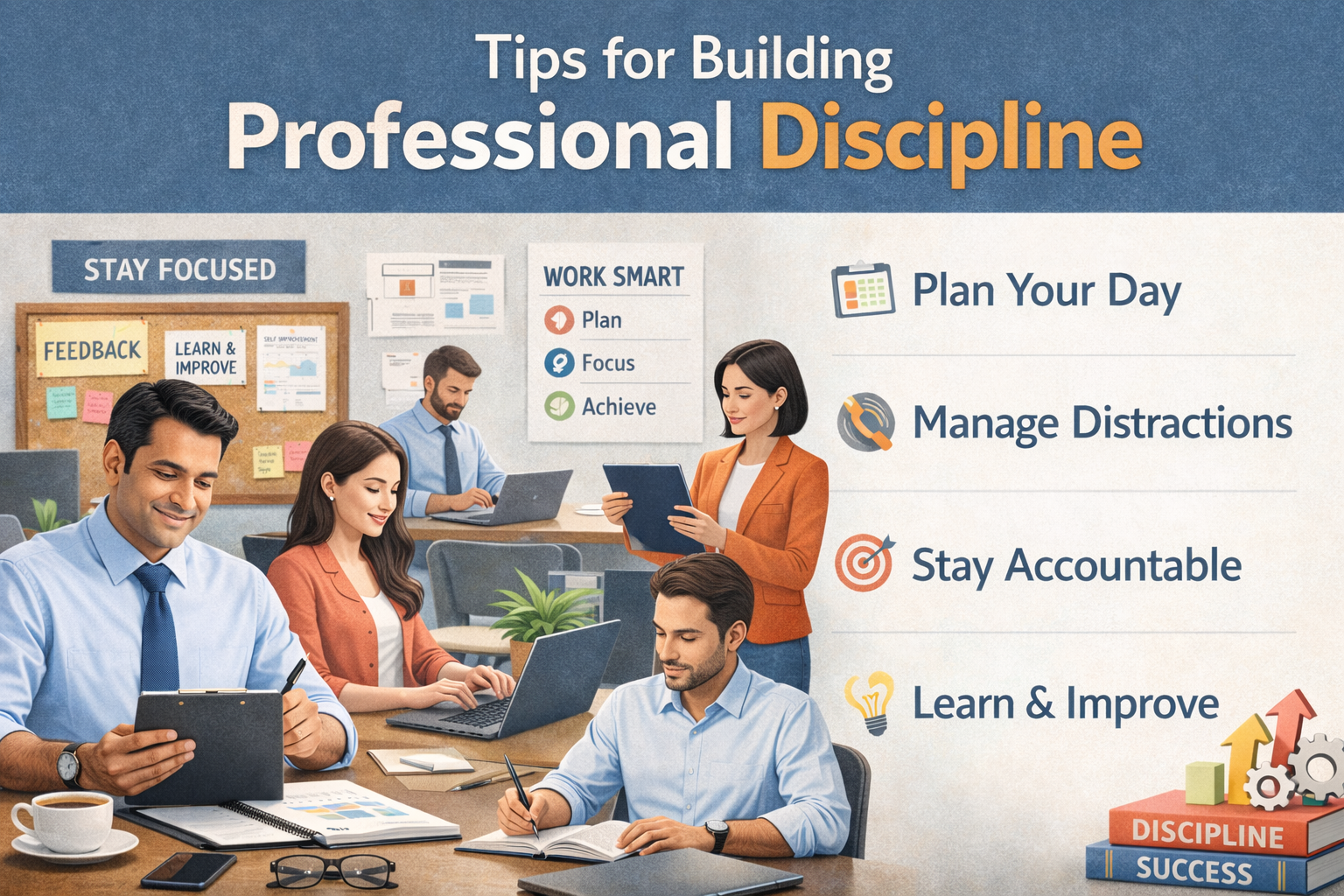
4. Managing Distractions and Building Focus
Distractions are everywhere, whether you are at work or at home. Managing these distractions is very important; otherwise, you may not be able to complete your work properly, which can harm your professional image.
The first step to managing distractions is to identify your major distractions, such as mobile phones, social media, and constant notifications. Try to control them with simple actions like keeping your phone on silent and closing unnecessary tabs. When you learn to avoid distractions, your performance automatically improves, and this becomes an important part of your professional discipline.
5. Consistency and Reliability to Build Professional Discipline
Another important tip is consistency and reliability. These two are strong signs of professional discipline. Consistency means completing your work every day with the same level of effort and dedication, while reliability means that people can depend on you.
Completing your work with quality, meeting deadlines, and following rules daily shows your consistency. When other employees see how well you perform your work, they start trusting you, which builds reliability. Because of this, managers and teammates begin to prefer you for important tasks, and as a result, new opportunities come your way.
Want to know more about reliability? Read this blog on “Why Reliability Builds Career Trust”.
6. Learning from Feedback and Continuous Improvement
Many times, our mentors, teammates, or managers give us feedback when they notice some gaps in our work. However, there are many employees who feel demotivated or get offended by it. This is completely wrong, because feedback is an essential part of learning and professional discipline.
When someone gives us feedback, we should take it as a learning opportunity. Feedback helps us identify our weaknesses, work on them, and improve ourselves. Continuous improvement means making small but regular efforts to enhance skills, knowledge, and work quality. That is why we should never ignore feedback, even if it is small—learn from it and keep improving yourself.
Conclusion
Discipline helps you stay reliable, improve work quality, and earn trust in the workplace. It reduces stress, increases productivity, and supports steady career growth in a constantly changing professional environment.
In the end, professional discipline is about choosing responsibility over excuses and consistency over short-term comfort. When practiced regularly, it becomes a powerful skill that shapes your work ethic, reputation, and future career opportunities.
Explore more such blogs here.






Comments
Be the first to leave a comment.