


What Are Measurable Goals in a Resume?
The meaning of measurable goals is those results or achievements that can be easily proven through numbers, percentages, or a timeline. When you add numbers in your resume then recruiters get to know quickly what you have achieved and what the impact was.
Measurable goals create your resume trustworthy and result-oriented. It creates your simple task into a real accomplishment. It means you are not just telling the recruiter about the work, you are also telling them the benefits that you brought to the company.
Importance of Measurable Goals
Adding measurable goals in a resume is very important because numbers are the clear proof of your work. When recruiters see your resume then they don’t just want to see your responsibilities, they also want to know the actual results. Below are some important aspects of measurable goals that you should know,
- Measurable goals are proof that you are result-oriented.
- Measurable goals create a trustworthy resume.
- It helps to highlight your impact on recruiters.
- It helps recruiters to decide quickly
- Makes you stand out in the competition.
- Measurable goals show your consistent performance.
Measurable goals are a simple technique, but they change the whole impression of your resume.
How to Create Measurable Goals in Resumes?
1. Use the SMART Method to Create Measurable Goals
Including measurable goals in a resume is very important, as we discussed above. But there should be a proper method to add measurable goals in your resume. If you write long paragraphs or don’t follow a proper structure, the recruiter may get confused about what work you have done, what achievements you have, and how your work benefited the company. It can also happen that the recruiter reads only half of it and skips the rest because the paragraph is too complicated.
That is why you need to use a simple technique called SMART.
SMART is an easy method to explain your goals to the recruiter in a clear, step-by-step way.
Specific: First, tell the recruiter exactly what specific task you worked on.
Measurable: Then talk about the numbers—what measurable results your work achieved.
Achievable: After that, see if the number is realistic. You should always focus on honesty. Do not add any number that looks fake or extraordinary.
Relevant: Next, check if the achievements you mentioned are related to your job role.
Time-bound: Finally, mention the time period—when you started and when you completed the task.
This is the SMART way to present your measurable goals in a resume.
2. Identify Key Areas to Add Numbers in Your Resume
Numbers in a resume are definitely impressive, but that doesn’t mean you should add numbers everywhere. If you fill your entire resume with numbers, it will start looking messy, and the recruiter won’t be impressed—even if your numbers are genuine and valuable.
You should add numbers only in a few important areas of your resume, such as:
- Productivity – Tell the recruiter which tasks you completed and how you achieved your targets.
- Time – Mention the deadlines you had for your tasks and how quickly you completed them.
- Money – Tell the recruiter how much revenue your work helped generate or how much cost you helped reduce for the company.
- Growth – You can also mention how your contribution increased followers, brought in new customers, or improved engagement.
- Leadership – You can add how many team members you handled, what training sessions you led, or what training you received.
3. How to Turn Daily Responsibilities into Measurable Achievements
To add measurable goals to your resume, you can convert your regular tasks into achievements.
For example, if you manage a team of 10–12 members every day, you can include this in your resume by saying that you manage a large team of 10–12 people.
Or, if your work helps the company in any way even slightly—you can mention it. For example, if your task helped the company gain two new clients, you can add that as well.
To explain this even better, you can use before-and-after examples What was the situation in the company before, and what positive impact occurred after your task?
But make sure the impact you share is always positive—never mention negative impact. You can also explain how you quantify even small improvements.
In this way, you can show your measurable goals or measurable achievements in your resume.
4. How to Add Measurable Goals Even If You Have No Experience
Experienced candidates have many things to share in their resume, and they can easily highlight their work through numbers, which impresses recruiters. But for a fresher, it becomes difficult to make an impressive resume because they usually have no work experience and haven’t done anything that directly benefited a company.
But this does not mean a fresher cannot add measurable goals to their resume. They absolutely can.
A fresher can include their academic achievements—like exam scores, how they handled projects, certifications they have completed, etc. If they have done any internship or volunteering, even for just one or two months, they can add what they achieved during that internship and how their work benefited the company and they can show this using numbers.
If they haven’t done any internship or don’t have any college projects to show, they can include personal projects. If they use social media, they can show their social media growth. Or if they have organized any event, they can mention that too.
You just need to mention any achievement from your life that can be shown through numbers.
Common Mistakes to Avoid When Creating Measurable Goals
There are some common mistakes that many candidates make while creating or adding measurable goals in their resume, and because of these mistakes, their selection gets cancelled. These mistakes are not very big—just small errors that candidates ignore. To help you avoid such issues, we have listed some common mistakes to avoid when creating measurable goals:
- Do not use unrealistic or fake numbers while creating measurable goals. Recruiters can easily detect when the numbers are fake, and they immediately reject such candidates.
- Adding numbers everywhere unnecessarily is another common mistake that many candidates make.
- Do not overload your resume with too much data. If you add too many numbers, the recruiter may get confused or frustrated and could reject your resume. Keep your resume simple with real and genuine measurable goals.
- Using only percentages without any context is also a common mistake. Candidates just mention that their achievement increased by xyz%, for example, “Sales increased by 50%.” This is an outdated method. You need to include the base number, the task, the comparison, and how you achieved that goal along with the percentage.
- Do not add irrelevant metrics. There’s no need to include metrics that are not related to the job role or don’t make sense for your profile.
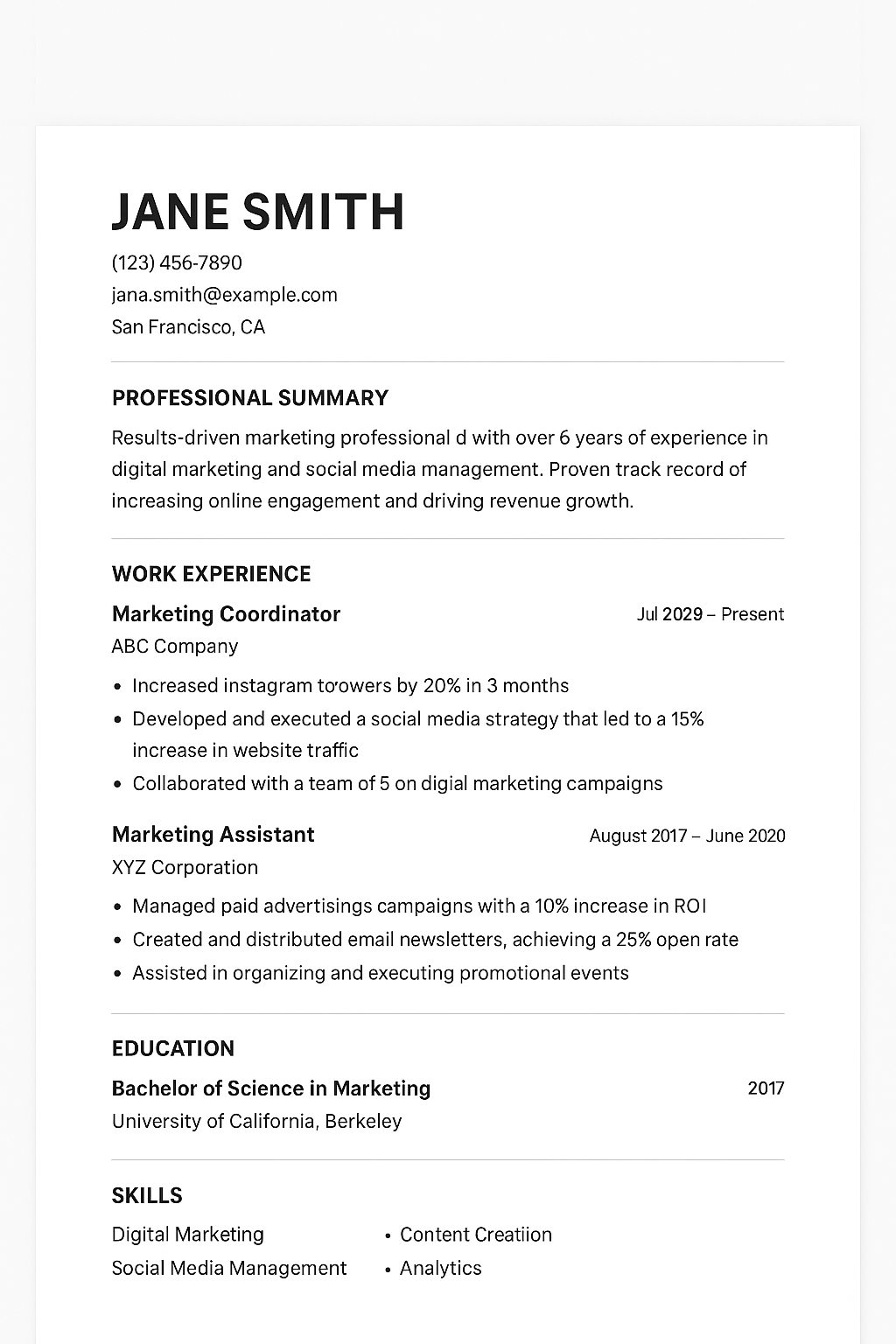
Resume Examples With Measurable Goals
Conclusion
Creating measurable goals in your resume is one of the simplest ways to make your profile stronger and more attractive to recruiters. Numbers instantly show the impact of your work and help employers understand the value you can bring to their team. Instead of using general statements, focus on achievements that highlight how much you improved, saved, supported, or delivered in your previous roles. Even if you have little or no experience, you can still use metrics from academic projects, internships, volunteer work, or personal accomplishments.
A resume that includes measurable goals doesn’t just describe what you did — it proves what you achieved. Start reviewing your past work, identify where you made a difference, and turn those moments into clear, measurable results. With this approach, your resume will stand out, tell your story more confidently, and increase your chances of getting noticed by the right employers.
If you want to know more resume tips then read here.
You can also read more blogs here.






Comments
Be the first to leave a comment.